Saladsamurai
- 3,009
- 7
So in one of my classes, we very non-rigorously derived the 1D stress field for a bar with a longitudinal surface loading T(x) like show below:
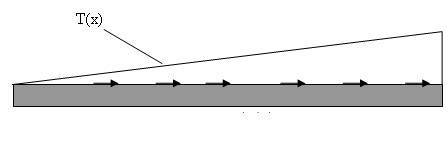
By taking out a differential element (assuming constant cross-sectional area) and applying good old Newton's Second, we end up with:
[tex]A \,d\sigma=-T(x)dx[/tex]
which is easily separable to find [itex]\sigma(x)[/itex].
My problem now is to do the same assuming that a concentrated loading is applied to one end like shown below:
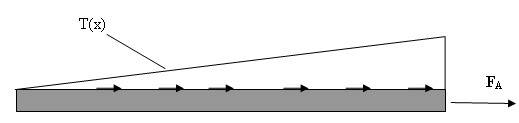
Now I feel like this should be simple in that we are only adding on a constant force. But I am not sure where to add it? That is, when I take out an arbitrary differential element, do I apply the FA to the element? That is, do I assume that FA acts along the entire length of the bar like in elementary statics? Like I have shown below:
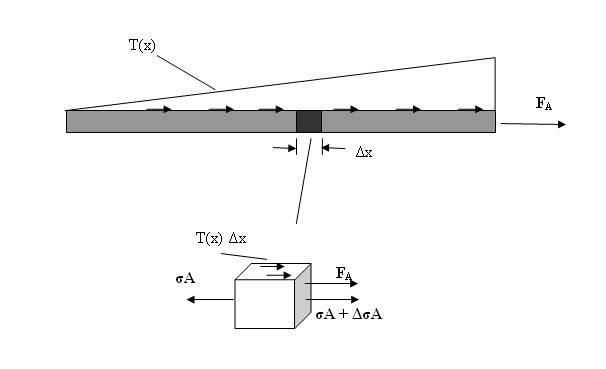
I ask because if I do this, I end up with the following differential EQ:
[tex]A \,\frac{d\sigma}{dx} = -T(x)-\frac{F_A}{dx}[/tex]
which I am not sure what to do with (though I admit, I have not tried too hard).
Any insight would be appreciated.
~Casey
EDIT hmmm...maybe I am a little slow today I think that by multiplying through by dx might help out.
EDIT 2 maybe not...if I multiply through by 'dx' I end up with
[tex]d\sigma = -\frac{T(x)dx}{A} - \frac{F}{A}[/tex]
which I cannot figure out how to integrate. The last term [tex]\frac{F}{A}[/tex] does not have a 'differential' to which I would integrate with respect too.
As a matter of fact, it should act to remain as a constant stress; and it seems like it 'wants to' but I cannot get the mathematics to show it.
By taking out a differential element (assuming constant cross-sectional area) and applying good old Newton's Second, we end up with:
[tex]A \,d\sigma=-T(x)dx[/tex]
which is easily separable to find [itex]\sigma(x)[/itex].
My problem now is to do the same assuming that a concentrated loading is applied to one end like shown below:
Now I feel like this should be simple in that we are only adding on a constant force. But I am not sure where to add it? That is, when I take out an arbitrary differential element, do I apply the FA to the element? That is, do I assume that FA acts along the entire length of the bar like in elementary statics? Like I have shown below:
I ask because if I do this, I end up with the following differential EQ:
[tex]A \,\frac{d\sigma}{dx} = -T(x)-\frac{F_A}{dx}[/tex]
which I am not sure what to do with (though I admit, I have not tried too hard).
Any insight would be appreciated.
~Casey
EDIT hmmm...maybe I am a little slow today
I think that by multiplying through by dx might help out.EDIT 2 maybe not...if I multiply through by 'dx' I end up with
[tex]d\sigma = -\frac{T(x)dx}{A} - \frac{F}{A}[/tex]
which I cannot figure out how to integrate. The last term [tex]\frac{F}{A}[/tex] does not have a 'differential' to which I would integrate with respect too.
As a matter of fact, it should act to remain as a constant stress; and it seems like it 'wants to' but I cannot get the mathematics to show it.
Last edited: