MatinSAR
- 677
- 207
- Homework Statement
- Derive the symmetry from time-independent Schrodinger's equation.
- Relevant Equations
- =
I'm studying Bloch theory in solid-state physics, and my textbook makes the following statement:
The eigenvalues ##E=E(k)## of the Schrödinger equation, when plotted as a function of ##k## within the first Brillouin zone, describe the band structure of the crystal. Notice that ##E(k)=E(-k)##, as can be seen from direct inspection of the Schrödinger equation under complex conjugate operation.
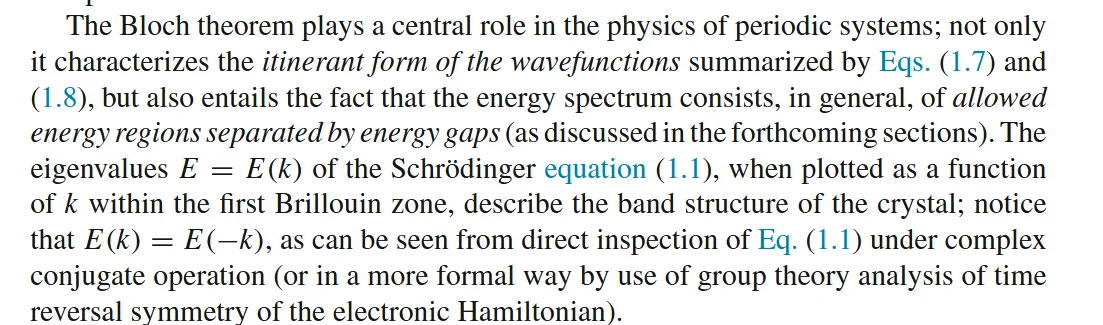
Equation ##1.1## is TISE that I wrote in relevant equations.
I want to understand and derive this result mathematically, following the reasoning suggested by the textbook.
I understand that, since the potential is real taking the complex conjugate of the time-independent Schrödinger equation gives another solution with the same energy. I mean it's easy to show that if ##\psi## is an answer to TISE then ##\psi ^{*}## should be the other answer. But I don't really understand how this leads to the conclusion that the energy eigenvalues corresponding to (k) and (-k) must be equal.
The eigenvalues ##E=E(k)## of the Schrödinger equation, when plotted as a function of ##k## within the first Brillouin zone, describe the band structure of the crystal. Notice that ##E(k)=E(-k)##, as can be seen from direct inspection of the Schrödinger equation under complex conjugate operation.
Equation ##1.1## is TISE that I wrote in relevant equations.
I want to understand and derive this result mathematically, following the reasoning suggested by the textbook.
I understand that, since the potential is real taking the complex conjugate of the time-independent Schrödinger equation gives another solution with the same energy. I mean it's easy to show that if ##\psi## is an answer to TISE then ##\psi ^{*}## should be the other answer. But I don't really understand how this leads to the conclusion that the energy eigenvalues corresponding to (k) and (-k) must be equal.