Describe the motion of yoyos suspended from the ceiling

Click For Summary

Homework Help Overview

The discussion revolves around the motion of multiple yoyos suspended from a ceiling, focusing on the dynamics involved when considering two or more yoyos (n=2, n=3). Participants are exploring the equations of motion, forces acting on each yoyo, and the relationships between their movements.

Discussion Character

  • Mixed

Approaches and Questions Raised

  • Participants discuss the equations of motion for each yoyo, including gravitational forces and tensions in the strings. There is an exploration of constraints relating the velocities and accelerations of the yoyos, particularly questioning the validity of the constraint linking the motion of adjacent yoyos.

Discussion Status

Some participants have provided guidance on approaching the problem by suggesting to consider simpler cases first and to analyze the interactions between the yoyos. There is an ongoing exploration of how to generalize the equations for n yoyos, with various interpretations of the constraints and forces involved.

Contextual Notes

Participants express uncertainty about the complexity of the interactions between multiple yoyos and the assumptions that can be made regarding their motions. There is mention of the introductory nature of the course, indicating that the problem may be expected to be manageable within that context.

Matejxx1
Messages
72
Reaction score
1
Homework Statement
Determine the motion of yoyos for $n=1,2,3$
Relevant Equations
##J=\frac{mr^2}{2}##
##J\ddot\theta=Fr##
I have trouble solving this problem any help would be appreciated.Problem statement

##J=\frac{mr^2}{2}##

a) Determine the motion of yoyos for ##n=1,2,3##

The case for ##n=1## is simple, however, I am having trouble with ##n=2## and ##n=3##.

for ##n=2## I started by drawing all the forces:
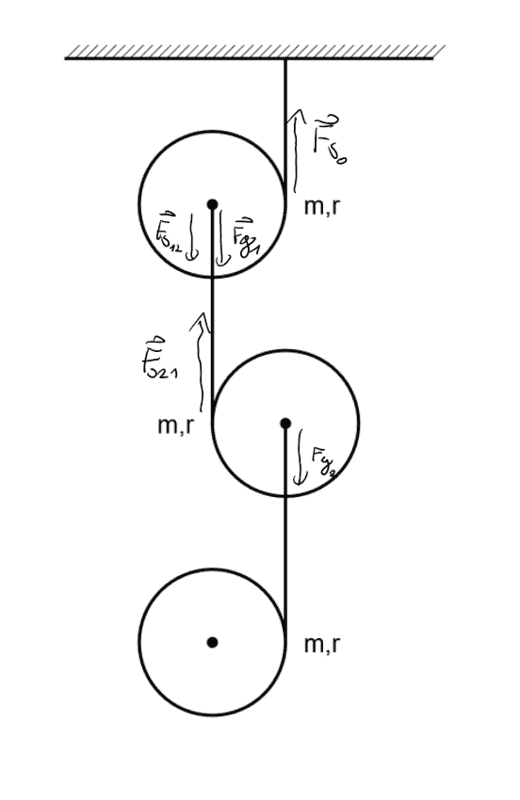
a.png


and then I wrote out the equations of motions.

##1## yoyo:
$$
m\ddot{x_1}=F_{g_{1}}+F_{s_{12}}-F_{s_{0}}$$
$$
J\ddot\theta_{1}=F_{s_{0}}r
$$

##2## yoyo:
$$
m\ddot{x_2}=F_{g_{2}}-F_{s_{21}}$$
$$
J\ddot\theta_{2}=F_{s_{21}}r
$$

What I wanted to do here was also introduce a constraint ##\dot{x_{2}}=\dot{x_{1}}+\dot\theta_{2}r##, however, I am not sure whether this is correct. It feels right because the speed of the 2nd one is going to depend on how fast the 2nd yoyo spins and how fast the 1st one moves. From here I continued

$$
\ddot\theta_{1}r=\ddot{x_{1}} \hspace{2cm} J\ddot\theta_{1}=F_{s_{0}}r\implies F_{s_{0}}=\frac{J}{r^2}\ddot{x_{1}}$$
$$
\ddot\theta_{2}r=\ddot{x_{2}}-\ddot{x_{1}}\implies\ddot\theta_{2}=\frac{\ddot{x_{2}}-\ddot{x_{1}}}{r}\implies F_{s_{21}}=\frac{J(\ddot{x_{2}}-\ddot{x_{1}})}{r^2}
$$

Plugging both forces into the equations of motions and using that ##|F_{s_{21}}|=|F_{s_{12}}|## I got

$$
m\ddot{x_1}=F_{g_{1}}+F_{s_{12}}-F_{s_{0}}\implies m\ddot{x_1}=mg+\frac{J(\ddot{x_{2}}-\ddot{x_{1}})}{r^2}-\frac{J}{r^2}\ddot{x_{1}} $$
$$
m\ddot{x_2}=F_{g_{2}}-F_{s_{21}}\implies m\ddot{x_2}=mg-\frac{J(\ddot{x_{2}}-\ddot{x_{1}})}{r^2}
$$

Plugging in ##J=\frac{mr^2}{2}##$$
m\ddot{x_1}=mg+\frac{m(\ddot{x_{2}}-\ddot{x_{1}})}{2}-\frac{m}{2}\ddot{x_{1}} $$
$$
m\ddot{x_2}=mg-\frac{m(\ddot{x_{2}}-\ddot{x_{1}})}{2}
$$
diving by ##m##$$
\ddot{x_1}=g+\frac{(\ddot{x_{2}}-\ddot{x_{1}})}{2}-\frac{1}{2}\ddot{x_{1}} \implies 2\ddot{x_1}-\frac{1}{2}\ddot{x_{2}}=g$$
$$
\ddot{x_2}=g-\frac{(\ddot{x_{2}}-\ddot{x_{1}})}{2}\implies\frac{3}{2}\ddot{x_{2}}-\frac{1}{2}\ddot{x_{1}}=g
$$

From here on its easy to find out ##\ddot{x_{1}}## and ##\ddot{x_{2}}##. However, I am not sure whether the way I did it is correct. I am unsure if the constraint ##\dot{x_{2}}=\dot{x_{1}}+\dot\theta_{2}r## really need to be there and I am also unsure how to go on from here to ##n=3## and for general ##n\in \mathbb{N}##.
 
Physics news on Phys.org
Matejxx1 said:
Homework Statement:: Determine the motion of yoyos for $n=1,2,3$
Relevant Equations:: ##J=\frac{mr^2}{2}##
##J\ddot\theta=Fr##

I have trouble solving this problem any help would be appreciated.Problem statement

##J=\frac{mr^2}{2}##

a) Determine the motion of yoyos for ##n=1,2,3##

The case for ##n=1## is simple, however, I am having trouble with ##n=2## and ##n=3##.

for ##n=2## I started by drawing all the forces:

and then I wrote out the equations of motions.

##1## yoyo:
$$
m\ddot{x_1}=F_{g_{1}}+F_{s_{12}}-F_{s_{0}}$$
$$
J\ddot\theta_{1}=F_{s_{0}}r
$$

##2## yoyo:
$$
m\ddot{x_2}=F_{g_{2}}-F_{s_{21}}$$
$$
J\ddot\theta_{2}=F_{s_{21}}r
$$

What I wanted to do here was also introduce a constraint ##\dot{x_{2}}=\dot{x_{1}}+\dot\theta_{2}r##, however, I am not sure whether this is correct. It feels right because the speed of the 2nd one is going to depend on how fast the 2nd yoyo spins and how fast the 1st one moves. From here I continued

$$
\ddot\theta_{1}r=\ddot{x_{1}} \hspace{2cm} J\ddot\theta_{1}=F_{s_{0}}r\implies F_{s_{0}}=\frac{J}{r^2}\ddot{x_{1}}$$
$$
\ddot\theta_{2}r=\ddot{x_{2}}-\ddot{x_{1}}\implies\ddot\theta_{2}=\frac{\ddot{x_{2}}-\ddot{x_{1}}}{r}\implies F_{s_{21}}=\frac{J(\ddot{x_{2}}-\ddot{x_{1}})}{r^2}
$$

Plugging both forces into the equations of motions and using that ##|F_{s_{21}}|=|F_{s_{12}}|## I got

$$
m\ddot{x_1}=F_{g_{1}}+F_{s_{12}}-F_{s_{0}}\implies m\ddot{x_1}=mg+\frac{J(\ddot{x_{2}}-\ddot{x_{1}})}{r^2}-\frac{J}{r^2}\ddot{x_{1}} $$
$$
m\ddot{x_2}=F_{g_{2}}-F_{s_{21}}\implies m\ddot{x_2}=mg-\frac{J(\ddot{x_{2}}-\ddot{x_{1}})}{r^2}
$$

Plugging in ##J=\frac{mr^2}{2}##$$
m\ddot{x_1}=mg+\frac{m(\ddot{x_{2}}-\ddot{x_{1}})}{2}-\frac{m}{2}\ddot{x_{1}} $$
$$
m\ddot{x_2}=mg-\frac{m(\ddot{x_{2}}-\ddot{x_{1}})}{2}
$$
diving by ##m##$$
\ddot{x_1}=g+\frac{(\ddot{x_{2}}-\ddot{x_{1}})}{2}-\frac{1}{2}\ddot{x_{1}} \implies 2\ddot{x_1}-\frac{1}{2}\ddot{x_{2}}=g$$
$$
\ddot{x_2}=g-\frac{(\ddot{x_{2}}-\ddot{x_{1}})}{2}\implies\frac{3}{2}\ddot{x_{2}}-\frac{1}{2}\ddot{x_{1}}=g
$$

From here on its easy to find out ##\ddot{x_{1}}## and ##\ddot{x_{2}}##. However, I am not sure whether the way I did it is correct. I am unsure if the constraint ##\dot{x_{2}}=\dot{x_{1}}+\dot\theta_{2}r## really need to be there and I am also unsure how to go on from here to ##n=3## and for general ##n\in \mathbb{N}##.
Looks fine to me, though I haven't checked all the algebra.
To get the general case, consider the ith yoyo and write the equations for how it interacts with its neighbours.
Your problem will be that in general the individual yoyos could be doing all sorts of motions out of phase with each other. For simplicity, you could assume they are synchronised some way.
 
That was what I was having trouble with. If I assume that I can use the constraint ##\dot{x_i}=\dot{x_{i-1}}+r*\dot\theta## then I could write all the equations with ##\ddot{x_i}##. The thing that is troubling me the most is where it is correct to assume that ##\dot{x_i}=\dot{x_{i-1}}+r*\dot\theta_{i}##.
 
Matejxx1 said:
That was what I was having trouble with. If I assume that I can use the constraint ##\dot{x_i}=\dot{x_{i-1}}+r*\dot\theta## then I could write all the equations with ##\ddot{x_i}##. The thing that is troubling me the most is where it is correct to assume that ##\dot{x_i}=\dot{x_{i-1}}+r*\dot\theta_{i}##.
You can think of the string tangent to a yoyo as a surface it is rolling along. Its speed relative to the surface is ##r*\dot\theta_{i}##.
But won't you still have a problem in the sheer complexity of the different motions they can have at one instant? It will be like a series of blocks joined by springs, that has many modes of oscillation.
 
I don't think it is supposed to be that hard. This is just an introductory course to mechanics. For a general i I was thinking of just writing the equations as mxi¨=mg+Fi,i+1−Fi,i−1 ##m\ddot{x_i}=mg+F_{i,i+1}-F_{i,i-1}## and using ##J\ddot\theta_{i}=rF_{i,i-1}## where again I would write ##\ddot\theta_{i}=\frac{\ddot{x_{i}}-\ddot{x_{i-1}}}{r^2}## as before to get a system of linear equations for ##\ddot{x_{i}}##. Not sure if that correct though.
 
It's always useful to solve a similar but simpler problem first to understand what is happening. Make sure you understand the physics of what is happening before blindly applying any equations.

I would solve for one yoyo to understand the tension in its supporting string throughout the motion.

I would then work from bottom up where the tension of the lower yoyo string becomes a downward force on the yoyo above, and so on. I could just add it to the weight of the higher yoyo taking care not to include it in that yoyo's moment of inertia. I will need to account for the fact that the lower yoyo is not fixed to something static but to something accelerating - it's simple: see Frames of Reference: Linear Acceleration View

I would also need to understand exactly what happens at the moment the yoyo "stops descending and starts ascending" where, I suspect, the yoyo becomes a dead weight for a moment during which the string tension is due to the yoyo's weight, or the tension jumps from the "descending" value to the "ascending" value. It's probably quite complex as, if the string is fixed to the axle, the moment arm will vary through the half of a revolution. It's probably best to assume a loop and the yoyo snatches the string.

A quick search finds Yo-Yo Type Problems which calculates the tension is constant during the fall at mg/3 so, during the fall (and during the rise - calculate the rise tension), the yoyo can be considered as a dead weight.

Presumably there is an impulse of mg at the moment of reversal which has to be considered. Or does it get lost in the change from "descending" tension to "ascending" tension?

Buying a few yoyos and trying it out would be fun :cool: especially with yoyos with different string lengths.

As you say " I don't think it is supposed to be that hard " you may find it to be a badly worded question and you are only required to calculate what happens during the falling and not consider when any yoyo rises, not least as you are not given string lengths. That is much simpler and you can ignore what happens when each yoyo reaches its lowest point.
 
Last edited:
  • Like
Likes   Reactions: Delta2
good task for Lagrange equations
 
  • Like
Likes   Reactions: etotheipi
Matejxx1 said:
This is just an introductory course to mechanics.
 

Similar threads

  • · Replies 11 ·
Replies
11
Views
3K
Replies
4
Views
2K
Replies
2
Views
2K
  • · Replies 9 ·
Replies
9
Views
2K
  • · Replies 10 ·
Replies
10
Views
2K
Replies
1
Views
1K
  • · Replies 4 ·
Replies
4
Views
3K
Replies
10
Views
4K
  • · Replies 5 ·
Replies
5
Views
10K