Design of bolts - Influence of higher free length

Click For Summary
SUMMARY

The discussion centers on the influence of free length (unthreaded length) in bolts on clamping force retention between joined elements. Participants agree that while longer shanks store more elastic energy and may require over-torquing during installation, both long and short shanks ultimately provide the same preload when tightened to the same torque. The consensus is that the operational life of the bolts is unaffected by shank length, but longer shanks may extend the life before yielding due to corrosion effects. The distinction between screws and bolts is also highlighted, emphasizing the importance of understanding their mechanical properties in joint design.

PREREQUISITES
  • Understanding of bolt and screw mechanics
  • Knowledge of torque application and its effects on clamping force
  • Familiarity with material properties and their influence on mechanical design
  • Basic concepts of fatigue failure in bolted joints
NEXT STEPS
  • Research the impact of bolt length on clamping force retention
  • Study the principles of torque application in mechanical fastening
  • Explore fatigue failure mechanisms in bolted joints
  • Learn about the differences between screws and bolts in mechanical applications
USEFUL FOR

Mechanical engineers, design engineers, and anyone involved in the design and analysis of bolted joints and fastening systems.

k.udhay
Messages
167
Reaction score
13
Hello all,

In a recent discussion, I came across this question of influence of free length (or unthreaded length) in bolts in retaining the clamping force between the elements to be joined. Out of the two proposals in the attached pic., which one will keep the two plates clamped for a longer time:
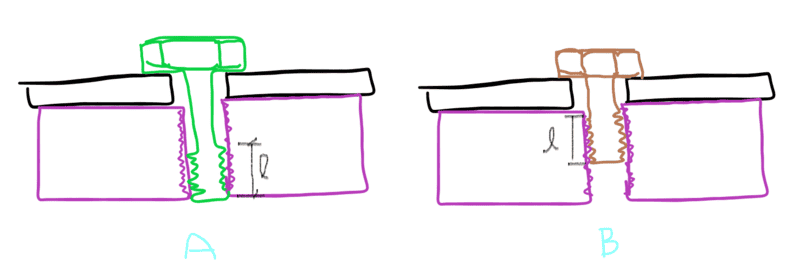
1689076103430.png

Here are some assumptions:

1. Materials of respective parts are same in both A and B
2. Diameters of the two bolts at comparable locations are also same
3. Torque given to tighten the bolts are also same
4. Length of thread engagement is also same

Pl. let me know your views. Thanks.
 
Engineering news on Phys.org
The free length of the shank is an elastic energy store in both tension and torque.

1. During installation, the long shank will need to be slightly over-torqued, then backed off to release torque remaining in the shank. (A shank subjected to torque, is proportionally shorter than one without).

2. During operational life, there should be no difference.

3. At the end of life, corrosion between the surfaces will force the plates apart. That will stretch the shank. The longer shank will extend the life before the bolt finally yields.
 
  • Like
Likes   Reactions: k.udhay
k.udhay said:
Pl. let me know your views.
What do you think and why?
 
berkeman said:
What do you think and why?
To me it really doesn't make difference. Let me think it out loud:
  • Longer shank (=unthreaded area in the bolt) is less stiff
  • For a given torque this can thus stretch more
  • Shorter shank is stiffer
  • For the same torque this will stretch less
  • But in either case, the preload between the male and female thread sufaces will be the same, thus making no difference from keeping the plates at certain clamping load over time.​

What do you think?
 
Baluncore said:
The free length of the shank is an elastic energy store in both tension and torque.

1. During installation, the long shank will need to be slightly over-torqued, then backed off to release torque remaining in the shank. (A shank subjected to torque, is proportionally shorter than one without).

2. During operational life, there should be no difference.

3. At the end of life, corrosion between the surfaces will force the plates apart. That will stretch the shank. The longer shank will extend the life before the bolt finally yields.
Thanks. What do you think on the clamping load between the two plates when the bolts in two conditions were given same tightening torque?
 
k.udhay said:
What do you think?
Good question. :smile:

To my untrained eye (I'm an EE not an ME), this version looks stupid. There is only one situation I can think of where it might make economic sense, but it's a stretch (pardon the pun).

1689205470070.png
 
  • Like
Likes   Reactions: k.udhay
I've had engines apart with a timing gear held on in the most seemingly stupid way. You guessed it, a bolt that seemed overly long. Torque instructions were X degrees after the slack was taken up. The elasticity in that bolt kept it tight. Main and rod bearing caps rely on something similar as do head bolts.
 
  • Like
Likes   Reactions: berkeman
k.udhay said:
Thanks. What do you think on the clamping load between the two plates when the bolts in two conditions were given same tightening torque?
The installation process needs to be different if they are to offer the same clamping force. That is because more torque can remain in the shank of the longer bolt, which is shortened in proportion to the magnitude of the torque.

Strictly speaking, these are screws, not bolts.

A screw is tightened by turning the head, so the shank rotates. A bolt is tightened by turning a nut, the head and shank do not rotate. There are not so obvious differences in the mechanical energy flow path during installation.

One important distinction is that they can fall in different taxation classes when imported, depending on their later application. Have you never wondered why bolts always come with a nut in the same box?
 
  • Informative
Likes   Reactions: k.udhay and berkeman
A bolted joint subject to variable loads can cause fatigue failure of the bolt. Bolt fatigue failures are caused by stress variation in the bolt. The bolt alternating stress is the same regardless of the clamp load, as long as the bolt clamp load is sufficient to keep the joint together.

Bolted joints with high variable loads are designed to reduce the alternating stress in the bolts. The relative stiffness of the bolt and joint affect the amount of stress variation in the bolt. A low stiffness bolt in a high stiffness joint has low alternating stress in the bolt, while a stiff bolt in a flexible joint has high alternating stress in the bolt.

The analysis is discussed in Fundamentals of Machine Component Design Second Edition, by Juvinall and Marshek (and other books), from which the following diagram was scanned:
Bolted joint.jpg

The hatched volume has a column stiffness, and the bolt has a column stiffness. The longer the bolt, the lower the bolt stiffness.
 
  • Like
  • Love
Likes   Reactions: k.udhay and Lnewqban
  • #10
Averagesupernova said:
I've had engines apart with a timing gear held on in the most seemingly stupid way. You guessed it, a bolt that seemed overly long. Torque instructions were X degrees after the slack was taken up. The elasticity in that bolt kept it tight. Main and rod bearing caps rely on something similar as do head bolts.
This is a bit confusing to me. If you tighten by X deg for both the proposals A and B, IMO B will be the better case. B has smaller shank length which means it has higher stiffness. For same angular rotation of the bolt, the one with more stiffness (which is B) will create more preload on the threads and hence should retain them engaged for a longer time. That's what I 'think'...
 
  • #11
k.udhay said:
For same angular rotation of the bolt, the one with more stiffness (which is B) will create more preload on the threads and hence should retain them engaged for a longer time.
It won't make more preload. If one bolt can take a higher preload, so does the other. the preload shall be the same in both cases for comparison.

The difference would lie in elongation under load. For the same stress, the strain (elongation divided by length) will be the same. This means that if a part is compressed under an external load - reducing the length of the bolt holding it - the shorter bolt will experience a larger strain, thus having a temporary lower stress and, consequently, preload. That is how things get loose with vibrations.
 
  • Like
Likes   Reactions: jrmichler and Lnewqban

Similar threads

  • · Replies 3 ·
Replies
3
Views
2K
Replies
8
Views
2K
Replies
1
Views
2K
Replies
6
Views
7K
Replies
8
Views
160K
  • · Replies 12 ·
Replies
12
Views
14K
  • · Replies 5 ·
Replies
5
Views
14K
  • · Replies 2 ·
Replies
2
Views
2K
  • · Replies 5 ·
Replies
5
Views
5K
  • · Replies 5 ·
Replies
5
Views
2K