qwereqe
- 2
- 0
- Homework Statement
- paradox about capacitor alignment
- Relevant Equations
- E=4πσ, V=-Ex
Assuming we have an infinite plane capacitor,where the upper plate is charged positively and the bottom layer is charged negatively. Now we know the field outside the capacitor is zero so we can't tell if the positive charge is on the upper plate or the lower plate.
But, if we place it inside another infinite plate capacitor, between its plates, and apply voltage between the external capacitor, we can't detect if it it is facing upward or downward.
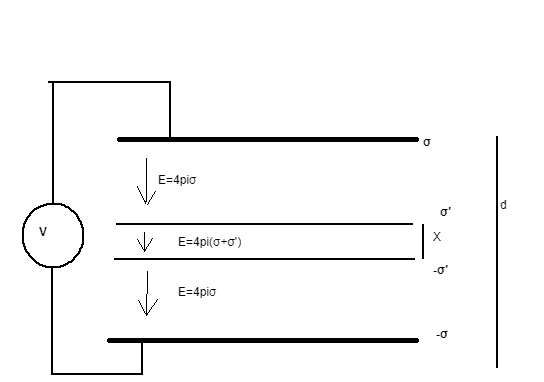
Using superposition, the field in the middle equals 4π(σ±σ′)4π(σ±σ′), depending of the inner plates alignment, with respect to the voltage. If the voltage is positive, we can calculate it integrating the field and get in one case:
V=4π(σd+σ′x)V=4π(σd+σ′x)
and if the inner capacitor is rotated downward we get:
V=4π(σd−σ′x)V=4π(σd−σ′x)
Where σ,dσ,d is the external capacitor charge density and distance and σ′,x is the inner capacitor charge density and distance.
So, because σ′,d,x,V are constant, we can see that the charge density on the external capacitor will change if the potential difference of the inner capacitor is aligned toward the external capacitor or not, and the force on the outer plates will be different in each case' because of the different charge density.
So, my problem is, if the field outside the inner capacitor is zero, how we can still detect its alignment? Seems, like a paradox to me.
Thanks.
But, if we place it inside another infinite plate capacitor, between its plates, and apply voltage between the external capacitor, we can't detect if it it is facing upward or downward.
Using superposition, the field in the middle equals 4π(σ±σ′)4π(σ±σ′), depending of the inner plates alignment, with respect to the voltage. If the voltage is positive, we can calculate it integrating the field and get in one case:
V=4π(σd+σ′x)V=4π(σd+σ′x)
and if the inner capacitor is rotated downward we get:
V=4π(σd−σ′x)V=4π(σd−σ′x)
Where σ,dσ,d is the external capacitor charge density and distance and σ′,x is the inner capacitor charge density and distance.
So, because σ′,d,x,V are constant, we can see that the charge density on the external capacitor will change if the potential difference of the inner capacitor is aligned toward the external capacitor or not, and the force on the outer plates will be different in each case' because of the different charge density.
So, my problem is, if the field outside the inner capacitor is zero, how we can still detect its alignment? Seems, like a paradox to me.
Thanks.
Last edited: