Discussion Overview
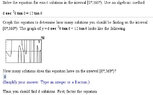
The discussion revolves around determining the exact solutions to a trigonometric equation using a graphing calculator, specifically focusing on solutions within the interval [0, 360) degrees. Participants explore how to interpret the graph to identify the number of solutions.
Discussion Character
- Exploratory, Technical explanation, Homework-related
Main Points Raised
- One participant describes their approach to inputting the function into a TI-83+ calculator and expresses interest in determining the exact solutions.
- Another participant suggests counting the roots visible on the graph to find the solutions.
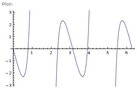
- A participant questions whether the graph is plotted in radians, noting that it appears to show 7 roots.
- There is clarification that the graph was plotted in radians without converting to degrees, which affects the counting of roots.
- One participant acknowledges seeing 7 points where y=0, but later corrects themselves to state they see 6 points after considering the domain restriction.
- Participants discuss the importance of not counting the root at x=2π, as it is excluded from the specified domain.
Areas of Agreement / Disagreement
Participants do not reach a consensus on the exact number of solutions initially, as there is a discrepancy between counting 6 and 7 roots. However, there is agreement on the importance of the domain in determining which roots to count.
Contextual Notes
The discussion includes assumptions about the graphing method and the interpretation of roots, which depend on the choice of radians versus degrees. The exclusion of x=2π from the domain is also a critical factor in the counting of solutions.
Who May Find This Useful
Students or individuals learning about trigonometric equations and their graphical representations, particularly those using graphing calculators for homework or study purposes.