Determine the final train speed (mass and slinky on a train)

Click For Summary

Homework Help Overview

The discussion revolves around a physics problem involving a train and two masses, one of which is a slinky. Participants are exploring the implications of mass interactions and momentum on the speed of the train.

Discussion Character

  • Exploratory, Assumption checking, Conceptual clarification

Approaches and Questions Raised

  • Participants are examining how the slinky's behavior affects the overall momentum and speed of the train. Questions arise about the nature of forces acting on the masses and the implications of the slinky's contraction and stretching.

Discussion Status

The discussion is ongoing, with various interpretations being explored. Some participants are questioning the assumptions about the forces involved and the mechanics of the slinky, while others are providing insights into classical mechanics and the behavior of the system.

Contextual Notes

There is mention of constraints regarding the problem's expectations, particularly the focus on classical mechanics rather than relativity. Participants are also grappling with the definitions and roles of the components involved, such as the slinky and the masses.

leafy
Messages
73
Reaction score
8
Homework Statement
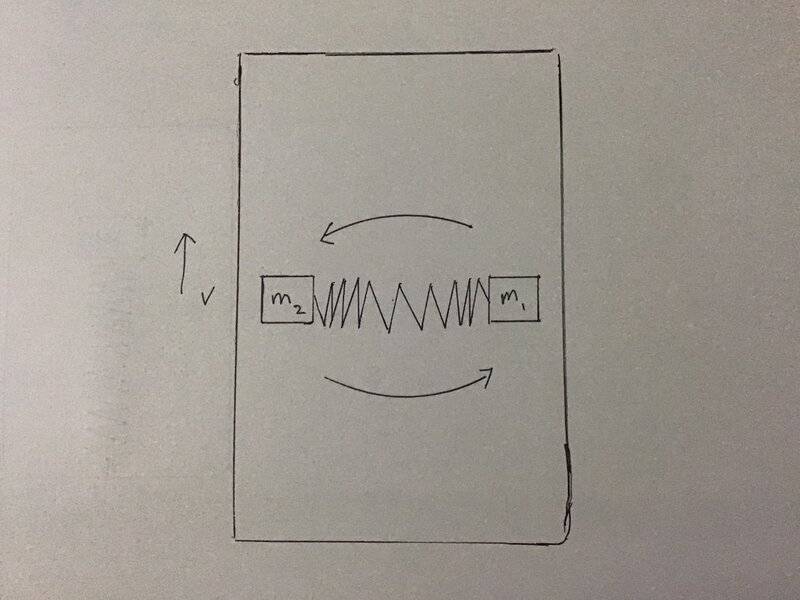
Top view of the train shown a rotating pair of mass m1 and m2 attached to a slinky. The train is moving north with constant speed v. At 0 degree, m1 is released from the slinky and move north to hit the train inelasticly. The slinky is fully contract when the system rotate 180 degrees. During this time, m2 continue to go in circle until 180 degrees. m2 is then released from the slinky and move north to hit the train. Determine the final speed of the train:

A) speed up
B) slow down
C) remain the same
Relevant Equations
F = dv/dt
A, the train speed up?
10A7DE33-5BB0-44FC-80FD-BE1393218060.jpeg
 
Physics news on Phys.org
What is your reasoning?
 
We have two masses hitting the train north, so the speed increase. However, after rethinking about the slinky mass (since mass is require for a force) has momentum component heading south. The overall speed of the train remain the same. But the interesting thing I'm thinking is can we actually delay the momentum.
 
leafy said:
We have two masses hitting the train north, so the speed increase. However, after rethinking about the slinky mass (since mass is require for a force) has momentum component heading south. The overall speed of the train remain the same. But the interesting thing I'm thinking is can we actually delay the momentum.
Not entirely sure what you meant by some of that. Does "slinky mass" refer to the mass of the slinky itself? And what do you mean by "delaying" momentum?

Think about how the second mass gets to be going N after initially going S.
 
yes, slinky are masses and springs connected in series. What I meant by delay momentum is slinky action redistribute the center of mass without an external force. If you see a slinky drop from a rooftop, the top part fall down faster, which means the center of mass change as it drop.

After the first mass is relase, the forces still acting on the second mass until the slinky is full contracted. That's how the second mass go north. Just like when the sun disappear, the Earth still going in circle until gravity catch on.
 
leafy said:
After the first mass is relase, the forces still acting on the second mass
And what is providing that force?
 
leafy said:
yes, slinky are masses and springs connected in series. What I meant by delay momentum is slinky action redistribute the center of mass without an external force. If you see a slinky drop from a rooftop, the top part fall down faster, which means the center of mass change as it drop.

After the first mass is relase, the forces still acting on the second mass until the slinky is full contracted. That's how the second mass go north. Just like when the sun disappear, the Earth still going in circle until gravity catch on.
The Earth still go on ellipse because information can't move faster than light. I am almost sure the problem here don't want you to invoke relativity, but just classical mechanics.

Apart from the fact that, even if it want you to invoke relativity, you would still be wrong
 
haruspex said:
And what is providing that force?
the stretched slinky, when unstretched, provides the force.
LCSphysicist said:
The Earth still go on ellipse because information can't move faster than light. I am almost sure the problem here don't want you to invoke relativity, but just classical mechanics.

Apart from the fact that, even if it want you to invoke relativity, you would still be wrong
It's resembled. The second mass still move in circle even when the first mass disconnected because pressure wave need time to reach the second mass.
 
leafy said:
the stretched slinky
And what holds that in place?
 
  • #10
leafy said:
like when the sun disappear, the Earth still going in circle until gravity catch on.
I have no idea what you are talking about. Gravity acts all the time, whether you can see the sun or not.
 
  • #11
haruspex said:
And what holds that in place?
initially the two mass stretched the slinky, after m1 release, the slinky contract toward the second mass.
haruspex said:
I have no idea what you are talking about. Gravity acts all the time, whether you can see the sun or not.
nevermind
 
  • #12
leafy said:
initially the two mass stretched the slinky, after m1 release, the slinky contract toward the second mass.
That doesn’t answer my question.
Why doesn’t the slinky hit the S end of the train?
 
  • #13
haruspex said:
That doesn’t answer my question.
Why doesn’t the slinky hit the S end of the train?
It should. That's why I say there is no speed change in the train.
 
  • #14
leafy said:
It should. That's why I say there is no speed change in the train.
Yet, we are told the second mass hits the front. I can only see twomways that can happen:
1. The slinky is fixed to an axis at its middle.
2. The slinky is massive, and the second mass is released after a 270° turn, or nearly, so projected N by the expanding slinky.

I don't really understand the text regarding the contraction of the slinky. Is it by some magic staying contracted during the 180° turn?

Where does this question come from?
 

Similar threads

Replies
3
Views
999
Replies
3
Views
1K
  • · Replies 84 ·
3
Replies
84
Views
5K
Replies
20
Views
2K
  • · Replies 17 ·
Replies
17
Views
4K
  • · Replies 23 ·
Replies
23
Views
1K
  • · Replies 14 ·
Replies
14
Views
3K
  • · Replies 28 ·
Replies
28
Views
2K
  • · Replies 29 ·
Replies
29
Views
2K
  • · Replies 5 ·
Replies
5
Views
7K