Determine the pressure gradient for suction

Click For Summary

Discussion Overview

The discussion revolves around designing a pneumatic system for lifting and transporting metal components, similar to a vacuum cleaner. Participants explore the calculation of pressure differences necessary for the operation and the mechanisms suitable for this application, focusing on pneumatic solutions rather than hydraulic ones.

Discussion Character

  • Exploratory
  • Technical explanation
  • Debate/contested

Main Points Raised

  • One participant seeks clarification on which area to use for pressure calculations, presenting three options: the area of a circle based on diameter, the product of diameter and length, or a custom-defined suction area.
  • Another participant suggests that the original poster is attempting to create a pneumatic conveyor and recommends searching for that term for further insights.
  • The original poster acknowledges the term "pneumatic conveyor" but emphasizes that their application differs as it involves lifting and transporting metal particles.
  • A later reply describes different configurations of pneumatic conveyors, including fan placements and the need for separation mechanisms to prevent metal pieces from entering the fan, suggesting the use of cyclone separators.

Areas of Agreement / Disagreement

Participants generally agree on the relevance of pneumatic conveyors to the original poster's project, but there is no consensus on the specific design requirements or the best method for achieving the desired functionality.

Contextual Notes

Participants have not resolved the specific calculations for pressure or the optimal design for the pneumatic system, and there are assumptions regarding the effectiveness of various mechanisms that remain unverified.

Avram
Messages
2
Reaction score
2
Hello,
Im designing a product which will pump components as vacuum cleaner does.
I have 2 questions:

Im trying to calculate the pressure different in order to pump those metal component with :
M=0.2 kg , dimensions (mm) cylinder with diameter 5.5 mm length 600mm .

the formula for pressure is F\A: which A should i take :
1. (1\4)*pai*diameter^2
2. diameter* length
3. cross section of suction area which can be determined as i wish?

Which mechanism can i rely on?

I have been thinking about air blower, but I am afraid the blades will fail quickly (i pump metal components)
Air blower : https://www.mcmaster.com/#9960k51/=1bb5u6o

which method can i rely on ? (no hydraulic only pneumatic)
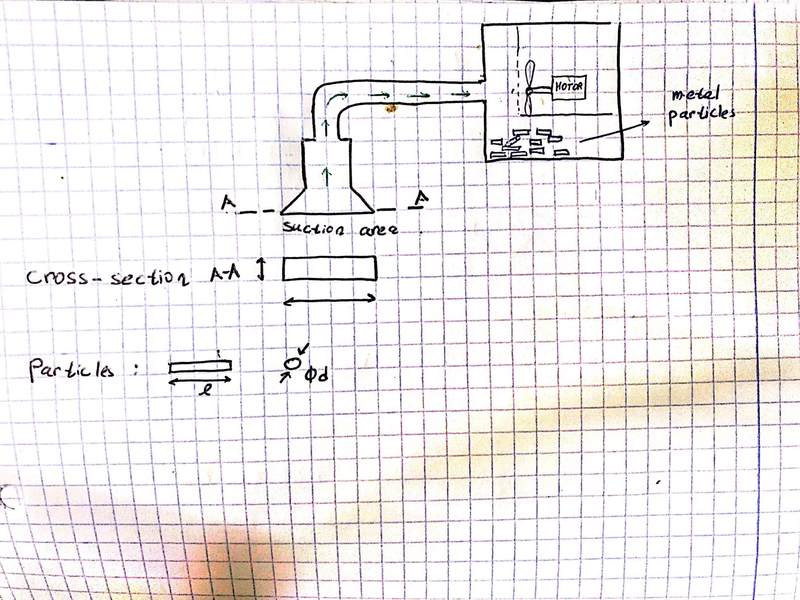
1WoRf0Q.jpg

thanks
 

Attachments

  • 1WoRf0Q.jpg
    1WoRf0Q.jpg
    80.6 KB · Views: 708
Last edited:
Engineering news on Phys.org
You are trying to invent a pneumatic conveyor. Google that term. You will find the answer to your questions, and give you some ideas.
 
jrmichler said:
You are trying to invent a pneumatic conveyor. Google that term. You will find the answer to your questions, and give you some ideas.

You right, that's the term.
But still my application is a bit different, my product goal is to lift and transport those metal particle.
The pneumatic conveyor just transport solid from one place to another.
 
Pneumatic conveyors are built with the fan at the pickup end, with the fan at the discharge end (as in your sketch), and with the fan off to the side. The systems with the fan off to the side inject air into the middle of the conveyor line through an arrangement similar to an eductor (google the term).

Your sketch will get the job done. You merely need to figure out how to separate the metal pieces from the air so they don't get sucked into the fan. For some ideas, look at shop vacuums and look up cyclone separators.
 

Similar threads

Replies
2
Views
2K
Replies
2
Views
2K
  • · Replies 1 ·
Replies
1
Views
2K
  • · Replies 2 ·
Replies
2
Views
2K
Replies
22
Views
3K
  • · Replies 5 ·
Replies
5
Views
2K
  • · Replies 2 ·
Replies
2
Views
2K
  • · Replies 5 ·
Replies
5
Views
2K
  • · Replies 1 ·
Replies
1
Views
2K
  • · Replies 4 ·
Replies
4
Views
2K