Determining Moles and Particles from Mass of a Compound

  • Context: Chemistry 
  • Thread starter Thread starter rachelmaddiee
  • Start date Start date
  • Tags Tags
    Mass Moles Particles
Click For Summary
SUMMARY

The discussion focuses on calculating the number of moles and particles from the mass of aluminum chloride (AlCl3). The molar mass of AlCl3 is determined to be 133.33 g/mol, leading to the calculation of 0.279 moles from a given mass of 37.2 g. The stoichiometric relationships indicate that each mole of AlCl3 produces 1 mole of Al3+ ions and 3 moles of Cl- ions. The final calculations yield approximately 1.67 x 10^23 Al3+ ions and 5.01 x 10^23 Cl- ions.

PREREQUISITES
  • Understanding of molar mass calculations
  • Familiarity with stoichiometric ratios in chemical reactions
  • Knowledge of Avogadro's number (6.02 x 10^23)
  • Basic principles of ionization in chemical compounds
NEXT STEPS
  • Study stoichiometry in chemical reactions
  • Learn about ionization equations and their applications
  • Explore molar mass calculations for various compounds
  • Review examples of particle calculations using Avogadro's number
USEFUL FOR

Chemistry students, educators teaching stoichiometry, and anyone involved in chemical calculations and analysis.

rachelmaddiee
Messages
67
Reaction score
5
Homework Statement
I need help with a question
Relevant Equations
N/A
mass = 37.2 g AICI3 (given)
number of ions = AI3+ Ions (unknown)
number of ions = CI- Ions (unknown)
mass = g/formula unit AICI3 (unknown)
The ratio of AI3+ Ions to CI- Ions is 1:3
Molar Mass AICI3
(1 x 26.98 g/mol AI) + (3 x 35.45 g/mol CI) = 133.33 g/mol AICI3
molar mass = 133.33 g/mol AICI3
Divide the given mass of aluminum chloride by its molar mass.
37.2 AICI3/133.33 mol = 0.279 mol AICI3

Is this correct?
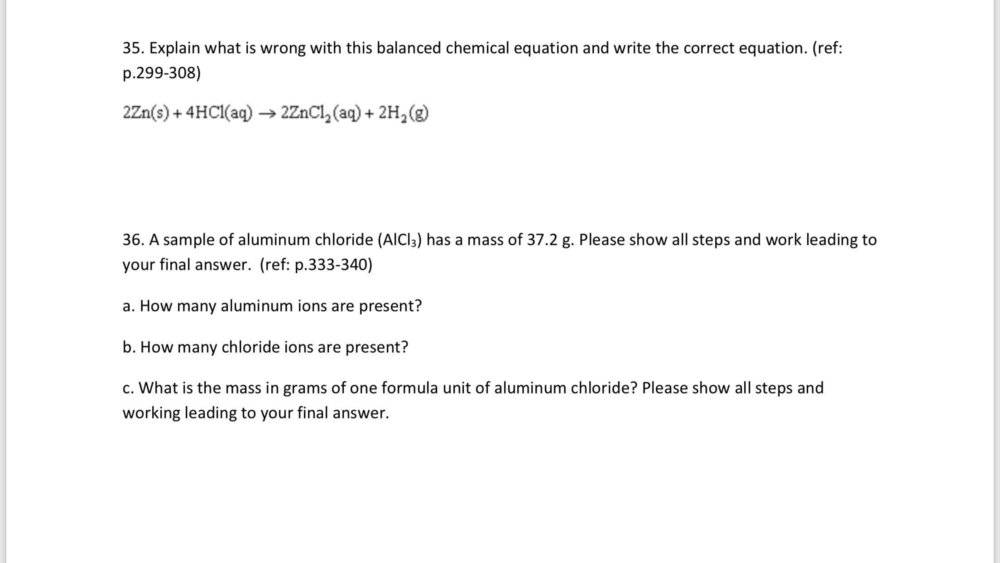
DB1914AA-E7F8-4E2D-BD90-0F60A2250649.jpeg
 
  • Like
Likes   Reactions: trurle
Physics news on Phys.org
So you have moles of AlCl3. Now you should write out the balanced equation showing the production of ions from the AlCl3.
 
Note: it is not AICI3, it is AlCl3 (small L, not capital I). Please revise what the chemical symbols of elements are.
 
You have got the number of moles of AlCl3. Which we will consider made of Al3+ and Cl- ions. The question (as I understand it) asks what is the number of these ions in the sample.

(Hint: a very large number).
 
epenguin said:
You have got the number of moles of AlCl3. Which we will consider made of Al3+ and Cl- ions. The question (as I understand it) asks what is the number of these ions in the sample.

(Hint: a very large number).
1 mole of aluminum ions and 3 moles of Chloride ions
 
rachelmaddiee said:
1 mole of aluminum ions and 3 moles of Chloride ions
Nope. You really should just write out the ionization equation. It will help you visualize how to proceed.
 
chemisttree said:
Nope. You really should just write out the ionization equation. It will help you visualize how to proceed.
Are you looking at question 36?
 
Yes.
When I was teaching AP Chemistry, I required my students to write out the relevant equation to help them visualize and organize their thoughts. I’m not being pedantic. I know it works. Try it yourself if you don’t believe me.
 
Last edited:
chemisttree said:
Yes.
When I was teaching AP Chemistry, I required my students to write out the relevant equation to help them visualize and organize their thoughts. I’m not being pedantic. I know it works. Try it yourself if you don’t believe me.
I don’t understand what I’m looking for.
 
  • #10
AB2 —-> A+2 + 2B -

This would be an example. Put what you are given above the equation and what you need to calculate beneath the equation.

Like this:

3.2 g
AB2 —-> A+2 + 2B -
? mol ?mol ?mol
? # ? # ? #
 
Last edited:
  • #11
rachelmaddiee said:
I don’t understand what I’m looking for.

If I ask how many atoms there are in a mole of an element does that help make sense of the Question?
 
  • #12
epenguin said:
If I ask how many atoms there are in a mole does that help make sense of the Question?
Nowadays they are asked for “how many particles” rather than how many atoms or molecules. It needlessly complicates things IMO but that’s the way it is.
 
  • #13
1 mole = 6.02 x 10^23 atoms
 
  • #14
rachelmaddiee said:
1 mole = 6.02 x 10²³ atoms
1 mole = 6.02 x 10²³ particles
 
  • Like
Likes   Reactions: rachelmaddiee
  • #15
chemisttree said:
1 mole = 6.02 x 10²³ atoms
Sorry, a mistake!
 
  • #16
chemisttree said:
AB2 —-> A+2 + 2B -

This would be an example. Put what you are given above the equation and what you need to calculate beneath the equation.

Like this:

3.2 g
AB2 —-> A+2 + 2B -
? mol ?mol ?mol
? # ? # ? #
This is confusing me. I can’t find any examples in my book.
 
  • #17
Which is why I’m going through it with you here.
 
  • #18
chemisttree said:
Which is why I’m going through it with you here.
37.2 g
AICI3 —> AI+3 + 3CI -
 
Last edited:
  • #19
Can you please give me an example of How should it be written when I get my result?
 
  • #20
image.jpg

OK. You are asked to find the number of ions of aluminum in part a. To do that you must calculate the number of moles of Al first. You have already calculated the moles of AlCl3 so you are on your way!
 
  • Like
Likes   Reactions: rachelmaddiee
  • #21
From the equation above how many moles of Al+3 are produced from each mole of AlCl3?
 
  • #22
chemisttree said:
From the equation above how many moles of Al+3 are produced from each mole of AlCl3?
133.34g/mol?
 
  • #23
rachelmaddiee said:
133.34g/mol?
No, that’s the formula weight. You notice there is a 1:1 relationship between AlCl3 and Al+3. Each mole of AlCl3 produces a mole of Al+3. Half a mole of AlCl3 produces half a mole of Al+3. How about 0.279 moles of AlCl3?
 
  • Like
Likes   Reactions: rachelmaddiee
  • #24
chemisttree said:
No, that’s the formula weight. You notice there is a 1:1 relationship between AlCl3 and Al+3. Each mole of AlCl3 produces a mole of Al+3. Half a mole of AlCl3 produces half a mole of Al+3. How about 0.279 moles of AlCl3?
Yes, I’ve solved for. That
 
  • #25
Ok then. How many moles of Cl- do you get from 0.279 moles of AlCl3?
 
  • #26
chemisttree said:
Ok then. How many moles of Cl- do you get from 0.279 moles of AlCl3?
Wouldn’t it be 0.279 moles too?
 
  • #27
rachelmaddiee said:
Wouldn’t it be 0.279 moles too?
Each mole of AlCl3 produces how many moles of Cl-? Refer to the equation.
 
  • #28
chemisttree said:
Each mole of AlCl3 produces how many moles of Cl-? Refer to the equation.
3?
 
  • #29
Right! So how many moles from 0.279 moles of AlCl3?
 
  • #30
chemisttree said:
Right! So how many moles from 0.279 moles of AlCl3?
I don’t. Understand how to find that?
 

Similar threads

  • · Replies 4 ·
Replies
4
Views
2K
  • · Replies 2 ·
Replies
2
Views
2K
Replies
2
Views
4K
  • · Replies 5 ·
Replies
5
Views
2K
  • · Replies 4 ·
Replies
4
Views
2K
  • · Replies 14 ·
Replies
14
Views
12K
Replies
7
Views
5K
  • · Replies 3 ·
Replies
3
Views
3K
  • · Replies 6 ·
Replies
6
Views
3K
  • · Replies 1 ·
Replies
1
Views
2K