Determining similarity of plane figures

  • Context:
  • Thread starter Thread starter MathIsHard123
  • Start date Start date
  • Tags Tags
    Plane
Join the discussion
Registration is free. Ask a follow-up in this thread, or start your own.
4 replies · 3K views
MathIsHard123
Messages
1
Reaction score
0
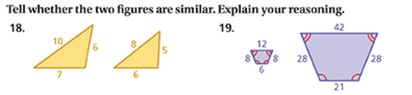
really need help on this I learned it but forgot how to do it. thanks if you reply with explanation
 

Attachments

  • Screen Shot 2014-09-21 at 2.56.03 PM.png
    Screen Shot 2014-09-21 at 2.56.03 PM.png
    21.7 KB · Views: 147
Mathematics news on Phys.org
Two polygons in Euclidean geometry are called similar when, roughly speaking, one can be resized (zoomed in and zoomed out) to obtain another.

This is essentially equivalent to saying (are you familiar with the geometric proof of this) that if you have two polygons with sides labeled $AB, BC, CD, \cdots$ and $A'B', B'C', C'D', \cdots$ and the angles labelled $\alpha, \beta, \gamma, \cdots$ and $\alpha', \beta', \gamma', \cdots$ in the same order, then $$\frac{AB}{A'B'} = \frac{BC}{B'C'} = \frac{CD}{C'D'} = \cdots$$ $$\alpha = \alpha', \beta = \beta', \gamma = \gamma', \cdots$$

What can you say about the polygons you are given? Can you use the fact above?
 
Last edited:
mathbalarka said:
Two polygons in Euclidean geometry are called similar when, roughly speaking, one can be resized (zoomed in and zoomed out) to obtain another.

This is essentially equivalent to saying (are you familiar with the geometric proof of this) that if you have two polygons with sides labeled $AB, BC, CD, \cdots$ and $A'B', B'C', C'D', \cdots$ in the same order, then $$\frac{AB}{A'B'} = \frac{BC}{B'C'} = \frac{CD}{C'D'} = \cdots$$
For triangles, this is indeed equivalent. For polygons with more than three sides, the fact that sides are proportional is necessary for the polygons to be similar, but it is not sufficient.
 
Hello MathIsHard123 (Wave) and welcome to MHB!I have re-titled your thread so that it reflects the nature of the question being asked. A title such as "Math Help" tells us no more than we already know...when our users view the thread listing, it is best if the titles give some indication of the type of question posted. This makes MHB more efficient for our users, and ensures you get the most prompt help possible.:)
 
Evgeny.Makarov said:
For triangles, this is indeed equivalent. For polygons with more than three sides, the fact that sides are proportional is necessary for the polygons to be similar, but it is not sufficient.

Fair enough, otherwise a Rhombus and a square would be similar. The diagonals must be similar too, but that fact isn't needed here. I evidently didn't see the angles marked in the image. :p