Why Is the d-Orbital Considered in Sc Term Symbols?

Click For Summary
SUMMARY

The discussion focuses on the derivation of term symbols for various atoms, specifically addressing the role of d-orbitals in the ground state of Scandium (Sc). Participants clarify that the s-orbital is full, contributing zero net angular momentum to the total L and S values, thus only partially filled subshells are relevant. The correct term symbol for Fluorine ion (F-) is determined to be 1S0, contrary to the initial assumption of 1P0. The conversation emphasizes the importance of accurately identifying orbital configurations in term symbol calculations.

PREREQUISITES
  • Understanding of term symbols in quantum mechanics
  • Familiarity with electron configurations and subshell filling
  • Knowledge of angular momentum in atomic physics
  • Basic principles of Hund's rules and Pauli exclusion principle
NEXT STEPS
  • Study the derivation of term symbols for transition metals
  • Learn about Hund's rules and their application in term symbol determination
  • Explore the significance of orbital filling order in electron configurations
  • Investigate the implications of full vs. partially filled subshells on atomic properties
USEFUL FOR

Chemistry students, physicists, and educators seeking to deepen their understanding of atomic structure and term symbols, particularly in the context of transition metals and their electronic configurations.

physicisttobe
Messages
56
Reaction score
13
Homework Statement
electron configuration of SC
Relevant Equations
...
I've solved further Term Symbol problems. The task is: derive the term symbols of the ground states of the following atoms: a) H, b) F, c) Cu, d) F- , e) P, f) Na, g) Sc

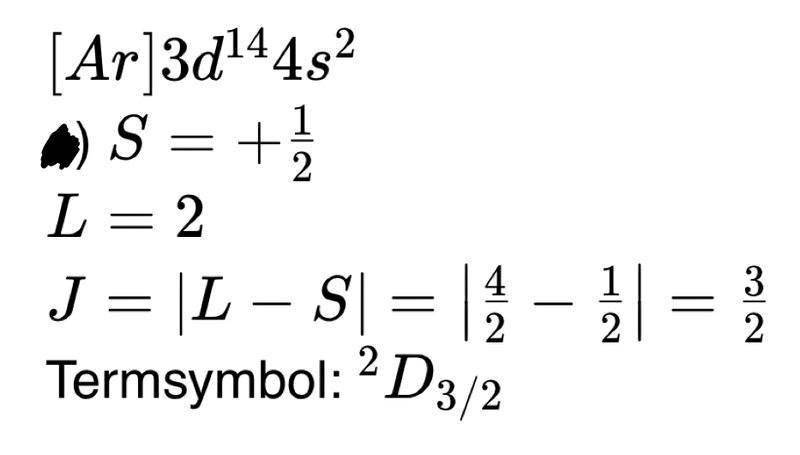
Why is the d-orbital considered here in g)? Why isn't the s orbital taken into account here? The 4s orbital is energetically higher than the 3d orbital, so why don't you look at the 4s orbital. I also post the solution and my approach to this problem. I can't explain why my approach is incorrect. Can someone help me?

my approach:
C5D1F174-C00B-4242-A072-B400DE853580.jpeg


solution:
ECB91335-C5CF-470D-94EE-3DA783A57DF4.jpeg
 
Physics news on Phys.org
The s orbital is full. The net contribution of all filled subshells to L and S is zero, so you only need to consider partially filled subshells. (And I assume 3d14 is a typo for 3d1.)

Oh, and if you meant Sc you should have said so. SC is something very different!
 
  • Like
Likes   Reactions: jim mcnamara
mjc123 said:
The s orbital is full. The net contribution of all filled subshells to L and S is zero, so you only need to consider partially filled subshells.
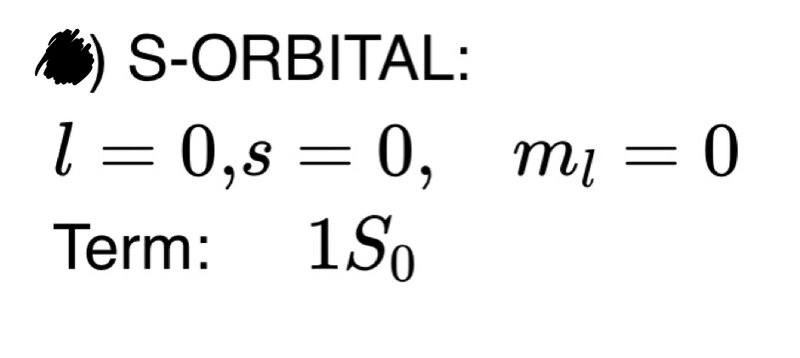
All right, but what about F-? We have the configuration [He]2s^2 2p^6, both orbitals are full.
I thought it would be 1P0 but it's wrong. The solution is 1S0, but I can't explain why 1S0.
I solved this problem like this:

EE4B9EA0-09D4-4259-8706-EEB25FFD77E8.jpeg

mjc123 said:
(And I assume 3d14 is a typo for 3d1.)
Yes, it's a typo, sorry for that.
mjc123 said:

Oh, and if you meant Sc you should have said so. SC is something very different!
Oh, sorry, I mean Sc, of course.
mjc123 said:
The s orbital is full. The net contribution of all filled subshells to L and S is zero, so you only need to consider partially filled subshells. (And I assume 3d14 is a typo for 3d1.)

Oh, and if you meant Sc you should have said so. SC is something very different!
 

Attachments

  • 9383CF58-1003-4E6C-96F1-A7FC418E457B.jpeg
    9383CF58-1003-4E6C-96F1-A7FC418E457B.jpeg
    20.4 KB · Views: 155
physicisttobe said:
All right, but what about F-? We have the configuration [He]2s^2 2p^6, both orbitals are full.
I thought it would be 1P0 but it's wrong. The solution is 1S0, but I can't explain why 1S0.

What is your reasoning for selecting ##P## in your solution ##^1P_0##?
A full orbital subshell has zero net orbital angular momentum.
 
Last edited:
physicisttobe said:
Oh, sorry, I mean Sc, of course.
{Fixed in thread title now)
 
TSny said:
What is your reasoning for selecting ##P## in your solution ##^1P_0##?
A full orbital subshell has zero net orbital angular momentum.
All right, I get it. Thank you so much for your help!
If any questions arise, I'll get in touch here
 
  • Like
Likes   Reactions: TSny and berkeman

Similar threads

  • · Replies 2 ·
Replies
2
Views
2K
  • · Replies 11 ·
Replies
11
Views
3K
Replies
4
Views
2K
  • · Replies 0 ·
Replies
0
Views
546
  • · Replies 3 ·
Replies
3
Views
2K
  • · Replies 9 ·
Replies
9
Views
1K
Replies
1
Views
3K
  • · Replies 1 ·
Replies
1
Views
1K
  • · Replies 2 ·
Replies
2
Views
3K
  • · Replies 9 ·
Replies
9
Views
3K