Determining the weight and angle of an object - Help please

  • Thread starter Thread starter riseofphoenix
  • Start date Start date
  • Tags Tags
    Angle Weight
Click For Summary

Homework Help Overview

The discussion revolves around determining the weight and angle of an object in a physics problem involving forces acting on a leg and cast. The original poster seeks assistance in solving for the unknown weight and angle while ensuring no net force is exerted on the hip joint.

Discussion Character

  • Exploratory, Assumption checking, Mathematical reasoning

Approaches and Questions Raised

  • Participants suggest drawing component forces to analyze the problem, questioning how the forces interact and cancel each other. The original poster expresses confusion about the calculations and relationships between the weights and angles involved.

Discussion Status

Some participants have provided guidance on breaking down the forces into horizontal and vertical components, noting the need for these components to balance. The original poster has attempted calculations but has encountered errors, leading to further questioning of the approach.

Contextual Notes

The problem involves specific weights and angles, with the original poster referencing previous similar problems. There is an emphasis on ensuring that the leg experiences no net force, which is central to the discussion.

riseofphoenix
Messages
294
Reaction score
2
Determining the weight and angle of an object -- Help please

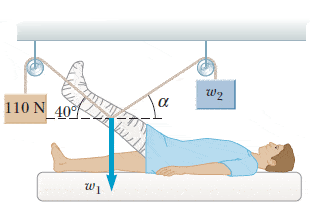
2. The leg and cast in the figure below weigh 158 N (w1). Determine the weight w2 and the angle α needed so that no force is exerted on the hip joint by the leg plus cast.
4-p-020.gif


w2 = ________ N
α = ________ °

OK so I figured out how to do a problem similar to this just a few minutes ago on my own (:D I was so happy), but I have no idea how to solve for this one...
I need help!
 
Physics news on Phys.org


Try drawing component forces(sideways and upwards) from each of the lines at the point where they meet.
The sideways ones should cancel each other, and the sum of the upward components should equal the weigh of the leg(so that there is no net force acting on the leg).
The rest is just delicious, delicious trigonometry.


Bandersnatch said:
Try drawing component forces(sideways and upwards) from each of the lines at the point where they meet.
The sideways ones should cancel each other, and the sum of the upward components should equal the weigh of the leg(so that there is no net force acting on the leg).
The rest is just delicious, delicious trigonometry.

I don't get it though...

You're saying

w3 + w2 = w1?
I tried doing 110 + w2 = 158
w2 = 158 - 110
w2 = 48 N

But that's wrong...

And then I tried doing

w3 = 110 sin 48 = 70
w1 -158 sin 270 = 158

And then I tried doing 158 - 70 = 88 N, which is wrong too...

?


You have to realize that the two forces exerted by the lines on the leg partially cancel each other, so you can't just add them.

In another situation, where both α & β would be equal to 0°, i.e. the lines would pull in the opposite direction, then as long as both weights w2 & w3 were equal, you'd have their forces cancel each other completely.
But then the leg would fall down, because there'd be nothing to counteract it's own weight(w1).

Here, you have a situation where part of the force provided by each of the weights pulls the leg horizontally - and cancels with the other force's horizontal component(otherwise the leg would feel a net force, and the injured guy would cry like a baby). The remaining, vertical components of each of the force add up to counterweigh the leg's downward pull.

What you need to do, is split the two force vectors(that's basically what the lines represent) into their horizontal and vertical components via right angle trigonometry.
If you're not sure what I'm talking about here, browse through this page:
http://zonalandeducation.com/mstm/physics/mechanics/forces/forceComponents/forceComponents.html

Since you know that the leg needs to feel no force at all, you can now write two equations. One for the two horizontal components, that you've just separated, cancelling out each other(i.e. they need to be equal and have opposite direction).
The second one for the two vertical components canceling out the weight of the leg(i.e.their sum must equal the leg's weight).
 

Similar threads

  • · Replies 2 ·
Replies
2
Views
3K
  • · Replies 15 ·
Replies
15
Views
3K
  • · Replies 1 ·
Replies
1
Views
2K
  • · Replies 2 ·
Replies
2
Views
941
Replies
7
Views
3K
Replies
10
Views
4K
Replies
1
Views
3K
Replies
7
Views
6K
  • · Replies 13 ·
Replies
13
Views
2K
  • · Replies 2 ·
Replies
2
Views
3K