Determining vector angle: why do we need to add 180°

  • Thread starter Thread starter Benjamin_harsh
  • Start date Start date
  • Tags Tags
    Angle Vector
Click For Summary
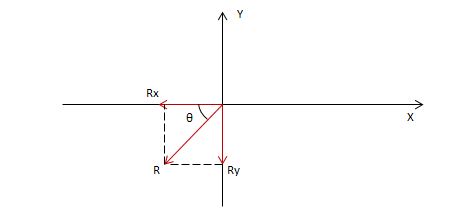
To determine the vector angle in this context, the angle θ is calculated as 56°, but to express the direction of the resultant vector R accurately, 180° must be added, resulting in 236°. This addition is necessary because angles are conventionally measured counterclockwise from the positive x-axis, and failing to follow this convention can lead to misunderstandings. The discussion emphasizes the importance of adhering to established mathematical conventions to avoid ambiguity in communication. Additionally, the calculation of R's magnitude and the use of the tangent function are clarified, highlighting the significance of signed quantities in the coordinate system.
Benjamin_harsh
Messages
211
Reaction score
5
Homework Statement
why we need to add 180 to 56?
Relevant Equations
why we need to add 180 to 56?
The magnitude of each force is shown below:
F1 = 10 N
F2 = 20 N
F3 = 40 N
243784


R = \sqrt {Rx^2 + Ry^2}
R = \sqrt {-10^2 -15^2} = 18N
θ = tan^{-1} \frac{Ry}{Rx}
θ = tan^{-1} \frac{Ry}{Rx} = 56

To express the direction of R, we need to calculate the direction angle (i.e. the counterclockwise angle that R makes with the positive x-axis), which in our case is 180° + θ, i.e. 236°.

why 236 but not 56? why we need to add 180 to 56?
 
Physics news on Phys.org
By convention angles are measured counterclockwise from the positive x axis.
 
hutchphd said:
By convention angles are measured counterclockwise from the positive x axis.

Why so?
 
Benjamin_harsh said:
Why so?
Why not? There has to be a common convention.
 
Benjamin_harsh said:
Why so?
So that you don't have specify the convention every time you want to specify an angle.
 
Benjamin_harsh said:
Why so?

If you just say "56 degrees", then people will assume that this is the angle measured from the postive x-axis, and that will give the wrong answer.

When you tell someone something, you both have to have an understanding and agreement of some basic "rules". You may not think of you two having an agreement on how to specify things, but you actually do. Here in math and science, this agreement or convention are codified and clarified so that there is no ambiguity on what means what.

In my class, my students have the freedom to either use the standard convention and signify the value of the angle from the +x-axis, or they can show on a sketch where this angle is and use the sketch itself to define the angle being measured. Otherwise, without such a sketch, a quoted angle will be assumed to be measured from the the +x-axis.

Of course, if this is an answer you have to enter into an online test or hw, it better be in the format or convention that it requires.

Zz.
 
  • Like
Likes hutchphd and PeroK
Benjamin_harsh said:
Problem Statement: why we need to add 180 to 56?
Relevant Equations: why we need to add 180 to 56?

The magnitude of each force is shown below:
F1 = 10 N
F2 = 20 N
F3 = 40 N
Not that it matters much, but what is the meaning of F1, F2 and F3 and what it their relation to the diagram?
Also, this is incorrect
Benjamin_harsh said:
##R = \sqrt {-10^2 -15^2} = 18N##
You should put parentheses where they belong. It probably doesn't matter here, but it may matter later.
 
Benjamin_harsh said:
why 236 but not 56?
Further to the answers above, you may also be wondering why ##\tan^{-1}## did not give the right answer. It is because tan is opposite/adjacent, and in the coordinate system these are both signed quantities. In the third quadrant they are both negative and (-y)/(-x)=y/x, so the value of tan is the same at (x,y) and (-x,-y).
By convention, the function ##\tan^{-1}## is defined as taking the value between -π/2 and +π/2. In principle, you always then need to decide whether to add π.
It is just like taking square roots. The function √ is defined as returning a nonnegative value; you must then decide whether the positive or negative value is appropriate.
 
Last edited:

Similar threads

  • · Replies 5 ·
Replies
5
Views
3K
Replies
2
Views
1K
  • · Replies 2 ·
Replies
2
Views
2K
  • · Replies 46 ·
2
Replies
46
Views
6K
  • · Replies 4 ·
Replies
4
Views
2K
  • · Replies 2 ·
Replies
2
Views
3K
  • · Replies 1 ·
Replies
1
Views
2K
Replies
1
Views
1K
Replies
3
Views
1K
Replies
6
Views
4K