Difference between Power Amp and Preamp?

Click For Summary
SUMMARY

The discussion clarifies the distinct roles of power amplifiers and preamplifiers in audio systems. A preamplifier boosts low-level signals, such as those from guitar pickups or microphones, to line level, while a power amplifier increases the signal's power to drive speakers. The conversation also outlines the four main classes of power amplifiers: Class A, Class B, Class AB, and Class D, each with unique operational characteristics and efficiency levels. Class A amplifiers operate with both transistors active at all times, leading to inefficiency, while Class B amplifiers enhance efficiency but introduce crossover distortion.

PREREQUISITES
  • Understanding of audio signal levels, including low-level and line-level signals.
  • Familiarity with amplifier classes: Class A, Class B, Class AB, and Class D.
  • Knowledge of basic electronic components, particularly transistors.
  • Awareness of concepts like crossover distortion and pulse width modulation.
NEXT STEPS
  • Research the operational principles of Class A and Class B amplifiers.
  • Learn about the design and functionality of Class AB amplifiers.
  • Explore the technology behind Class D amplifiers and pulse width modulation.
  • Investigate the role of preamplifiers in audio signal processing and their impact on sound quality.
USEFUL FOR

Audio engineers, sound technicians, musicians, and anyone interested in understanding audio amplification and signal processing in sound systems.

saad87
Messages
83
Reaction score
0
Hello all,

I was wondering what the difference between a power amplifier and a preamplifier was. Someone told me that a power-amp provides current and voltage gain whereas a pre-amplifier only provides voltage gain.

If this is the case, why are circuits like the following considered Class A Power Amps?
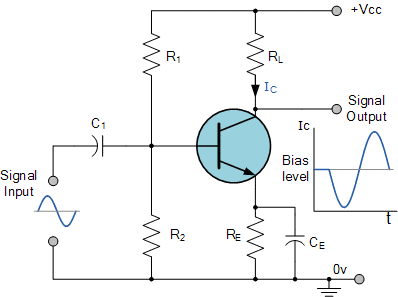
amp21.gif


Does this circuit provide current gain? I think it only provides voltage gain, but I could be wrong.
 

Attachments

  • amp21.gif
    amp21.gif
    7.5 KB · Views: 1,157
Engineering news on Phys.org
I can answer a couple of your questions. The preamp amplifies what is called a low level signal like a guitar pickup, turntable cartridge or microphone signal. These are typically very low like 3mV. The preamp amplifies the signal to line level and provides filtering, ie tone control. The power amplifier amplifies the signal from the preamp so it is "powerful" enough to operate the speaker and produce sound.

I don't know if you attached a schematic or not but I can't see it. There are 4 main types of power amplifier classes for audio.

Class A amplifier operates in push pull mode which means one transistor amplifies the positive cycle and the other transistor amplifies the negative cycle. The key here is a class A has both transistors active at all times so it's considered inefficient.

Class B amplifier has each transistor on only half the time. This helps with power efficiency but introduces something called crossover distortion when the signal switches from pos cycle to neg cycle.

Class AB tries to remedy this by keeping both transistor very close to being active to minimize crossover distortion but keep Class B efficiency.

Class D is bit more complicated and there are different types. Basically it uses pulse width modulation and relies on filtering to extract the audio signal.
 
Most likely this can only be answered by an "old timer". I am making measurements on an uA709 op amp (metal can). I would like to calculate the frequency rolloff curves (I can measure them). I assume the compensation is via the miller effect. To do the calculations I would need to know the gain of the transistors and the effective resistance seen at the compensation terminals, not including the values I put there. Anyone know those values?

Similar threads

Replies
6
Views
4K
  • · Replies 3 ·
Replies
3
Views
2K
  • · Replies 8 ·
Replies
8
Views
2K
  • · Replies 40 ·
2
Replies
40
Views
3K
  • · Replies 6 ·
Replies
6
Views
5K
  • · Replies 22 ·
Replies
22
Views
2K
  • · Replies 3 ·
Replies
3
Views
3K
  • · Replies 1 ·
Replies
1
Views
1K
  • · Replies 16 ·
Replies
16
Views
2K
Replies
5
Views
3K