rosedog09
- 18
- 3
- Homework Statement
- A metal sphere with radius 1.20 cm is supported on an insulating stand at the center of a hollow, metal, spherical shell with radius rb = 9.40 cm. Charge +q is put on the inner sphere and charge −q on the outer spherical shell. The magnitude of q is chosen to make the potential difference between the spheres 400 V, with the inner sphere at higher potential.
- Relevant Equations
- V(sphere) = kq/r
deltaV = V2-V1
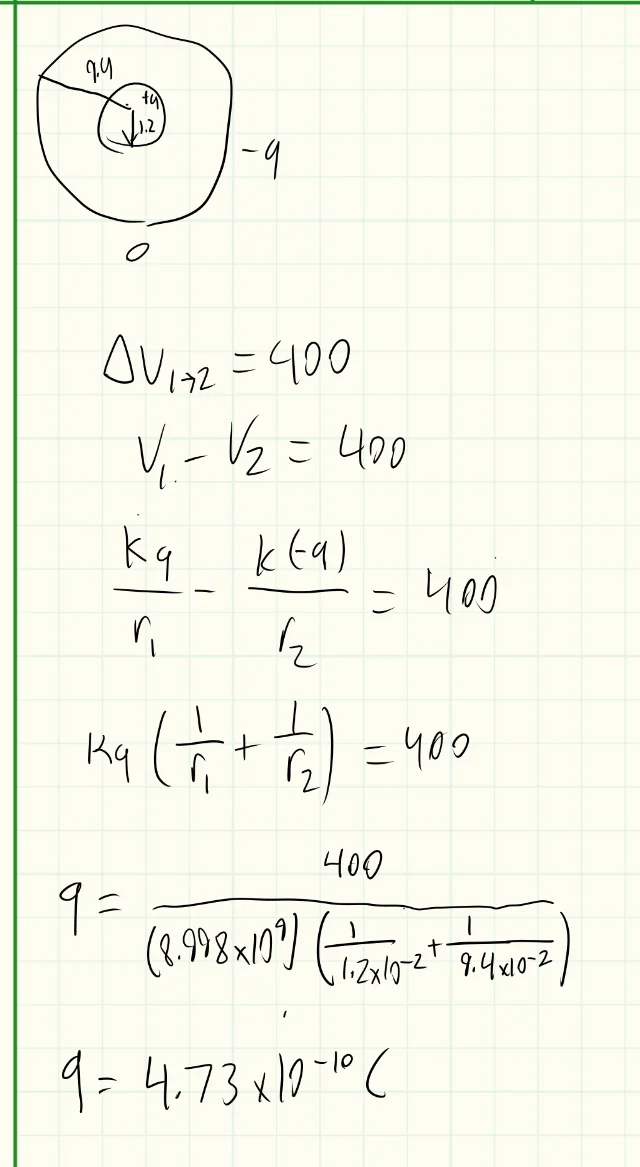
I have attached a copy of my work. I know that the voltage for a sphere (assuming a reference distance of infinity) is
V = kq/r
I also know that I am trying to find the charge given potential difference or voltage between the inner sphere (charge +q) and the other shell(charge -q), so I attempt the following equation:
deltaV = 400
V1 - V2 = 400
kq/(r1) - k(-q)/(r2) = 400
Rearranging for q gives:
kq(1/r1 + 1/r2) = 400
q = 400/(k(1/r1+1/r2))
Finally, I plug in the numbers and get the following
q = 400/(8.998*10^9(1/(1.2*10^-2)+1/(9.4*10^-2))) = 4.37*10^-10 C
I know this answer is incorrect, but i'm not sure where I went wrong. I believe I likely flipped a negative, but I have redone my math several times and can't see where. Any help is greatly appreciated.
V = kq/r
I also know that I am trying to find the charge given potential difference or voltage between the inner sphere (charge +q) and the other shell(charge -q), so I attempt the following equation:
deltaV = 400
V1 - V2 = 400
kq/(r1) - k(-q)/(r2) = 400
Rearranging for q gives:
kq(1/r1 + 1/r2) = 400
q = 400/(k(1/r1+1/r2))
Finally, I plug in the numbers and get the following
q = 400/(8.998*10^9(1/(1.2*10^-2)+1/(9.4*10^-2))) = 4.37*10^-10 C
I know this answer is incorrect, but i'm not sure where I went wrong. I believe I likely flipped a negative, but I have redone my math several times and can't see where. Any help is greatly appreciated.