Difference in Potential Between Charged Sphere and Surrounding Shell

  • Thread starter Thread starter rosedog09
  • Start date Start date
  • Tags Tags
    Elecrostatics
Join the discussion
Registration is free. Ask a follow-up in this thread, or start your own.
7 replies · 366 views
rosedog09
Messages
18
Reaction score
3
Homework Statement
A metal sphere with radius 1.20 cm is supported on an insulating stand at the center of a hollow, metal, spherical shell with radius rb = 9.40 cm. Charge +q is put on the inner sphere and charge −q on the outer spherical shell. The magnitude of q is chosen to make the potential difference between the spheres 400 V, with the inner sphere at higher potential.
Relevant Equations
V(sphere) = kq/r
deltaV = V2-V1
I have attached a copy of my work. I know that the voltage for a sphere (assuming a reference distance of infinity) is

V = kq/r

I also know that I am trying to find the charge given potential difference or voltage between the inner sphere (charge +q) and the other shell(charge -q), so I attempt the following equation:

deltaV = 400
V1 - V2 = 400
kq/(r1) - k(-q)/(r2) = 400

Rearranging for q gives:

kq(1/r1 + 1/r2) = 400

q = 400/(k(1/r1+1/r2))

Finally, I plug in the numbers and get the following

q = 400/(8.998*10^9(1/(1.2*10^-2)+1/(9.4*10^-2))) = 4.37*10^-10 C

I know this answer is incorrect, but i'm not sure where I went wrong. I believe I likely flipped a negative, but I have redone my math several times and can't see where. Any help is greatly appreciated.
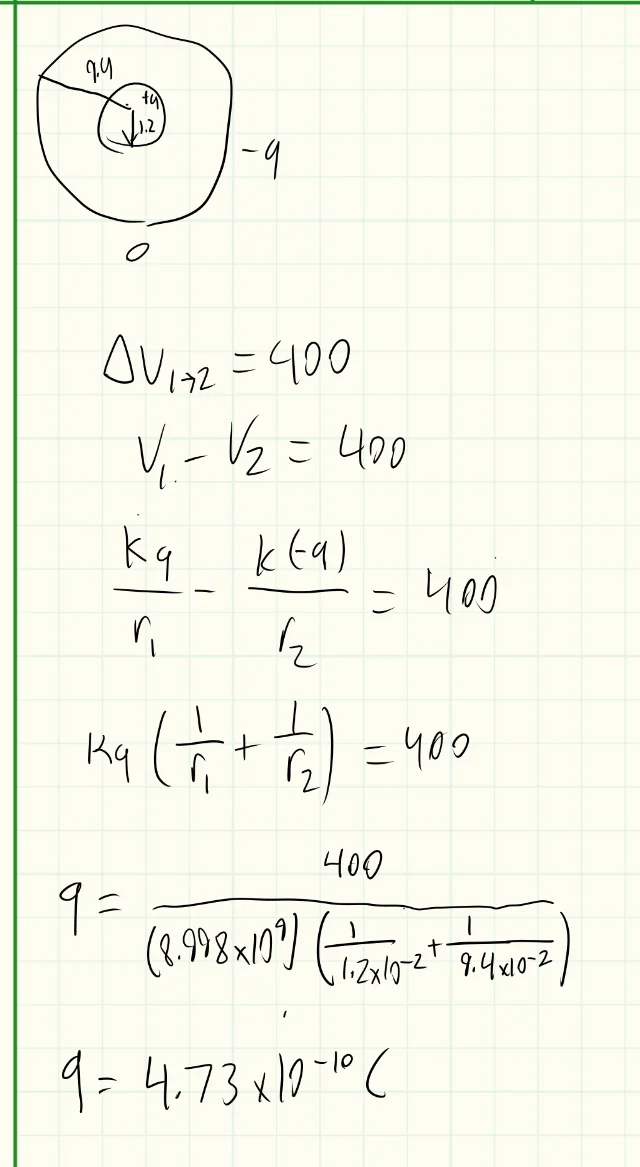
1789678781643.webp
 
Physics news on Phys.org
Did you realize you have a spherical capacitor? What you wrote down is the potential difference between two charged spheres separated in space by a distance much larger than either of their radii. That's not what you have here.
 
kuruman said:
Did you realize you have a spherical capacitor? What you wrote down is the potential difference between two charged spheres separated in space by a distance much larger than either of their radii. That's not what you have here.
Thinking about it now, I realize that....although we havent learned capacitors yet. It seems to me that the capacitor formula you provided is the exact same as mine except a negative is flipped somewhere. It even says "The voltage between the spheres can be found by integrating the electric field along a radial line" on the website you linked.

1789686387261.webp
 
If ##V_1-V_2=400## then ##V_2-V_1=-400##. That is likely where your sign got "flipped".

How do you know your answer is wrong?

How do you know you're supposed to be solving for the value of ##q##?
 
rosedog09 said:
Thinking about it now, I realize that....although we havent learned capacitors yet. It seems to me that the capacitor formula you provided is the exact same as mine except a negative is flipped somewhere. It even says "The voltage between the spheres can be found by integrating the electric field along a radial line" on the website you linked.

Does this look right to you? If you put the negative sign inside the parentheses, you must change the sign of both terms inside, not just one.

Screenshot 2026-09-17 at 7.09.16 PM.webp
 
  • Like
Likes   Reactions: Herman Trivilino and berkeman
kuruman said:
Does this look right to you? If you put the negative sign inside the parentheses, you must change the sign of both terms inside, not just one.

View attachment 374207
You are correct, that was a silly oversight. However, the more I think about it, the more I get confused. If the two spheres have different charges (q and -q), how can we use an integral that has only one q value. Additionally, I still don't see why my initial method did not work. The problem asks me the find the q which results in a difference of 400 volts between the surfaces of the two spheres. If I know the surface voltage of each sphere (assuming a reference distance of infinity) is

$$V_1 = kq_1/R_1$$

and

$$V_2 = kq_2/R_2$$


The shouldnt the potential difference (400V) just be

$$V_1 - V_2 = 400$$

I am not seeing where my logic falls apart and causes the flipped negative error.
 
rosedog09 said:
You are correct, that was a silly oversight. However, the more I think about it, the more I get confused. If the two spheres have different charges (q and -q), how can we use an integral that has only one q value. Additionally, I still don't see why my initial method did not work. The problem asks me the find the q which results in a difference of 400 volts between the surfaces of the two spheres. If I know the surface voltage of each sphere (assuming a reference distance of infinity) is

$V_1 = kq_1/R_1$

and

$V_2 = kq_2/R_2$


The shouldnt the potential difference (400V) just be

$V_1 - V_2 = 400$

I am not seeing where my logic falls apart and causes the flipped negative error.
Herman Trivilino said:
If ##V_1-V_2=400## then ##V_2-V_1=-400##. That is likely where your sign got "flipped".

How do you know your answer is wrong?

How do you know you're supposed to be solving for the value of ##q##?
I know i'm wrong because it is graded by a computer program and it told me I was wrong. Flipping the negative back gave the correct answer. I evidentially failed to properly copy the question, but it asks for q.
 
rosedog09 said:
If the two spheres have different charges (q and -q), how can we use an integral that has only one q value.
Think Gauss's Law.

Only the enclosed charge counts. If you draw a Gaussian concentric sphere of radius ##r##, (##r_a<r<r_b##), that encloses the inner sphere only, then the electric field in the in-between-region will be $$\mathbf E= \frac{kq}{r^2}\mathbf{\hat r}$$ regardless of whether the outer sphere has net positive, negative or zero charge. Thus, you can just do the integral $$V_2-V_1=-\int_{r_1}^{r_2} \mathbf E\cdot d\mathbf r.$$FAQ
Why can I ignore the charge placed on the outer shell?
Answer: Because the inner surface of the outer shell always carries total surface charge ##-q##, i.e. opposite to what is placed on the inner sphere, no matter how much charge and of what sign you place on it.

And why is that?
Answer: Because if I construct a concentric Gaussian sphere inside the conducting "meat" of the outer shell, the electric field everywhere on it must be zero. By Gauss Law, the total enclosed charge must also be zero. I already know that the inner sphere carries charge ##+q##, therefore the inner surface must have total charge ##-q## to bring the total enclosed charge to zero.

Three practice exercises
1. Suppose I put total charge ##+2q## on the inner sphere and total charge ##+5q## on the outer shell. How much total charge will be
(a) On the surface of the inner sphere
(b) On the inner surface of the shell
(c) On the outer surface of the shell

2. The outer shell in Exercise 1 is now connected to the ground. This specifies that its electrostatic potential is zero. What quantities will change?
(a) The potential difference between sphere and shell only.
(b) The total charge on the shell only.
(c) Both the potential difference between sphere and shell and the total charge on the shell.

3. In Exercise 2, when the shell is grounded, does negative charge flow to or from the Earth? How much?

If you can answer these correctly, you will have a good grasp of this problem.

(Edited for typos)
 
Last edited: