padawan
- 1
- 0
I am working on this
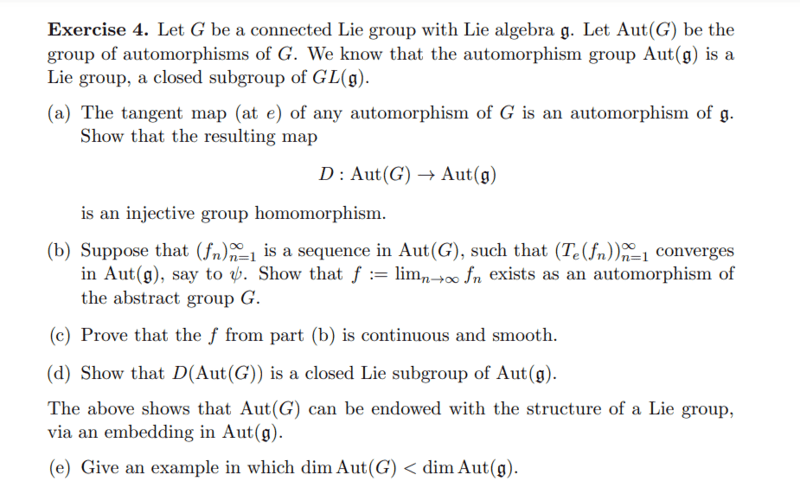
I am having trouble with b and c:
b) Suppose ##(f_n)_{n=1}^{\infty}## is a sequence in ##Aut(G)##, such that ##(T_e(f_n))_{n=1}^{\infty} \to \psi## converges in ##Aut(\mathfrak g)##
I want to show that ## f := \lim_{n\to \infty} f_n## exists as an continuous automorphism of the abstract group ##G##
First of all the ##f_n## are smooth, because they are in Aut(G), so they are Lie group isomorphisms, and therefore smooth by definition
Then by a known property of the exp:
##f_n(\exp(X))=\exp(T_ef_n X), \forall X \in T_eG## taking the limit yields:
##\lim_{n\to \infty} f_n(\exp(X))=\exp(\psi(X))\in G, \forall X \in T_eG##
##\lim_{n\to \infty} f_n(g)=\exp(\psi(X))=:f(g)\in G, \forall g## in a nbhd of the identity
I know that the image of the exponential map generates the connected component of the identity ##G_e##,and by connectedness this coincides with G so:
##G=G_e=<(T_eG)>=<\exp(\psi(T_eG))>=<\exp(T_eG)>##
This means that convergence is actually valid in the whole group, because if I have convergence in the generating set, I must have convergence in the generated set.
I hope this is correct,if not please tell me. Still I have to prove that it is bijective and a group homomorphism. I am not sure how to do this
b) How do I argue from here that ##f## is continuous? First I thought it was automatic, but then I recalled from analysis that pointwise convergence of a sequence of functions does not imply continuity. So I am clueless about how to proceed here as well
I am having trouble with b and c:
b) Suppose ##(f_n)_{n=1}^{\infty}## is a sequence in ##Aut(G)##, such that ##(T_e(f_n))_{n=1}^{\infty} \to \psi## converges in ##Aut(\mathfrak g)##
I want to show that ## f := \lim_{n\to \infty} f_n## exists as an continuous automorphism of the abstract group ##G##
First of all the ##f_n## are smooth, because they are in Aut(G), so they are Lie group isomorphisms, and therefore smooth by definition
Then by a known property of the exp:
##f_n(\exp(X))=\exp(T_ef_n X), \forall X \in T_eG## taking the limit yields:
##\lim_{n\to \infty} f_n(\exp(X))=\exp(\psi(X))\in G, \forall X \in T_eG##
##\lim_{n\to \infty} f_n(g)=\exp(\psi(X))=:f(g)\in G, \forall g## in a nbhd of the identity
I know that the image of the exponential map generates the connected component of the identity ##G_e##,and by connectedness this coincides with G so:
##G=G_e=<(T_eG)>=<\exp(\psi(T_eG))>=<\exp(T_eG)>##
This means that convergence is actually valid in the whole group, because if I have convergence in the generating set, I must have convergence in the generated set.
I hope this is correct,if not please tell me. Still I have to prove that it is bijective and a group homomorphism. I am not sure how to do this
b) How do I argue from here that ##f## is continuous? First I thought it was automatic, but then I recalled from analysis that pointwise convergence of a sequence of functions does not imply continuity. So I am clueless about how to proceed here as well
Last edited by a moderator: