Difficulties with derivative of a vector [Landau Textbook]

Click For Summary

Discussion Overview

The discussion revolves around the computation of the derivative of a vector function as presented in a specific section of the Landau textbook. Participants explore the spatial and temporal dependencies of the function, as well as the mathematical manipulations required to derive certain expressions. The focus is primarily on the mathematical reasoning and technical details involved in these derivatives.

Discussion Character

  • Technical explanation
  • Mathematical reasoning
  • Exploratory

Main Points Raised

  • One participant describes the need to compute the derivative of a function with respect to time and coordinates, noting the spatial dependence on the vector ##\mathbf{r}## and time dependence on the source positions ##\mathbf{r}_a##.
  • Another participant provides detailed calculations for the spatial derivative and the time derivative of the distance between the vectors, leading to expressions involving velocities and unit vectors.
  • It is proposed that if ##f = -(k/2) \sum_a m_a |\mathbf{r} - \mathbf{r}_a|##, then the second derivative can be expressed in terms of the velocities and distances between the vectors.
  • A later reply clarifies the notation used for ##n_{a \alpha}##, explaining it as the component of the unit vector rather than its modulus, and acknowledges the potential confusion in the notation used by the authors.

Areas of Agreement / Disagreement

Participants generally agree on the mathematical manipulations and interpretations presented, but there is a point of clarification regarding the notation used for the unit vector components. No consensus is reached on the broader implications of the calculations.

Contextual Notes

The discussion includes complex mathematical expressions and relies on specific definitions and notations from the Landau textbook, which may not be universally understood without further context.

GrimGuy
Messages
11
Reaction score
2
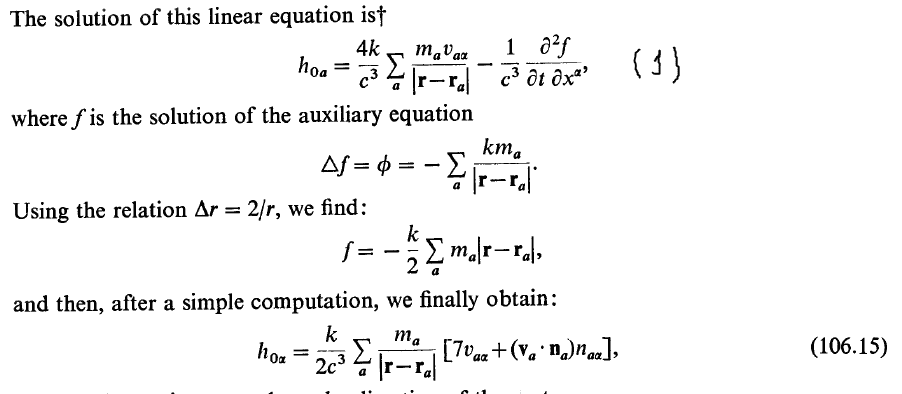
Hi guys, I'm having trouble computing a pass 1 to 106.15. It's in the pictures.

1618494074718.png


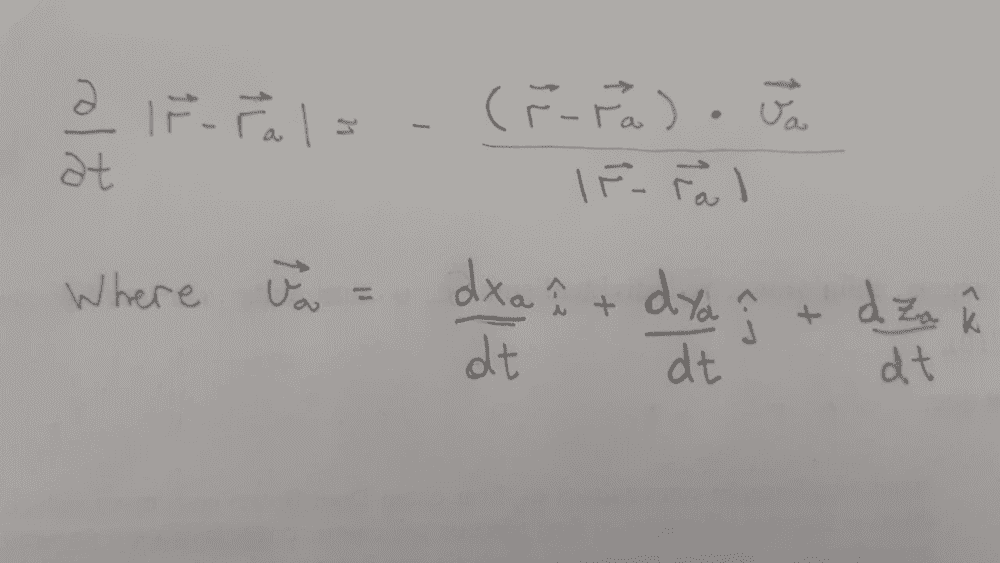
So, what a have to do is the derivative of ##f## with respect to time and coordinates. Then I need to rearrange the terms to find the equation 106.15. I am using the following conditions. ##r## vector varies in space and the vector ##r_a## varies in time.

I did that:
1618494870010.png


This calculus is from. (Section 106)
1618494426971.png
 

Attachments

  • 1618494413115.png
    1618494413115.png
    89.1 KB · Views: 194
  • Like
Likes   Reactions: Delta2
Physics news on Phys.org
The spatial dependence of ##f## is in the argument ##\mathbf{r}##, whilst the time dependence is in the source positions ##\mathbf{r}_a##\begin{align*}
\partial_{\alpha} |\mathbf{r} - \mathbf{r}_a| &= \frac{x_{\alpha} - x_{a \alpha}}{|\mathbf{r} - \mathbf{r}_a|} = n_{a \alpha}

\end{align*}Then taking the time derivative\begin{align*}
\partial_t \partial_{\alpha} |\mathbf{r} - \mathbf{r}_a| = \partial_t \left( \frac{x_{\alpha} - x_{a \alpha}}{|\mathbf{r} - \mathbf{r}_a|} \right) &= \frac{-v_{a \alpha}}{|\mathbf{r} - \mathbf{r}_a|} + (x_{\alpha} - x_{a \alpha}) \partial_t \left( \frac{1}{|\mathbf{r} - \mathbf{r}_a|} \right) \\

&= \frac{-v_{a \alpha}}{|\mathbf{r} - \mathbf{r}_a|} + \frac{-(x_{\alpha} - x_{a \alpha})}{|\mathbf{r} - \mathbf{r}_a|^2} \left( \frac{(\mathbf{r} - \mathbf{r}_a) \cdot (-\mathbf{v}_a )}{|\mathbf{r} - \mathbf{r}_a|} \right) \\

&= \frac{-v_{a \alpha}}{|\mathbf{r} - \mathbf{r}_a|} + \frac{n_{a \alpha} (\mathbf{n}_a \cdot \mathbf{v}_a)}{|\mathbf{r} - \mathbf{r}_a|}

\end{align*}Hence if ##f = -(k/2) \sum_a m_a |\mathbf{r} - \mathbf{r}_a |##, then\begin{align*}

\frac{\partial^2 f}{\partial t \partial x^a} &= \frac{k}{2} \sum_a m_a \left[ \frac{v_{a \alpha}}{|\mathbf{r} - \mathbf{r}_a|} - \frac{n_{a \alpha} (\mathbf{n}_a \cdot \mathbf{v}_a)}{|\mathbf{r} - \mathbf{r}_a|} \right]\end{align*}and consequently\begin{align*}
h_{0 \alpha} &= \frac{8k}{2c^3} \sum_a \frac{m_a v_{a\alpha}}{|\mathbf{r} - \mathbf{r}_a|} - \frac{k}{2c^3} \sum_a \left[ \frac{m_av_{a \alpha}}{|\mathbf{r} - \mathbf{r}_a|} - \frac{m_a n_{a \alpha} (\mathbf{n}_a \cdot \mathbf{v}_a)}{|\mathbf{r} - \mathbf{r}_a|} \right] \\

&= \frac{k}{2c^3} \sum_a \frac{m_a}{|\mathbf{r} - \mathbf{r}_a|} \left[ 7v_{a \alpha} + n_{a \alpha} (\mathbf{n}_a \cdot \mathbf{v}_a ) \right]\end{align*}
 
Last edited by a moderator:
  • Like
Likes   Reactions: GrimGuy
etotheipi said:
The spatial dependence of ##f## is in the argument ##\mathbf{r}##, whilst the time dependence is in the source positions ##\mathbf{r}_a##\begin{align*}
\partial_{\alpha} |\mathbf{r} - \mathbf{r}_a| &= \frac{x_{\alpha} - x_{a \alpha}}{|\mathbf{r} - \mathbf{r}_a|} = n_{a \alpha}

\end{align*}Then taking the time derivative\begin{align*}
\partial_t \partial_{\alpha} |\mathbf{r} - \mathbf{r}_a| = \partial_t \left( \frac{x_{\alpha} - x_{a \alpha}}{|\mathbf{r} - \mathbf{r}_a|} \right) &= \frac{-v_{a \alpha}}{|\mathbf{r} - \mathbf{r}_a|} + (x_{\alpha} - x_{a \alpha}) \partial_t \left( \frac{1}{|\mathbf{r} - \mathbf{r}_a|} \right) \\

&= \frac{-v_{a \alpha}}{|\mathbf{r} - \mathbf{r}_a|} + \frac{-(x_{\alpha} - x_{a \alpha})}{|\mathbf{r} - \mathbf{r}_a|^2} \left( \frac{(\mathbf{r} - \mathbf{r}_a) \cdot (-\mathbf{v}_a )}{|\mathbf{r} - \mathbf{r}_a|} \right) \\

&= \frac{-v_{a \alpha}}{|\mathbf{r} - \mathbf{r}_a|} + \frac{n_{a \alpha} (\mathbf{n}_a \cdot \mathbf{v}_a)}{|\mathbf{r} - \mathbf{r}_a|}

\end{align*}Hence if ##f = -(k/2) \sum_a m_a |\mathbf{r} - \mathbf{r}_a |##, then\begin{align*}

\frac{\partial^2 f}{\partial t \partial x^a} &= \frac{k}{2} \sum_a m_a \left[ \frac{v_{a \alpha}}{|\mathbf{r} - \mathbf{r}_a|} - \frac{n_{a \alpha} (\mathbf{n}_a \cdot \mathbf{v}_a)}{|\mathbf{r} - \mathbf{r}_a|} \right]\end{align*}and consequently\begin{align*}
h_{0 \alpha} &= \frac{8k}{2c^3} \sum_a \frac{m_a v_{a\alpha}}{|\mathbf{r} - \mathbf{r}_a|} - \frac{k}{2c^3} \sum_a \left[ \frac{m_av_{a \alpha}}{|\mathbf{r} - \mathbf{r}_a|} - \frac{m_a n_{a \alpha} (\mathbf{n}_a \cdot \mathbf{v}_a)}{|\mathbf{r} - \mathbf{r}_a|} \right] \\

&= \frac{k}{2c^3} \sum_a \frac{m_a}{|\mathbf{r} - \mathbf{r}_a|} \left[ 7v_{a \alpha} + n_{a \alpha} (\mathbf{n}_a \cdot \mathbf{v}_a ) \right]\end{align*}
Thx man, I'll take a time to understand and check it. Thank you a lot.

EDIT: I checked it and everything is fine and i could undestand the whole explanation, except for one little thing. What u were considering to write it '##n_{a \alpha}##'. It is the modul of the unit vector, or it is just a simplifyed notation to write ##\frac{x_{\alpha} - x_{a \alpha}}{|\mathbf{r} - \mathbf{r}_a|}## ?
 
Last edited:
  • Like
Likes   Reactions: etotheipi
GrimGuy said:
EDIT: I checked it and everything is fine and i could undestand the whole explanation, except for one little thing. What u were considering to write it '##n_{a \alpha}##'. It is the modul of the unit vector, or it is just a simplifyed notation to write ##\frac{x_{\alpha} - x_{a \alpha}}{|\mathbf{r} - \mathbf{r}_a|}## ?
Not the modulus, it's the second option: the ##\alpha## component of the vector ##\mathbf{n}_a := (\mathbf{r} - \mathbf{r}_a)/|\mathbf{r} - \mathbf{r}_a|##, as L&L define below the bit you posted. So ##n_{a \alpha} := (\mathbf{r} - \mathbf{r}_a)_{\alpha}/|\mathbf{r} - \mathbf{r}_a| = (x_{\alpha} - x_{a \alpha})/|\mathbf{r} - \mathbf{r}_a|##

I'll admit it's a slightly confusing notation on the authors' part, using ##a## to enumerate the different sources and ##\alpha## to denote vector components 😜
 
  • Like
Likes   Reactions: GrimGuy

Similar threads

  • · Replies 2 ·
Replies
2
Views
4K
  • · Replies 1 ·
Replies
1
Views
3K
  • · Replies 6 ·
Replies
6
Views
2K
  • · Replies 2 ·
Replies
2
Views
2K
Replies
6
Views
1K
  • · Replies 1 ·
Replies
1
Views
3K
  • · Replies 19 ·
Replies
19
Views
4K
  • · Replies 16 ·
Replies
16
Views
6K
  • · Replies 3 ·
Replies
3
Views
3K
Replies
3
Views
2K