Difficulty extracting fluid from balloon via syringe

Click For Summary

Discussion Overview

The discussion revolves around the challenges faced when extracting fluid from a balloon using a syringe and catheter setup. Participants explore potential causes for resistance encountered during fluid extraction, including the design of the catheter, air pressure issues, and the physical properties of the fluid involved.

Discussion Character

  • Exploratory
  • Technical explanation
  • Debate/contested

Main Points Raised

  • One participant describes a setup involving a syringe, infusion pump, pressure transducer, and catheter for fluid extraction from a balloon, noting resistance during extraction.
  • Concerns are raised about the flared catheter tip potentially causing issues during fluid extraction.
  • Another participant suggests that the method of creating the flare might lead to resistance, proposing alternatives to the flaring technique.
  • Some participants speculate that air pressure equilibration during the transfer from infusion to extraction could be a contributing factor to the resistance.
  • Discussion includes the possibility of using a Y-adapter to streamline the process and avoid disconnecting the syringe during the transfer.
  • One participant questions whether the fluid could become more viscous or develop clumps that might block the catheter during extraction.

Areas of Agreement / Disagreement

Participants express multiple competing views regarding the cause of the resistance during fluid extraction, with no consensus reached on a definitive solution or explanation.

Contextual Notes

Participants note that the catheter's flared end is patent and not obstructed, but the discussion remains open regarding the effects of ambient air and potential blockages during the extraction process.

Who May Find This Useful

This discussion may be of interest to individuals involved in experimental fluid dynamics, biomedical engineering, or material compliance testing, particularly those working with catheter systems and fluid extraction methods.

blah2222
Messages
4
Reaction score
0
Hello,

New to the forum, so apologies if this is not the correct sub-category.

I am testing compliances of materials by filling balloons with different fluids. I do this by filling up a 30 mL syringe with fluid and placing it into an infusion pump set to infuse at a rate of 0.1 mL/min. The syringe is attached to a serial pressure transducer which is then attached to a 23 gauge needle inserted into a PE-50 catheter (350 mm long). The free end of the catheter is then implanted into the balloon. To secure the implantation, the end of the catheter is flared with a lighter to make a small lip, then it is placed into the balloon via a small hole and sealed using a purse-string suture.

Following infusion I disconnect the catheter from the transducer and attach it to a 1 mL syringe and recollect the fluid.

One thing that I noticed is that in a lot of cases I cannot extract the fluid and there is resistance while pulling the 1 mL syringe. I have checked that the end of the catheter is in the middle of the balloon and not sucking the wall of the balloon. I can understand that if the balloon is being emptied, the catheter tip might not be in the remaining fluid, but I see this issue when the balloon is full.

I was curious to see if others might know what be happening and possible solutions to get around this issue.

What I can think of:
- flared catheter tip opening causing issues
- air?
- length of catheter
- equilibration of air pressure when transferring to 1 mL syringe?

Attached a pic of setup (green rectangle is pressure transducer):
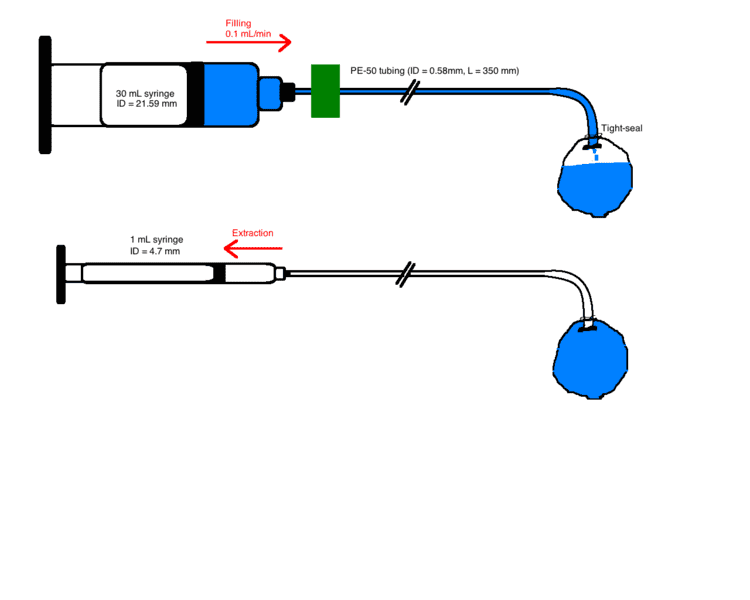
balloon_syringe.png


Any help is much appreciated!
 
Last edited:
Physics news on Phys.org
blah2222 said:
Hello,

New to the forum, so apologies if this is not the correct sub-category.

I am testing compliances of materials by filling balloons with different fluids. I do this by filling up a 30 mL syringe with fluid and placing it into an infusion pump set to infuse at a rate of 0.1 mL/min. The syringe is attached to a serial pressure transducer which is then attached to a 23 gauge needle inserted into a PE-50 catheter (350 mm long). The free end of the catheter is then implanted into the balloon. To secure the implantation, the end of the catheter is flared with a lighter to make a small lip, then it is placed into the balloon via a small hole and sealed using a purse-string suture.

Following infusion I disconnect the catheter from the transducer and attach it to a 1 mL syringe and recollect the fluid.

One thing that I noticed is that in a lot of cases I cannot extract the fluid and there is resistance while pulling the 1 mL syringe. I have checked that the end of the catheter is in the middle of the balloon and not sucking the wall of the balloon. I can understand that if the balloon is being emptied, the catheter tip might not be in the remaining fluid, but I see this issue when the balloon is full.

I was curious to see if others might know what be happening and possible solutions to get around this issue.

What I can think of:
- flared catheter tip opening causing issues
- air?
- length of catheter
- equilibration of air pressure when transferring to 1 mL syringe?

Attached a pic of setup (green rectangle is pressure transducer):
View attachment 203701

Any help is much appreciated!
Welcome to the PF.

I'm guessing there is an issue with the flare that you are making by hand with the lighter. Something that would let you still fill through it, but would resist suction back through the tubing.

Have you inspected the flange after you had problems with it? If you cut the flange off, does it work then? Maybe you can come up with a different way to do the flange that doesn't involve melting the tubing -- maybe some sort of attachment you place on the end of the tubing instead?
 
Hi berkeman, thank you for the reply and suggestions.

I was thinking of making an adapter, but it is a pretty small catheter that I am using and I cannot changing the size of it.

The flared end of the tube is patent and not obstructed. It is usually the first try or so of the extraction that doesn't work but after moving the catheter around inside the balloon and wiggling it, I can eventually start the extraction.

Somehow I feel as though the issue is pressure related w.r.t. ambient air getting into the catheter when I am transferring between the infusion and extraction periods.
 
blah2222 said:
Hi berkeman, thank you for the reply and suggestions.

I was thinking of making an adapter, but it is a pretty small catheter that I am using and I cannot changing the size of it.

The flared end of the tube is patent and not obstructed. It is usually the first try or so of the extraction that doesn't work but after moving the catheter around inside the balloon and wiggling it, I can eventually start the extraction.

Somehow I feel as though the issue is pressure related w.r.t. ambient air getting into the catheter when I am transferring between the infusion and extraction periods.
Can you do it a slightly different way? Use a Y-adapter near the balloon so you don't need to disconnect the first syringe to connect the second one? Are you using screw-on adapters for the syringes and tubing now, or just attaching the syringe to the tubing by forcing it into the tubing opening?

Like the Y-adapter near the end of this multi-port system (note the screw-on adapters):

http://cdnll.sharn.com/images/xxl/codan-anesthesia-iv-extension-sets.jpg
codan-anesthesia-iv-extension-sets.jpg
 
That is an interesting idea. I might give this a try.

All connections are Luer-lock type.
 
blah2222 said:
To secure the implantation, the end of the catheter is flared with a lighter to make a small lip, then it is placed into the balloon via a small hole and sealed using a purse-string suture.
blah2222 said:
The flared end of the tube is patent and not obstructed. It is usually the first try or so of the extraction that doesn't work but after moving the catheter around inside the balloon and wiggling it, I can eventually start the extraction.
Are you collapsing the wall of the catheter by this technique?
 
Nope. Catheter is in good shape. I think it may be air getting into the catheter before extracting.
 
blah2222 said:
Nope. Catheter is in good shape. I think it may be air getting into the catheter before extracting.
But air would not increase resistance (as stated in your OP), would it?. Since the balloon is compliant (I'm assuming, can't picture it any other way), it seems it would need to be a blockage of some sort. I thought the collapsing tubing was a good suggestion (it might collapse under vacuum, but allow flow under pressure), but you say that was eliminated as a cause. Any other component that might collapse like that?

Any chance the fluid becomes more viscous, or develops 'clumps' after filling that might block the tube? I like the idea of a 'Tee' so you don't need to change anything to go from filling to drawing.
 

Similar threads

  • · Replies 7 ·
Replies
7
Views
3K
  • · Replies 5 ·
Replies
5
Views
17K
Replies
2
Views
4K
Replies
2
Views
3K
  • · Replies 4 ·
Replies
4
Views
3K