Difficulty understanding the reasoning behind constraint equations in

griffith
Messages
10
Reaction score
0
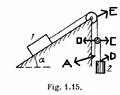
I’m not looking for the final equations themselves, but rather an explanation of the physical and geometric ideas used to construct constraint equations in systems involving strings and pulleys. How should one think about these constraints in a systematic way?
 

Attachments

  • fahhh.webp
    fahhh.webp
    10.3 KB · Views: 1
  • fah.webp
    fah.webp
    10.5 KB · Views: 1
Physics news on Phys.org
:welcome:

Physical constraints are usually based on a physical understanding of the problem. In general, we have to figure out how to apply Newton's laws to any given problem. In this case, the block is constrained to move up and down the ramp; and, the length of the string joining the block to the hanging weight must be constant.

If you ask how I know that, then it's not easy to explain.
 
A mechanical system consists of rigid bodies and particles. Sometimes we a priori know something about motion of some components of the system. For example a pendulum can only rotate or a particle can only slide along the inclined plane. These restrictions are called constraints. In more complicated systems the restrictions are imposed not only on positions of the parts of the system but on their velocities as well.
 
wrobel said:
A mechanical system consists of rigid bodies and particles. Sometimes we a priori know something about motion of some components of the system. For example a pendulum can only rotate or a particle can only slide along the inclined plane. These restrictions are called constraints. In more complicated systems the restrictions are imposed not only on positions of the parts of the system but on their velocities as well.

PeroK said:
:welcome:

Physical constraints are usually based on a physical understanding of the problem. In general, we have to figure out how to apply Newton's laws to any given problem. In this case, the block is constrained to move up and down the ramp; and, the length of the string joining the block to the hanging weight must be constant.

If you ask how I know that, then it's not easy to explain.
Can u teach me how I can create an expression relating the accelerations of the masses 1 and 2 by double differentiating the length segment functions with respect to time? It took me 2 hours just to create an expression, and I would like to listen to how u think of solving these kinds of problems.
 
griffith said:
Can u teach me how I can create an expression relating the accelerations of the masses 1 and 2 by double differentiating the length segment functions with respect to time? It took me 2 hours just to create an expression, and I would like to listen to how u think of solving these kinds of problems.
You could post this under homework. I looked more closely and those diagrams and it's a little complicated. Three suggestions:

1) You need to figure out how many degrees of freedom the system has. The weight can move down (or up); the pulley can move down (or up); and, then weight can move up the ramp (or down).

2) Consider a small displacement from the starting position. If the weight moves down ##\Delta y_W## and the pulley moves down ##\Delta y_P##, then you can figure out how much the weight must have moved ##\Delta x##. Note I'm using ##x## for the direction up the slope.

3) Consider using conservation of energy, rather than forces and tensions.

Note that if you have an equation involving displacements ##y_W, y_P## and ##x##, then you can differentiate that equation with respect to time and get an equation for the velocities ##v_W, v_P## and ##v_x##. Velocities are what are needed for the energy equation.

Alternatively, you could differentiate again to get an equation in the accelerations and relate this to the forces and tensions involved. But, from experience, I'd say energy is the way to go for a problem like this.
 
PeroK said:
You could post this under homework. I looked more closely and those diagrams and it's a little complicated. Three suggestions:

1) You need to figure out how many degrees of freedom the system has. The weight can move down (or up); the pulley can move down (or up); and, then weight can move up the ramp (or down).

2) Consider a small displacement from the starting position. If the weight moves down ##\Delta y_W## and the pulley moves down ##\Delta y_P##, then you can figure out how much the weight must have moved ##\Delta x##. Note I'm using ##x## for the direction up the slope.

3) Consider using conservation of energy, rather than forces and tensions.

Note that if you have an equation involving displacements ##y_W, y_P## and ##x##, then you can differentiate that equation with respect to time and get an equation for the velocities ##v_W, v_P## and ##v_x##. Velocities are what are needed for the energy equation.

Alternatively, you could differentiate again to get an equation in the accelerations and relate this to the forces and tensions involved. But, from experience, I'd say energy is the way to go for a problem like this.
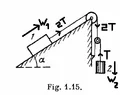
my bad it was given in the question that we were supposed to assume the mass 2 accelerating downwards. Yea, as u suggested (2), I followed that approach of taking small displacement, differentiating the function (once/twice) and I found that 2a1 = a2. Also thank you :)
 
griffith said:
my bad it was given in the question that we were supposed to assume the mass 2 accelerating downwards. Yea, as u suggested (2), I followed that approach of taking small displacement, differentiating the function (once/twice) and I found that 2a1 = a2. Also thank you :)
I guess you eventually need to express ##a_1## as a function of ##m_1, m_2, \alpha## and ##g##?
 
PeroK said:
I guess you eventually need to express ##a_1## as a function of ##m_1, m_2, \alpha## and ##g##?
yeah I had to.
 
PeroK said:
You could post this under homework. I looked more closely and those diagrams and it's a little complicated. Three suggestions:

1) You need to figure out how many degrees of freedom the system has. The weight can move down (or up); the pulley can move down (or up); and, then weight can move up the ramp (or down).

2) Consider a small displacement from the starting position. If the weight moves down ##\Delta y_W## and the pulley moves down ##\Delta y_P##, then you can figure out how much the weight must have moved ##\Delta x##. Note I'm using ##x## for the direction up the slope.

3) Consider using conservation of energy, rather than forces and tensions.

Note that if you have an equation involving displacements ##y_W, y_P## and ##x##, then you can differentiate that equation with respect to time and get an equation for the velocities ##v_W, v_P## and ##v_x##. Velocities are what are needed for the energy equation.

Alternatively, you could differentiate again to get an equation in the accelerations and relate this to the forces and tensions involved. But, from experience, I'd say energy is the way to go for a problem like this.

I have a few other problems I suffered , how do i post them under "Homework"?
 
  • #10
griffith said:
I have a few other problems I suffered , how do i post them under "Homework"?
There's an Introductory Physics Homework section. It has a template.
 
  • #11
PeroK said:
There's an Introductory Physics Homework section. It has a template.
oh, appreciate it kind sir
 
  • #12
griffith said:
oh, appreciate it kind sir
Actually, I'll ask that this thread is moved to homework. Just post your working on this thread.
 
  • #13
PeroK said:
Actually, I'll ask that this thread is moved to homework. Just post your working on this thread.
???
 

Similar threads

  • · Replies 2 ·
Replies
2
Views
8K
  • · Replies 16 ·
Replies
16
Views
3K
  • · Replies 3 ·
Replies
3
Views
2K
  • · Replies 5 ·
Replies
5
Views
3K
  • · Replies 22 ·
Replies
22
Views
3K
  • · Replies 3 ·
Replies
3
Views
3K
  • · Replies 8 ·
Replies
8
Views
3K
  • · Replies 60 ·
3
Replies
60
Views
6K
  • · Replies 4 ·
Replies
4
Views
9K
  • · Replies 9 ·
Replies
9
Views
2K