Diffraction using a circular aperture

Click For Summary

Homework Help Overview

The discussion revolves around a problem related to diffraction using a circular aperture, specifically involving the setup and interpretation of an Airy pattern. The original poster attempts to analyze the relationship between angles and distances in this context.

Discussion Character

  • Mixed

Approaches and Questions Raised

  • Participants discuss the original poster's sketch and assumptions regarding angles, with some questioning the realism of the proposed answer. There are suggestions to improve the diagram and clarify the relationships between distances and angles in the setup.

Discussion Status

There is ongoing dialogue about the accuracy of the original sketch and the assumptions made. Some participants provide constructive feedback on how to enhance the diagram and clarify the concepts involved, indicating a productive exchange of ideas.

Contextual Notes

Participants note the importance of accurately labeling diagrams and the implications of using sine versus tangent for small angles. There is also mention of the Rayleigh criterion and its relevance to the discussion.

Bolter
Messages
262
Reaction score
31
Homework Statement
See image below
Relevant Equations
dsin(theta) = 1.22 lambda
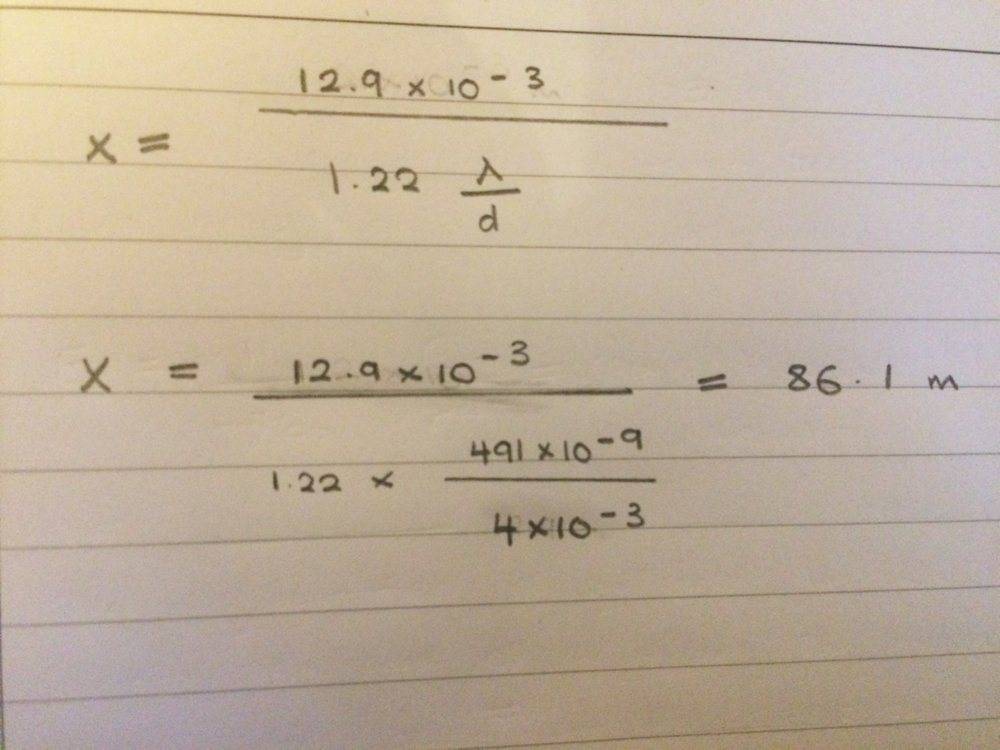
Here is the following question I have been trying to answer

Screenshot 2020-03-24 at 09.45.18.png

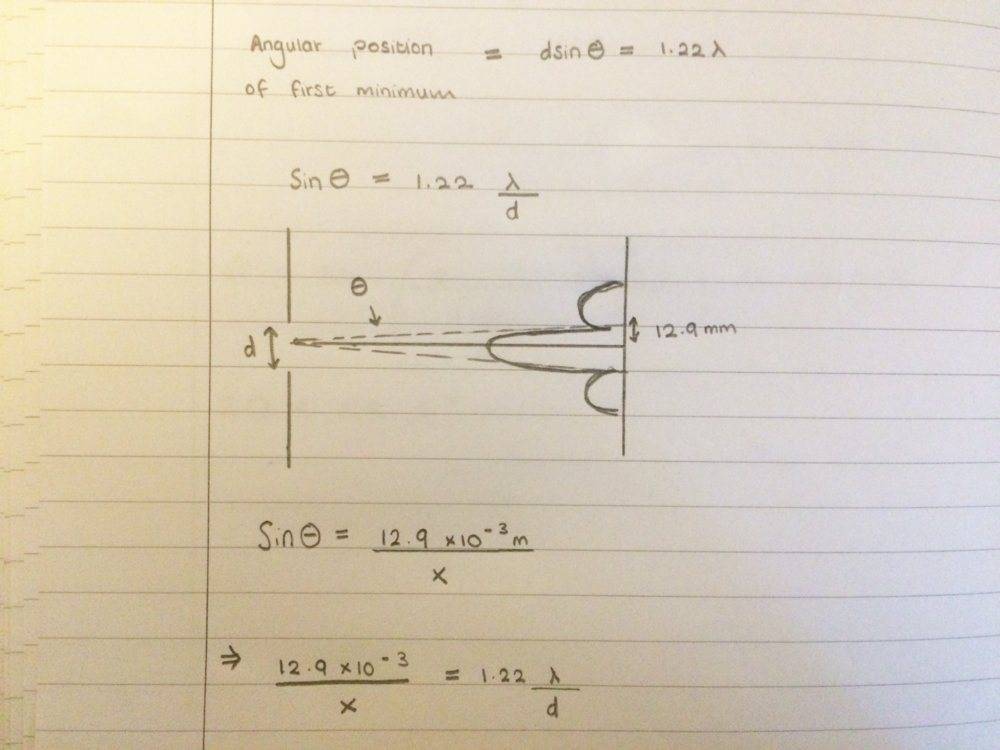
I have drawn a quick simple sketch of what I believe is happening in the set up.
Also because the angle that I am dealing with is very small, I made the assumption that sin(theta) = 12.9mm/X (where X in this case is the max distance I need from the observer)

Any help would be much appreciated! Thanks
IMG_4334.jpg


IMG_4335.jpg
 
Physics news on Phys.org
Bolter said:
Any help would be much appreciated!
Sure. What kind of help, except that we do your exercise :wink: ?

Do you think the answer is realistic ?
 
This is pretty much right except that diagram offends. Labeling the Airy pattern with the object distances looks terrible, and you don’t show x. Why not draw a diagram with two objects a distance 12.9mm apart a distance x from your pupil with a diameter d = 4.0 mm and continue through the pupil to a screen on the other side of the pupil on which you draw your Airy patterns and label your angle. It will be clear from the construction that the angle to the Airy minimum is the same as the angle on the other side.

One other quibble. It doesn’t matter for such small angles, but technically the object side should be tangent. Very technically the half angle should be the tangent with the half separation. On the other hand, with such a small angle thinking in arc and calling it sine is fairly defensible, and it won’t change the answer. Nevertheless, given the construction, tangent is more correct.
 
  • Like
Likes   Reactions: Bolter
Agree with Cutter. Unfortunately, nowadays a quick google permits a superficial look at the situation and devaluates the essence of a relevant sketch.
@Bolter: you did just fine, but do take cutter's advice !

Furthermore I am of the opinion that the Rayleigh criterion is to optimistic o0)
 
  • Like
Likes   Reactions: Bolter
Cutter Ketch said:
This is pretty much right except that diagram offends. Labeling the Airy pattern with the object distances looks terrible, and you don’t show x. Why not draw a diagram with two objects a distance 12.9mm apart a distance x from your pupil with a diameter d = 4.0 mm and continue through the pupil to a screen on the other side of the pupil on which you draw your Airy patterns and label your angle. It will be clear from the construction that the angle to the Airy minimum is the same as the angle on the other side.

One other quibble. It doesn’t matter for such small angles, but technically the object side should be tangent. Very technically the half angle should be the tangent with the half separation. On the other hand, with such a small angle thinking in arc and calling it sine is fairly defensible, and it won’t change the answer. Nevertheless, given the construction, tangent is more correct.

Thank you I can now see from what you have mentioned how flawed my sketch appears to be :rolleyes: but it makes sense now :)
 

Similar threads

  • · Replies 3 ·
Replies
3
Views
4K
  • · Replies 4 ·
Replies
4
Views
2K
  • · Replies 4 ·
Replies
4
Views
2K
Replies
1
Views
1K
  • · Replies 6 ·
Replies
6
Views
3K
  • · Replies 1 ·
Replies
1
Views
2K
  • · Replies 1 ·
Replies
1
Views
2K
  • · Replies 4 ·
Replies
4
Views
3K
  • · Replies 3 ·
Replies
3
Views
2K
  • · Replies 1 ·
Replies
1
Views
1K