Dimensions of a rectangular prism

Join the discussion
Ask a follow-up here, or get your own question answered by working scientists, mathematicians and engineers — people, not an autocomplete.
Real named experts · corrections over time · the nuance an AI answer skips
2 replies · 2K views
Madds
Messages
2
Reaction score
0
The volume of a rectangular prism can be represented by the polynomial
V(x)=2x^2+9x^2+4x-15
a. The depth of the tank is (x-1) feet. The length is 13 feet. Assume the length is the greatest dimension. Which linear factor represents the 13 ft?This is probably a really easy question but I am so confused reading it, I really need help on how to do these kinds of problems.
 
Mathematics news on Phys.org
Re: Help with an equation problem

I am assuming the volume is the cubic polynomial:

$$V(x)=2x^3+9x^2+4x-15$$

We are told the depth is $x-1$, so we know $1$ is a zero of the polynomial...so let's use synthetic division:

$$\begin{array}{c|rr}& 2 & 9 & 4 & -15 \\ 1 & & 2 & 11 & 15 \\ \hline & 2 & 11 & 15 & 0 \end{array}$$

So, we now know:

$$V(x)=(x-1)\left(2x^2+11x+15\right)$$

Now we need to factor the quadratic factor...

$$V(x)=(x-1)(2x+5)(x+3)$$

What value of $x$ makes the largest factor equal to 13?
 
Re: Help with an equation problem

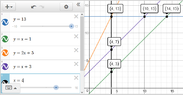
As a followup, we can determine which value of $x$ makes the largest factor 13 by looking at the following graph:

View attachment 7450

We can easily see that when $x=4$, the largest linear factor is $2x+5=13$. The dimensions of the tank are:

$$3\text{ ft}\times7\text{ ft}\times13\text{ ft}$$
 

Attachments

  • prismfactors.png
    prismfactors.png
    17.8 KB · Views: 132