Undergrad Dirac Delta using Fourier Transformation

Click For Summary
SUMMARY

The discussion focuses on the Dirac delta function and its representation using Fourier transformation. It establishes that the Dirac delta function, defined as $$\delta(x) = \infty$$ for $$x = 0$$ and $$0$$ otherwise, can be expressed as $$\delta(x) = \lim_{\Omega \rightarrow \infty} \frac{\sin{(\Omega x)}}{\pi x}$$. However, participants clarify that this limit does not exist for $$x \neq 0$$, and the rigorous definition of the Dirac delta function is essential for accurate interpretation. The conversation emphasizes the importance of understanding the Fourier transformation in relation to the delta function.

PREREQUISITES
  • Understanding of Fourier transformation principles
  • Familiarity with the Dirac delta function and its properties
  • Knowledge of limits and their behavior in mathematical analysis
  • Basic concepts of complex exponentials and integrals
NEXT STEPS
  • Study the rigorous definition of the Dirac delta function in mathematical analysis
  • Learn about the properties and applications of Fourier transforms in signal processing
  • Explore the concept of distributions and generalized functions
  • Investigate the implications of limits in the context of Fourier series and integrals
USEFUL FOR

Mathematicians, physicists, and engineering students interested in advanced calculus, signal processing, and the theoretical foundations of the Dirac delta function.

arpon
Messages
234
Reaction score
16
We know,
$$\delta(x) = \begin{cases}
\infty & \text{if } x = 0 \\
0 & \text{if } x \neq 0
\end{cases}$$
And, also,
$$\int_{-\infty}^{\infty}\delta(x)\,dx=1$$
Using Fourier Transformation, it can be shown that,
$$\delta(x)=\lim_{\Omega \rightarrow \infty}\frac{\sin{(\Omega x)}}{\pi x}$$
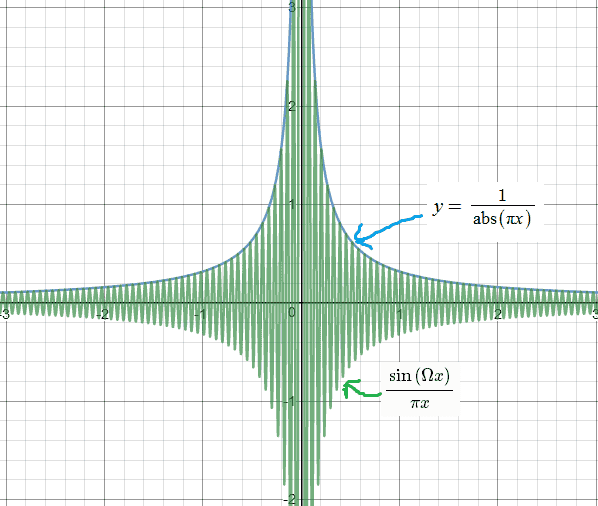
Let's look at the graph of ##y=\frac{\sin{(\Omega x)}}{\pi x}##, for large ##\Omega##.
Untitled.png


So, from this graph, it seems,
$$\lim_{\Omega \rightarrow \infty}\frac{\sin{(\Omega x)}}{\pi x}\neq 0 \text{ , for } x\neq 0 $$

But, this is actually the Fourier transformation of the function,
$$f(t)=1=\exp{(i\cdot 0\cdot t)}$$

So, intution tells me that the frequency spectrum of ##f(t)## should have infinite amplitude at ##x=0## and ##0## amplitude otherwise, just like the Dirac-delta function.

Now, how can I show that,
$$\lim_{\Omega \rightarrow \infty}\frac{\sin{(\Omega x)}}{\pi x} = 0 \text{ when, } x\neq 0$$
 
Last edited:
Mathematics news on Phys.org
The rigorous definition of dirac delta function is not the one you write at the beginning of your post. Even if we accept that definition (because intuitively that's what the dirac delta is) then I don't know how you come up with ##\delta(x)=\lim_{\Omega \rightarrow \infty} \frac{sin(\Omega x)}{\pi x}## cause that limit simply does NOT exist. (it does not exist for ##x\neq 0##, if we first take the limit x->0 then it exists and is infinite).
 
Last edited:
Delta² said:
The rigorous definition of dirac delta function is not the one you write at the beginning of your post. Even if we accept that definition (because intuitively that's what the dirac delta is) then I don't know how you come up with ##\delta(x)=\lim_{\Omega \rightarrow \infty} \frac{sin(\Omega x)}{\pi x}## cause that limit simply does NOT exist. (it does not exist for ##x\neq 0##, if we first take the limit x->0 then it exists and is infinite).

Using Fourier transformation, we have,
AS.PNG


Comparing with the equation,
$$f(t)=\int_{-\infty}^{\infty}\delta(t-u)f(u)\,du$$
we have,
ASS.PNG


Thus,
$$\begin{align}
\delta(t)&=\frac{1}{2\pi}\int_{-\infty}^{\infty}e^{i\omega t}\,d\omega\\
&=\frac{1}{2\pi}\lim_{\Omega\rightarrow \infty}\left[\frac{e^{i\omega t}}{i\omega t}\right]^{\Omega}_{\omega=-\Omega}\\
&=\lim_{\Omega \rightarrow \infty}\frac{\sin{(\Omega t)}}{\pi t}
\end{align}$$

Reference:
Mathematical Methods for Physics and Engineering: A Comprehensive Guide, 3rd Edition by K. F. Riley, M. P. Hobson, S. J. Bence, Page/442
 
The last two equalities would hold only if the limit ##\frac{1}{2\pi}\lim_{\Omega\rightarrow \infty}\left[\frac{e^{i\omega t}}{it}\right]^{\Omega}_{\omega=-\Omega}=
\lim_{\Omega \rightarrow \infty}\frac{\sin{(\Omega t)}}{\pi t}

## existed but it does not exist, as you can easily prove for any x<>0 the limit ##\lim_{\Omega \rightarrow \infty}\sin{(\Omega x)}## does not exist.
 
Last edited:

Similar threads

  • · Replies 11 ·
Replies
11
Views
2K
  • · Replies 2 ·
Replies
2
Views
2K
  • · Replies 2 ·
Replies
2
Views
3K
  • · Replies 12 ·
Replies
12
Views
2K
  • · Replies 3 ·
Replies
3
Views
3K
Replies
1
Views
2K
  • · Replies 3 ·
Replies
3
Views
28K
  • · Replies 2 ·
Replies
2
Views
2K
  • · Replies 5 ·
Replies
5
Views
4K
  • · Replies 2 ·
Replies
2
Views
3K