Direct Modulation and Photon Lifetime - Laser

Click For Summary
SUMMARY

The discussion centers on the concept of direct modulation in semiconductor lasers, specifically addressing the relationship between modulation frequency and photon lifetime. It is established that the fundamental limit for modulation frequency is indeed the inverse of the photon lifetime (τ_ph). Participants clarify that while the turn-on delay is significant, the photon must also have sufficient time to escape the laser cavity to maintain coherent light output. The conversation emphasizes the importance of understanding the rate equations governing population inversion and stimulated emission in laser operation.

PREREQUISITES
  • Understanding of semiconductor laser physics
  • Familiarity with photon lifetime (τ_ph) and its implications
  • Knowledge of population inversion and stimulated emission
  • Basic grasp of laser rate equations
NEXT STEPS
  • Research the mathematical derivation of laser rate equations
  • Study the effects of photon lifetime on laser performance
  • Explore the concept of population inversion in detail
  • Examine the principles of direct modulation in semiconductor lasers
USEFUL FOR

Laser physicists, electrical engineers, and researchers in photonics who are looking to deepen their understanding of modulation techniques and photon dynamics in semiconductor lasers.

ulver48
Hello,

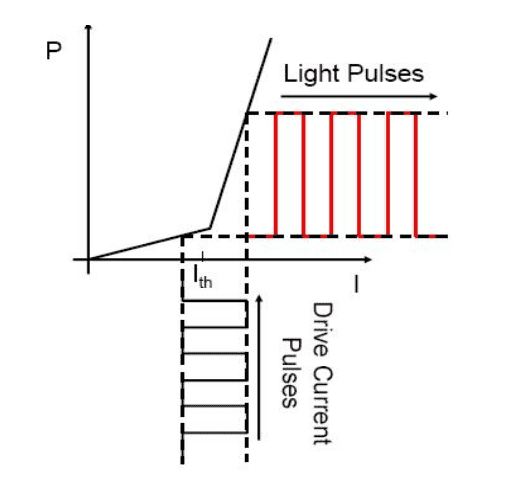
There is a thing I struggle to understand on laser physics. There is a modulation method called direct modulation for semiconductor lasers where by changing the current we modulate the light which is emitted form the laser cavity. There is a picture below
QSsKtWb.png


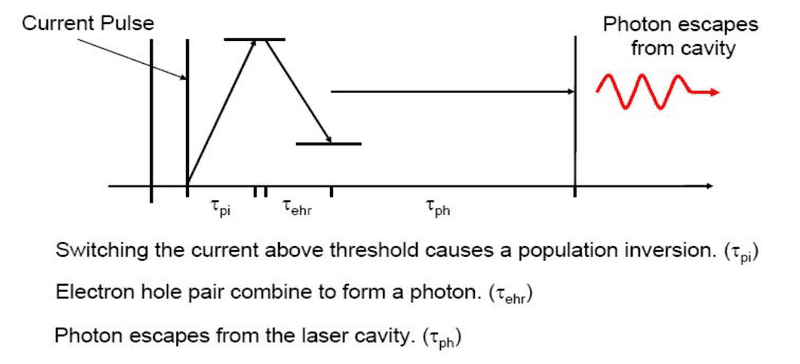
It is stated in bibliography that the fundamental limit as far as the modulation frequency is concerned is the inverse of the photon lifetime. This is shown in the following picture. Can someone explain to me why tph is the fundamental limit? Thank you for your time.
9r8Gle1.png
 

Attachments

  • QSsKtWb.png
    QSsKtWb.png
    14.4 KB · Views: 1,473
  • 9r8Gle1.png
    9r8Gle1.png
    22.4 KB · Views: 1,065
Science news on Phys.org
If you cut off the power "instantly", you still have the population inversion - the laser will continue to emit photons until most atoms are in the ground state again. The time is related to the photon lifetime.
If you switch on the power "instantly", you first have to excite enough atoms to reach population inversion before the laser starts working. Typically the time constant here will be similar.
 
So you can't understand this concept just by imagining that the photon is a particle bouncing back and forth in the laser cavity until it abandons it. You take the rate equations of the laser and you find the time needed for the population inversion to happen in order for the stimulated emission rate to be higher than the absorption rate. So if you modulate the laser so as to create population inversion and then you cut off the current immediately, you will see a small portion of coherent light coming out of the laser cavity and then immediately absorption and spontaneous emissions will become greater than the stimulated emission and you will see no coherent light afterwards. Isn't then the fundamental limit equal to the turn on delay? Is this turn on delay related to the photon lifetime? From the above diagram the turn on delay is equal to τ_pi, not τ_ph. I am a little confused.

Edit: No I am wrong. It is not only the turn on delay. The photons must have time to destabilize some electrons on the higher level and create some coherent light. I remember that this time is equal to the time needed for a round trip. But a photon can make many round trips before it is gone. Well yes, shouldn't the round trip time be the fundamental limit ?

Edit2: Oh , I see it now. The photon must have also sometime...well to escape the cavity. If the population is not maintained long enough then absorption will get the poor photons and no coherent light will come out of the laser. Was it that simple ?
 
Last edited by a moderator:

Similar threads

  • · Replies 6 ·
Replies
6
Views
1K
  • · Replies 2 ·
Replies
2
Views
3K
  • · Replies 3 ·
Replies
3
Views
2K
  • · Replies 1 ·
Replies
1
Views
2K
  • · Replies 2 ·
Replies
2
Views
1K
Replies
15
Views
4K
  • · Replies 1 ·
Replies
1
Views
1K
  • · Replies 4 ·
Replies
4
Views
3K
  • · Replies 7 ·
Replies
7
Views
2K
  • · Replies 10 ·
Replies
10
Views
3K