Graduate Direction of velocity parallel to magnetic field?

Click For Summary
SUMMARY

The discussion centers on the behavior of magnetic fields generated by parallel conductive wires carrying equal currents and the implications for a conductive loop moving parallel to these fields. It is established that the electromotive force (emf) generated in the loop is zero when moving parallel to a constant magnetic field, as there is no change in magnetic flux. The Lorentz force acting on the loop is also zero due to the alignment of the magnetic fields and currents, leading to a stable equilibrium with potential for torque if disturbed. The interaction between the wires is characterized by repulsion due to the same direction of current flow, contradicting the assumption of attraction.

PREREQUISITES
  • Understanding of magnetic fields generated by current-carrying conductors
  • Familiarity with the Lorentz force law and its implications
  • Knowledge of electromotive force (emf) and magnetic flux concepts
  • Basic principles of electromagnetic induction
NEXT STEPS
  • Study the principles of electromagnetic induction in detail
  • Learn about the Lorentz force and its applications in electromagnetic systems
  • Explore the behavior of magnetic fields around multiple conductors
  • Investigate the conditions for induced emf in conductive loops
USEFUL FOR

Physicists, electrical engineers, and students studying electromagnetism, particularly those interested in the interactions of magnetic fields and currents in conductive materials.

PhiowPhi
Messages
203
Reaction score
8
I have a set-up where there are multiple conductive wires separated by insulators placed parallel to one another and current ##I_w## is flowing within each conductor(all currents are parallel and equal),they create a magnetic field and I believe would add up like this diagram:
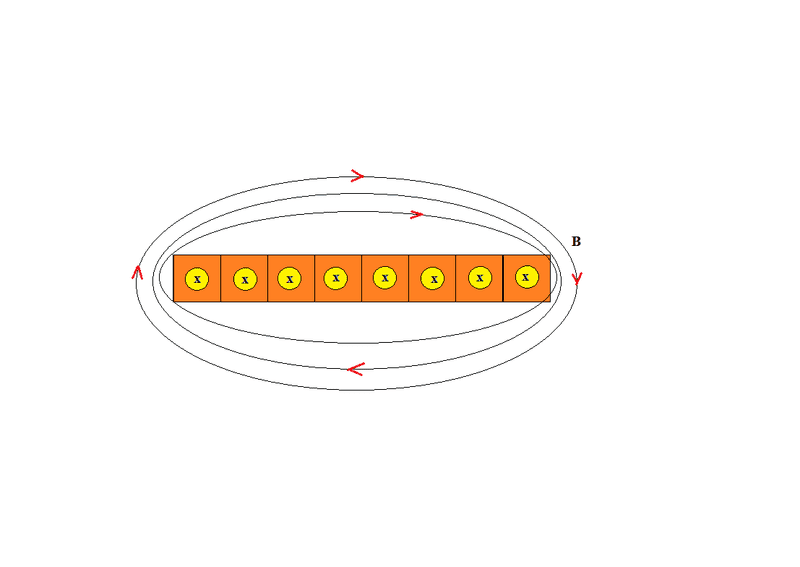
Gv6vD.png

The current is flowing downwards, in the diagram above current is flowing into the page.
The way I diagrammed the magnetic field is it correct? Or approximately close to what it would be?

If there was a conductive loop placed in front of the wires, and moved parallel to the magnetic field like so:
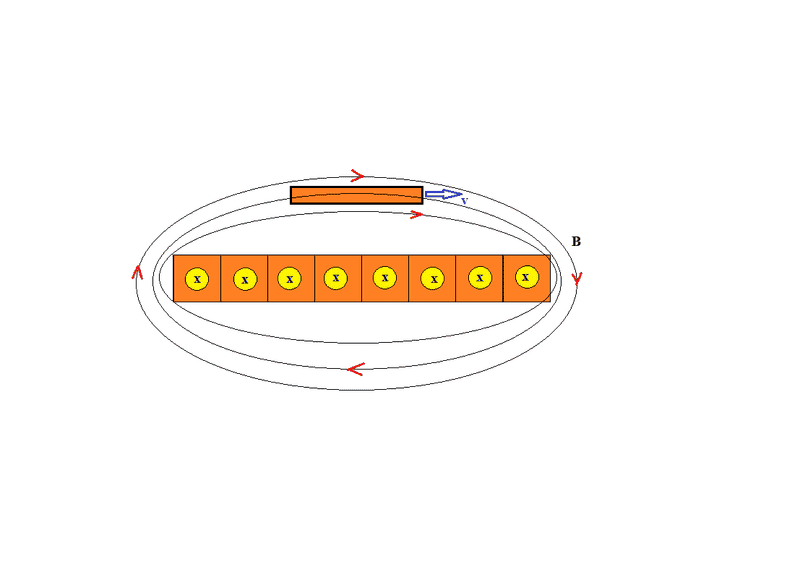
a6bRx.png


Due to the motion of the loop being parallel to the magnetic field ##-\epsilon = 0 ## correct?
Finally, if we allowed current to flow in the conductive loop like so:
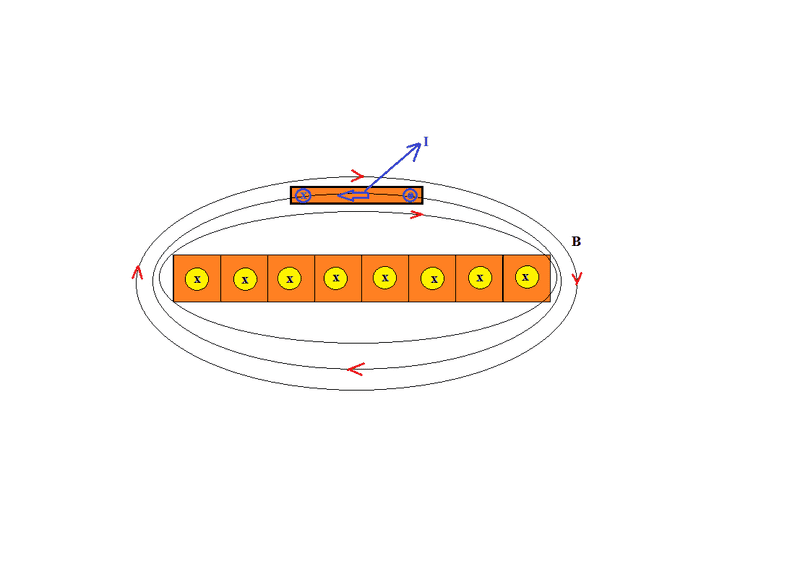
PRZwD.png

I'm not really sure what the Lorentz force acting on the wire would be, I'm assuming due to the current being opposite in direction the same magnetic field it would be zero...

I worked a lot of examples similar to this, but I'm not confident enough to say I'm right, always feel like I am missing something...
 
Physics news on Phys.org
First of all, there would be a few concentric lines of forces around the center of the individual wire showing that the wires would have a slight repulsion among themselves but it could be the case that these lines of forces could be of little or no importance if the loop is far away from the source of magnetic field.
Yes, the emf generated would be zero in the second case, since the magnetic field is not fluctuating near the loop, motion being parallel to the field (Assuming the magnitude of the field remains constant too).
The Lorentz force, I think, would be zero, since all the magnetic field generated by the loop is at right angles to the given magnetic field so no force would act on the loop. But it'd be an unstable equilibrium and the loop may experience a torque in anticlockwise direction w.r.t the diagram given, if disturbed.
Please let me know if I'm right or not!
 
Last edited:
  • Like
Likes PhiowPhi
If the forces between the wires(repulsion) is due to the Lorentz force, that is not true since they are all in the same direction, therefore, would attract one another.
I agree about the induced voltage would be zero due to the flux lines not being perpendicular to the velocity(although perpendicular to the length).

For the Lorentz force, since the current flows are opposite in the same flux lines they cancel out, there can't be a force.
I think that's what happens in this case!

Thanks for revising this with me.
 
Nope, they would be repulsive! It requires opposite directions of the force to induce attractive forces.
I may be confused, but see it for yourself take magnetic field from one of the wires and see it's force on another wire with current in the same direction
 

Similar threads

  • · Replies 5 ·
Replies
5
Views
1K
  • · Replies 8 ·
Replies
8
Views
2K
  • · Replies 61 ·
3
Replies
61
Views
5K
  • · Replies 1 ·
Replies
1
Views
2K
  • · Replies 5 ·
Replies
5
Views
2K
  • · Replies 6 ·
Replies
6
Views
2K
  • · Replies 2 ·
Replies
2
Views
2K
  • · Replies 11 ·
Replies
11
Views
2K
  • · Replies 1 ·
Replies
1
Views
957
  • · Replies 2 ·
Replies
2
Views
1K