Directional Derivatives and Derivations - Tangent Spaces

Click For Summary
SUMMARY

The discussion centers on John M. Lee's "Introduction to Smooth Manifolds," specifically Chapter 3, which addresses the concepts of directional derivatives and derivations. Lee defines the directional derivative as a linear operation at a tangent vector \( v_a \) and establishes a product rule for functions. The introduction of derivations generalizes the concept of directional derivatives to accommodate more complex manifolds beyond \( \mathbb{R}^n \), ensuring that the properties of vector spaces are maintained. This generalization is crucial for studying abstract manifolds and their tangent spaces effectively.

PREREQUISITES
  • Understanding of directional derivatives in calculus
  • Familiarity with linear algebra concepts, particularly vector spaces
  • Basic knowledge of smooth manifolds and their properties
  • Acquaintance with Lie groups and their tangent spaces
NEXT STEPS
  • Study the concept of derivations in the context of algebraic structures
  • Explore the relationship between tangent spaces and Lie algebras
  • Learn about the generalization of directional derivatives in abstract manifolds
  • Investigate the implications of the product rule in differential geometry
USEFUL FOR

Mathematicians, physicists, and students of differential geometry who are interested in the foundational concepts of smooth manifolds and their applications in advanced mathematical theories.

Math Amateur
Gold Member
MHB
Messages
3,920
Reaction score
48
I am reading John M. Lee's book: Introduction to Smooth Manifolds ...

I am focused on Chapter 3: Tangent Vectors ...

I need some help in fully understanding Lee's conversation on directional derivatives and derivations ... ... (see Lee's conversation/discussion posted below ... ... )

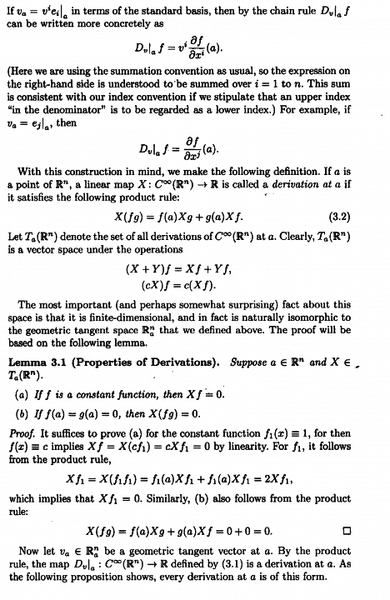
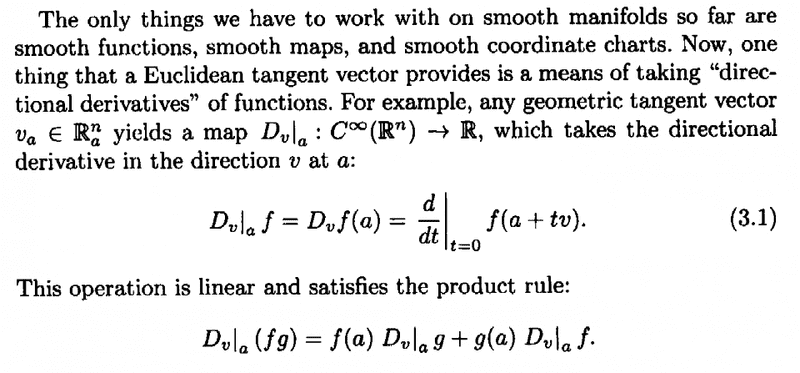
Lee defines a directional derivative and notes that taking a directional derivative of a function f in \mathbb{R}^n at a tangent vector v_a is a linear operation ... ... and follows a product rule ... ... that is, for two functions at v_a we have

D_{v|_a} (fg) = f(a) D_{v|_a} g + g(a) D_{v|_a} fLee then defines a derivation ... that seems to generalise the directional derivative to any linear map that satisfies the product rule (see definition and (3.2) below ...

... ... BUT ... ... why does Lee need a 'derivation' ... why not stay with the the directional derivative ... especially as Proposition 3.2 (see below) establishes an isomorphism between \mathbb{R}^n_a by using a map:

v_a \mapsto D_{v|_a}

... that is a map that is onto the directional derivative ...Can someone please explain why Lee is introducing the derivation ... ? ... and not just staying with the directional derivative ... ?The relevant discussion in Lee, referred to above, is as follows:
?temp_hash=50298ce87f9fc90b14414b8cd9b5c703.png

?temp_hash=50298ce87f9fc90b14414b8cd9b5c703.png

?temp_hash=50298ce87f9fc90b14414b8cd9b5c703.png
 

Attachments

  • Lee - 1 - DirnDerivatives and Derivations - Lee Page 62 - PART 1.png
    Lee - 1 - DirnDerivatives and Derivations - Lee Page 62 - PART 1.png
    33.3 KB · Views: 1,161
  • Lee - 2 - Dirn Derivatives and Derivations - Lee Page 63 - PART 2     .png
    Lee - 2 - Dirn Derivatives and Derivations - Lee Page 63 - PART 2 .png
    66.5 KB · Views: 913
  • Lee - 3 - Dirn Derivatives and Derivations - Lee Page 64 - PART 3     .png
    Lee - 3 - Dirn Derivatives and Derivations - Lee Page 64 - PART 3 .png
    6.6 KB · Views: 775
Physics news on Phys.org
Without knowing the textbook I assume it is about Lie groups, too. They play a major role in physics and one way to study them is to consider the representations of their tangent space, their Lie algebras. Derivations play a major role there, e.g. the left multiplication in a Lie algebra is one. And if you study the multiplication and automorphisms of Lie groups you will end up with derivations in their corresponding Lie algebra.
As you can see in what you uploaded a tangent vector is a function for which the product rule holds, a derivation.

For short: it is often easier to study the Euclidean tangent spaces of a manifold than the manifold itself and obtain important results about the latter.
 
I'm reading that same chapter in Lee's book too. From what I understand, the directional derivative works fine for a Euclidean manifold. But for an abstract manifold, you won't be be able to apply the same definition. So he generalizes the directional derivative to derivations. Then, given p \in M, he identifies T_p(M) with T_{\phi(p)}(\mathbb{R}^n), where this identification is independent of the coordinate chart. If you keep reading in the chapter and doing the mini-exercises along the way, you'll see how he does this. With this identification, we can think of the Euclidean tangent space instead, which is more intuitive.

EDIT: Look at the picture at the top of page 60. That should give you a picture of what he's doing.
 
  • Like
Likes   Reactions: Math Amateur
Thanks fresh_42 and JonnyG ... appreciate your help ...

Peter
 
I think that the author might be looking ahead to the case of more general manifolds than R^n.

If you have an arbitrary manifold M, and you have a parametrized path \mathcal{P}(t) (that is a continuous, smooth function of type R \rightarrow M), you can implicitly define a kind of vector--the tangent vector to the path \mathcal{P}(t)--by just giving its directional derivative:

If v = \frac{d \mathcal{P}}{dt}, and a = \mathcal{P(0)}, then D_{v|a} is that operator defined by:

D_{v|a} f = \frac{d}{dt}|_{t=0} f(\mathcal{P}(t))

This is a generalization of the original definition, which assumed a simple form of \mathcal{P}(t): \mathcal{P}(t) = a + vt. Adding a vector to a point doesn't make sense for an arbitrary smooth manifold, but you can still make sense of a parametrized path.

Now, the problem with this generalization of the notion of a directional derivative is that it's not completely obvious that it forms a vector space. That is, if you have two directional derivatives: D_{v|a} and D_{u|a}, can you always find a third directional derivative D_{w|a} = D_{u|a} + D_{v|a}? You can, but it's not obvious. In contrast, the proof that derivations form a vector space is pretty trivial.
 

Similar threads

  • · Replies 21 ·
Replies
21
Views
3K
  • · Replies 7 ·
Replies
7
Views
3K
  • · Replies 4 ·
Replies
4
Views
2K
  • · Replies 6 ·
Replies
6
Views
7K
  • · Replies 7 ·
Replies
7
Views
4K
  • · Replies 5 ·
Replies
5
Views
3K
  • · Replies 4 ·
Replies
4
Views
3K
  • · Replies 2 ·
Replies
2
Views
4K
  • · Replies 4 ·
Replies
4
Views
2K
  • · Replies 15 ·
Replies
15
Views
6K