Directly Finite and Directly Infinite R-Modules - Bland S2.2

  • Context: Undergrad 
  • Thread starter Thread starter Math Amateur
  • Start date Start date
  • Tags Tags
    Finite Infinite
Click For Summary
SUMMARY

The discussion centers on Paul E. Bland's book "Rings and Their Modules," specifically Section 2.2, which addresses directly finite and directly infinite R-modules. Participants seek clarification on Bland's example regarding the isomorphism ##M \cong M \oplus M## when ##M = \bigoplus_\mathbb{N} \mathbb{Z}##, and the relationships involving ##\text{Hom}_\mathbb{Z}(M, M)## and ##\text{Hom}_\mathbb{Z}(M, M \oplus M)##. The isomorphism is established through bijections between the natural numbers and their even/odd subsets, demonstrating that the structure of free modules allows for such duplications without loss of generality.

PREREQUISITES
  • Understanding of R-modules and their properties
  • Familiarity with direct sums and isomorphisms in algebra
  • Knowledge of homomorphisms, specifically ##\text{Hom}_\mathbb{Z}##
  • Basic concepts of bijections and cardinality in set theory
NEXT STEPS
  • Study the properties of free modules in algebraic structures
  • Explore the concept of direct sums in module theory
  • Learn about the implications of cardinality in R-modules
  • Investigate the role of homomorphisms in module isomorphisms
USEFUL FOR

Mathematicians, algebraists, and graduate students focusing on module theory, particularly those studying the properties of R-modules and their applications in abstract algebra.

Math Amateur
Gold Member
MHB
Messages
3,920
Reaction score
48
I am reading Paul E. Bland's book "Rings and Their Modules ...

Currently I am focused on Section 2.2 Free Modules ... ...

I need some help in order to fully understand Bland's Example on page 56 concerning directly finite and directly infinite R-modules ... ...

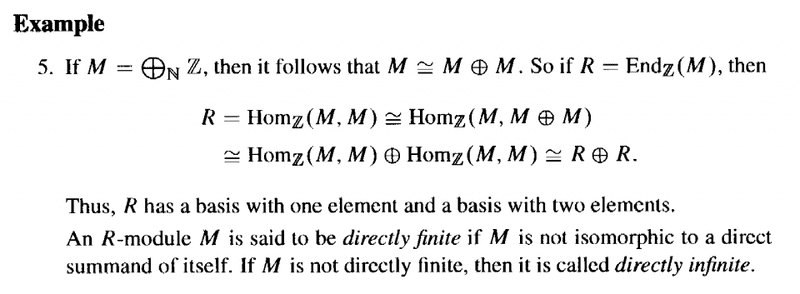
Bland's Example on page 56 reads as follows:
?temp_hash=f1e054a86dd4996d5bffefa455ffb1d1.png
Question 1

In the above Example from Bland's text we read the following:" ... ... If ##M = \bigoplus_\mathbb{N} \mathbb{Z}##, then it follows that ##M \cong M \oplus M## ... ... "How ... exactly ... do we know that it follows that ##M \cong M \oplus M## ... ... ?

Question 2In the above Example from Bland's text we read the following:" ... ...##R = \text{ Hom}_\mathbb{Z} (M, M) \cong \text{ Hom}_\mathbb{Z} (M, M \oplus M )####\cong \text{ Hom}_\mathbb{Z} (M, M) \oplus \text{ Hom}_\mathbb{Z} (M, M)####\cong R \oplus R## ... ... "Although the above relationships look intuitively reasonable ... how do we know ... formally and rigorously that:

##\text{ Hom}_\mathbb{Z} (M, M) \cong \text{ Hom}_\mathbb{Z} (M, M \oplus M )##

##\cong \text{ Hom}_\mathbb{Z} (M, M) \oplus \text{ Hom}_\mathbb{Z} (M, M)##Hope someone can help ...

Peter
 

Attachments

  • Bland - Example - Directly Infinite R-Modules ....png
    Bland - Example - Directly Infinite R-Modules ....png
    24 KB · Views: 858
Physics news on Phys.org
Math Amateur said:
I am reading Paul E. Bland's book "Rings and Their Modules ...

Currently I am focused on Section 2.2 Free Modules ... ...

I need some help in order to fully understand Bland's Example on page 56 concerning directly finite and directly infinite R-modules ... ...

Bland's Example on page 56 reads as follows:
?temp_hash=f1e054a86dd4996d5bffefa455ffb1d1.png
Question 1

In the above Example from Bland's text we read the following:" ... ... If ##M = \bigoplus_\mathbb{N} \mathbb{Z}##, then it follows that ##M \cong M \oplus M## ... ... "How ... exactly ... do we know that it follows that ##M \cong M \oplus M## ... ... ?

Question 2In the above Example from Bland's text we read the following:" ... ...##R = \text{ Hom}_\mathbb{Z} (M, M) \cong \text{ Hom}_\mathbb{Z} (M, M \oplus M )####\cong \text{ Hom}_\mathbb{Z} (M, M) \oplus \text{ Hom}_\mathbb{Z} (M, M)####\cong R \oplus R## ... ... "Although the above relationships look intuitively reasonable ... how do we know ... formally and rigorously that:

##\text{ Hom}_\mathbb{Z} (M, M) \cong \text{ Hom}_\mathbb{Z} (M, M \oplus M )##

##\cong \text{ Hom}_\mathbb{Z} (M, M) \oplus \text{ Hom}_\mathbb{Z} (M, M)##Hope someone can help ...

Peter
If you split ##ℕ## in even and odd numbers you get two copies which are as big as ##ℕ## is. Thus you can "double" your basis index set without gaining or losing something. Set up the bijections between ##ℕ## and ##2ℕ## and ##ℕ## and ##2ℕ + 1## and expand them to the isomorphism ##⊕_{ℕ} ℤ ≅ (⊕_{ℕ} ℤ) ⊕ (⊕_{ℕ} ℤ)##.

The first isomorphism in question 2 is clear, because it is simply the substitution of ##M## by ##M⊕M## as developed in question 1.
So it remains to show that ##\text{ Hom}_\mathbb{Z} (M, M \oplus M ) \cong \text{ Hom}_\mathbb{Z} (M, M) \oplus \text{ Hom}_\mathbb{Z} (M, M).##
Take a homomorphism ##φ \in \text{ Hom}_\mathbb{Z} (M, M \oplus M )##. Then every image ##φ(m)## splits into two components ##φ_i(m) \; : \; φ(m) = φ_1(m) + φ_2(m)## or as a vector ##φ(m) = (φ_1(m) , φ_2(m)).##
Then each ##φ_i## is a homomorphism of ##M## and ##φ = φ_1 + φ_2 = (φ_1 , φ_2)## which establishes the required isomorphism.
 
  • Like
Likes   Reactions: Math Amateur
fresh_42 said:
If you split ##ℕ## in even and odd numbers you get two copies which are as big as ##ℕ## is. Thus you can "double" your basis index set without gaining or losing something. Set up the bijections between ##ℕ## and ##2ℕ## and ##ℕ## and ##2ℕ + 1## and expand them to the isomorphism ##⊕_{ℕ} ℤ ≅ (⊕_{ℕ} ℤ) ⊕ (⊕_{ℕ} ℤ)##.

The first isomorphism in question 2 is clear, because it is simply the substitution of ##M## by ##M⊕M## as developed in question 1.
So it remains to show that ##\text{ Hom}_\mathbb{Z} (M, M \oplus M ) \cong \text{ Hom}_\mathbb{Z} (M, M) \oplus \text{ Hom}_\mathbb{Z} (M, M).##
Take a homomorphism ##φ \in \text{ Hom}_\mathbb{Z} (M, M \oplus M )##. Then every image ##φ(m)## splits into two components ##φ_i(m) \; : \; φ(m) = φ_1(m) + φ_2(m)## or as a vector ##φ(m) = (φ_1(m) , φ_2(m)).##
Then each ##φ_i## is a homomorphism of ##M## and ##φ = φ_1 + φ_2 = (φ_1 , φ_2)## which establishes the required isomorphism.
Thanks for the help, fresh_42 ... appreciate your help ...

Sorry to be slow in replying ... been traveling ...

You write:

" ... ... If you split ##ℕ## in even and odd numbers you get two copies which are as big as ##ℕ## is. Thus you can "double" your basis index set without gaining or losing something. Set up the bijections between ##ℕ## and ##2ℕ## and ##ℕ## and ##2ℕ + 1## and expand them to the isomorphism ##⊕_{ℕ} ℤ ≅ (⊕_{ℕ} ℤ) ⊕ (⊕_{ℕ} ℤ)## ... ... "So ... you define two functions ##\psi_1## and ##\psi_2## as follows:

## \psi_1 \ : \ \mathbb{N} \longrightarrow 2 \mathbb{N} \ \text{ where } \psi_1 (x) = 2x ##

and

## \psi_2 \ : \ \mathbb{N} \longrightarrow 2 \mathbb{N} + 1 \ \text{ where } \psi_2 (x) = 2x + 1##These are both isomorphisms ... BUT ... how exactly (details?) do we expand them to the isomorphism ##⊕_{ℕ} ℤ ≅ (⊕_{ℕ} ℤ) ⊕ (⊕_{ℕ} ℤ)## ... ... ?Can you help ... ?

Peter
 
Hi Peter!

You can settle an isomorphism ##⊕_{ℕ} ℤ ≅ (⊕_{2ℕ} ℤ) ⊕ (⊕_{2ℕ+1} ℤ)## by the following map:

If ##a_n## denotes an element ##a## at the ##n##-th position, i.e. an element of ## ⊕_{ℕ} ℤ##, then we map it to ##(a_{2k},0)## if ##n=2k## is even and to ##(0,a_{2k+1})## if ##n=2k+1## is odd. Again the index only shows the position of ##a## and I wrote the elements of ##(⊕_{2ℕ} ℤ) ⊕ (⊕_{2ℕ+1} ℤ)## as pairs. It doesn't matter, you could write it as well as a sum. I simply felt that ##a_{2k}+ 0## might be confusing.

So it remains to show that, e.g. ##⊕_{ℕ} ℤ ≅ ⊕_{2ℕ} ℤ##. This could be done by mapping ##a_n## to ##a_{2n}##.
 
  • Like
Likes   Reactions: Math Amateur
fresh_42 said:
Hi Peter!

You can settle an isomorphism ##⊕_{ℕ} ℤ ≅ (⊕_{2ℕ} ℤ) ⊕ (⊕_{2ℕ+1} ℤ)## by the following map:

If ##a_n## denotes an element ##a## at the ##n##-th position, i.e. an element of ## ⊕_{ℕ} ℤ##, then we map it to ##(a_{2k},0)## if ##n=2k## is even and to ##(0,a_{2k+1})## if ##n=2k+1## is odd. Again the index only shows the position of ##a## and I wrote the elements of ##(⊕_{2ℕ} ℤ) ⊕ (⊕_{2ℕ+1} ℤ)## as pairs. It doesn't matter, you could write it as well as a sum. I simply felt that ##a_{2k}+ 0## might be confusing.

So it remains to show that, e.g. ##⊕_{ℕ} ℤ ≅ ⊕_{2ℕ} ℤ##. This could be done by mapping ##a_n## to ##a_{2n}##.
Thanks for the help, fresh_42 ...

Peter
 

Similar threads

Replies
7
Views
2K
  • · Replies 25 ·
Replies
25
Views
4K
Replies
2
Views
2K
  • · Replies 5 ·
Replies
5
Views
2K
  • · Replies 4 ·
Replies
4
Views
1K
Replies
36
Views
7K
  • · Replies 7 ·
Replies
7
Views
1K
  • · Replies 12 ·
Replies
12
Views
3K
  • · Replies 3 ·
Replies
3
Views
2K
  • · Replies 1 ·
Replies
1
Views
1K