Discrete Mathmatics :logically equivalent

Click For Summary

Discussion Overview

The discussion revolves around the logical equivalence of the statement S = [¬(p -> q)] V [¬(p V q)], focusing on constructing truth tables and finding simpler expressions. It involves technical reasoning and mathematical exploration related to discrete mathematics.

Discussion Character

  • Technical explanation
  • Mathematical reasoning
  • Debate/contested

Main Points Raised

  • Participants are tasked with constructing truth tables for the statement S and finding a simpler equivalent expression.
  • Some participants express confusion about specific steps in the logical transformation, particularly regarding the transition from conjunction to disjunction.
  • One participant suggests that the transformation involves distributing disjunction over conjunction and references the Idempotent Law.
  • Another participant proposes a method of substituting symbols for logical operations to simplify the expression, detailing a series of algebraic manipulations.
  • A participant explains that a disjunctive statement can be represented as a denial of a conjunction, potentially simplifying the expression.
  • There are comments regarding the correct spelling of "discrete" in the thread title, with participants providing clarifications on the terminology.

Areas of Agreement / Disagreement

Participants express confusion about specific logical steps, and there are multiple interpretations of how to simplify the expression. The discussion remains unresolved regarding the exact transformations and simplifications involved.

Contextual Notes

Some participants mention specific laws and operations in logic, but there is uncertainty about their application and the assumptions behind the transformations. The discussion includes various approaches without a clear consensus on the best method.

Ziek_4790
Messages
2
Reaction score
0
TL;DR
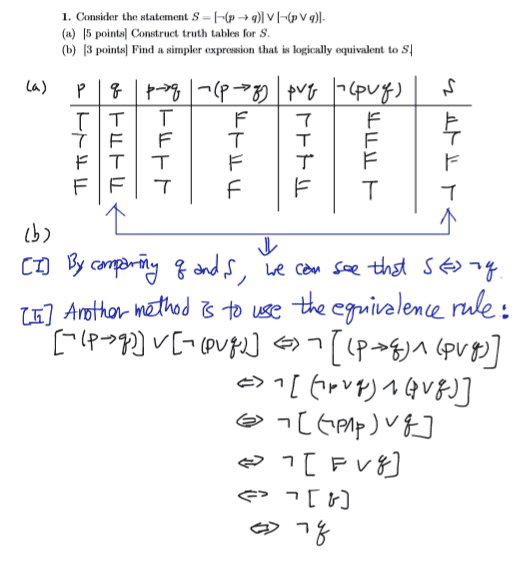
basically am studying for my exam tomorrow and I got in uni late registration this semester so I can't really get how they solved this question, tried to see the Dr and I couldn't get an appointment or (meet him in general),so please if u can explain this for me I would be grateful, I did understand half of it after spending more than 2 hours on it and I cant figure out rest of the steps.
its just the 2nd question (The equivalence Rule) that I need help with.
1. Consider the statement S =[¬(p ->q)]V[¬(pVq)].
(a) Construct truth tables for S.
(b) Find a simpler expression that is logically equivalent to S.
Capture.PNG
 
Technology news on Phys.org
What part/step is it you're confused about?
 
WWGD said:
What part/step is it you're confused about?
this.PNG

exactly these two lines, how did it come to be from (and) to (Or), and where did the p in the left premise came from.
thought that the right premise is (simplification with Idempotent Law ),but then I can't tell how the (and) flipped to (Or).
 
It seems they're distributing v over the /\ and then using that pvp==p. (AvB)/\(CvB)=A/\C v. My phone is dying, will get back after charging it.
 
One trick is to sub in a + for union/or and a × for intersection ( I also don't know how to \tex them ):
(-p+q)(p+q)=-pp-pq+qp+qq=(-p&p)v(-p&q)v(q&p)v(q&q). The last is the same as q. The 2nd and 3rd term simplify to( changing notation again)

q(p-p)=q&(pv-p)=q&p. But we already have both q, p in the other sentences, which then " absorb" these. Does that make sense?Edit: I will bring someone in a few hours to check, when I am on my PC .
 
Last edited:
A disjunctive statement of the form '(not p) or (not q)' can be exchanged for a logically equivalent denial of a conjunction, as in 'not (p and q)', which is simpler in the sense that it uses the (monary) negation operator once instead of twice. If your symbolic logic system allowed the use of the | operator, which is a binary operator that means 'either not or not', you could simplify by writing (p | q). In computer hardware terms, we would use a NAND gate to replace two inverters and an OR gate.
 
Regarding your thread title, please be aware that 'discreet' means not injudiciously overt, while 'discrete' means not continuous. :oldwink:
 
sysprog said:
Regarding your thread title, please be aware that 'discreet' means not injudiciously overt, while 'discrete' means not continuous. :oldwink:
Fixed...
 

Similar threads

  • · Replies 3 ·
Replies
3
Views
2K
  • · Replies 4 ·
Replies
4
Views
2K
  • · Replies 2 ·
Replies
2
Views
2K
Replies
1
Views
2K
  • · Replies 2 ·
Replies
2
Views
2K
  • · Replies 1 ·
Replies
1
Views
2K
  • · Replies 3 ·
Replies
3
Views
2K
  • · Replies 22 ·
Replies
22
Views
4K
  • · Replies 1 ·
Replies
1
Views
2K
  • · Replies 5 ·
Replies
5
Views
1K