Distance and acceleration from a v(t) graph

Join the discussion
Registration is free. Ask a follow-up in this thread, or start your own.
34 replies · 3K views
gladidi said:
The last point is to calculate the distance traveled by objects.
it is said that should calculate the surface area
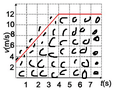
Yes, in a velocity-time graph the distance traveled is given by the 'area' under the graph line. But the area of each square means the product of the coordinate intervals.
Here, the vertical grid lines are at 1 second intervals and the horizontal grid lines at intervals of 2m/s, so each little square represents 1 second x 2m/s = 2m.
 
Physics news on Phys.org
haruspex said:
Yes, in a velocity-time graph the distance traveled is given by the 'area' under the graph line. But the area of each square means the product of the coordinate intervals.
Here, the vertical grid lines are at 1 second intervals and the horizontal grid lines at intervals of 2m/s, so each little square represents 1 second x 2m/s = 2m.
Is this right way to solve this? example 35*2+8/2*2?
 

Attachments

  • ....PNG
    ....PNG
    13.3 KB · Views: 155
gladidi said:
Is this right way to solve this? example 35*2+8/2*2?
That is the right answer. I cannot tell whether you are expected to do it by counting squares are algebraically. I would use standard formulae for areas of rectangles and triangles.
 
haruspex said:
That is the right answer. I cannot tell whether you are expected to do it by counting squares are algebraically. I would use standard formulae for areas of rectangles and triangles.
35*2+8/2*2? is 78m but it's not right..
 
gladidi said:
35*2+8/2*2? is 78m but it's not right..
You want the distance for the whole 8 seconds, right?
In the first 4 seconds the average speed is (3+12)/2=7.5m/s. Over four seconds that covers 30m.
For the remaining 4 seconds the speed is 12m/s, giving a distance of 48m.
30m+48m=78m.