How should I calculate the distance D with two different motions?

  • Thread starter Thread starter simphys
  • Start date Start date
Click For Summary
SUMMARY

The discussion centers on calculating the distance D in a scenario involving projectile motion and a moving boat. The original poster mistakenly subtracted the boat's displacement from the projectile's range, while the correct approach is to add both displacements together. The confusion arises from the direction of the boat's motion, but proper handling of signs clarifies the calculation. The poster later realizes the error in timing regarding when the distance D is measured.

PREREQUISITES
  • Understanding of projectile motion principles
  • Familiarity with displacement and distance concepts
  • Basic knowledge of vector addition in physics
  • Ability to interpret motion diagrams
NEXT STEPS
  • Study the principles of projectile motion in physics
  • Learn about vector addition and its application in motion problems
  • Review examples of motion involving multiple objects
  • Explore the effects of direction on displacement calculations
USEFUL FOR

Students studying physics, educators teaching motion concepts, and anyone involved in solving problems related to projectile motion and relative motion scenarios.

simphys
Messages
327
Reaction score
46
Homework Statement
An important piece of landing equipment must be thrown to
a ship, which is moving at 45.0 cm>s, before the ship can dock. This
equipment is thrown at 15.0 m>s at 60.0° above the horizontal from the
top of a tower at the edge of the water, 8.75 m above the ship’s deck
(Fig. P3.54). For this equipment to land at the front of the ship, at what
distance D from the dock should the ship be when the equipment is
thrown? Ignore air resistance
Relevant Equations
kinematic equations
pic.png


My question is this:
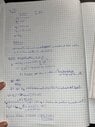
So in my solution, to get D I *substracted* the displacement of the boat within the same time interfval of the projectile motion from the range of the projectile motion. whilst in the solutions it says that I need to *add* them together.
Question: Why do I need to add them as the boat is going in the opposition direction, and from my reasoning I would think that the distance D would become smaller this way.
 

Attachments

  • image.jpg
    image.jpg
    60.6 KB · Views: 231
Physics news on Phys.org
edit: forgot the solution
 
simphys said:
So in my solution
I don't see no solution ?
Please post your work...

Anyway, if you deal with the signs properly, this shouldn't be a problem...

##\ ##
 
BvU said:
I don't see no solution ?
Please post your work...

Anyway, if you deal with the signs properly, this shouldn't be a problem...

##\ ##
I have ?
 
Oh gosh my apologies... wow I just find out at that it is says the distance D from the time when the equipment is thrown... mine was at the end of the thrown then..

My apologies for posting!
 
simphys said:
I have ?
Yes, after I posted :biggrin:

[edit] can hardly decipher it anyway ...
 
BvU said:
Yes, after I posted :biggrin:

[edit] can hardly decipher it anyway ...
Yeah my apologies :) I needed to quickly switch to the phone to post the pic afterwards. But for some reason it always pixelates my picture lol, they look crisp and clear when I look at it on the camera roll, strangeee
 
Miraculous camera if it can clarify those scribbles o0)
 

Similar threads

  • · Replies 11 ·
Replies
11
Views
2K
  • · Replies 9 ·
Replies
9
Views
584
  • · Replies 5 ·
Replies
5
Views
2K
Replies
13
Views
2K
Replies
4
Views
2K
  • · Replies 4 ·
Replies
4
Views
3K
Replies
4
Views
4K
Replies
9
Views
2K
Replies
3
Views
850
  • · Replies 6 ·
Replies
6
Views
1K