WeiShan Ng
- 36
- 2
I am confused about the difference between the two
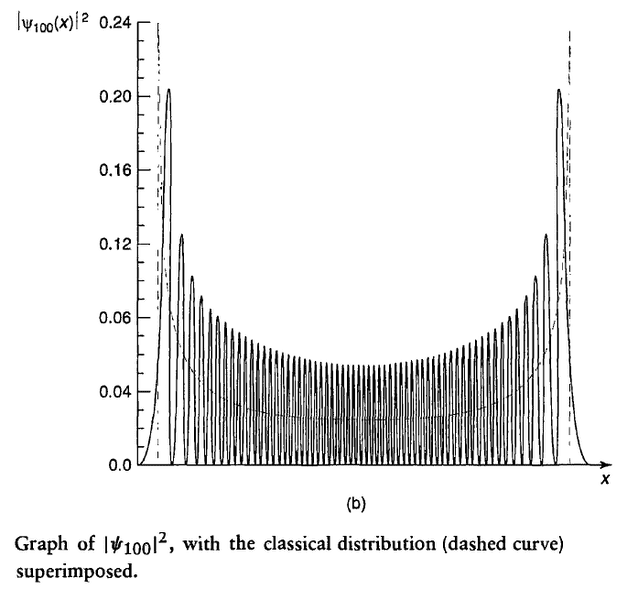
In Griffith's 2.3 The Harmonic Oscillator, he superimposes the quantum distribution and classical distribution and says
What I understand for quantum case is that ##|\Psi_{100} (x)|^2## gives the probability we will measure the particle at position ##x##. So if we were given a large set of the particles we will have a probability distribution of the measured ##x## and this distribution is what shown on the graph. However I don't quite understand what the distribution over time means in the classical case. I don't really see how the dependence of time fit in, since the graph is only x-dependence.
In Griffith's 2.3 The Harmonic Oscillator, he superimposes the quantum distribution and classical distribution and says
In the classical case we are talking about the distribution of positions over time for one oscillator, whereas in the quantum case we are talking about the distribution over an ensemble of identically prepared systems.
What I understand for quantum case is that ##|\Psi_{100} (x)|^2## gives the probability we will measure the particle at position ##x##. So if we were given a large set of the particles we will have a probability distribution of the measured ##x## and this distribution is what shown on the graph. However I don't quite understand what the distribution over time means in the classical case. I don't really see how the dependence of time fit in, since the graph is only x-dependence.
