Dividing a Quadrilateral into Equal Parts

  • Context:
  • Thread starter Thread starter Albert1
  • Start date Start date
  • Tags Tags
    parts
Join the discussion
Registration is free. Ask a follow-up in this thread, or start your own.
3 replies · 5K views
Albert1
Messages
1,221
Reaction score
0
ABCD is a quadrilateral,and point P is a point on AD ,and

between points A and D

please construct a line (passing through point P),and

divide ABCD into two parts with equal area
 
Mathematics news on Phys.org
Re: quadrilateral

Do you know how Russian revolutionaries in the beginning of the 20th century wrote letters to their comrades from tsarist prisons? They would use milk to write hidden messages between the lines. (Yes, apparently, at that time, they served milk in prisons.) When milk was dry, it was invisible, but by holding the letter over a candle, the hidden message could be revealed. I have a feeling that something is written between the lines in this problem statement as well.

Edit: Apparently, the following is incorrect. There is no reason to believe that any line through the centroid cuts a quadrilateral into two parts with equal area.

Is it not the line that passes through P and the centroid? As Wikipedia helpfully reminds, the centroid can be found by constructing the centroid of triangles into which the quadrilateral is divided by diagonals.
 
Last edited:
Re: quadrilateral

This strikes me as an extension of the http://www.mathhelpboards.com/f28/change-pentagon-into-triangle-equal-area-5486/.

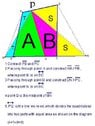
[sp]Regard the quadrilateral ABCD as being a pentagon PABCD, with a $180^\circ$ angle at P. Then apply the construction in comment #6 in the pentagon thread. This gives a triangle with its apex at P, whose opposite edge (ST say) contains the edge BC of the quadrilateral, and which has the same area as the quadrilateral. Now bisect ST to get a point Q on BC. The line PQ will bisect the triangle and will therefore also bisect the quadrilateral.

I would include a diagram if I had time, but I expect Albert can provide one. (Smile)[/sp]
 
Re: quadrilateral

Opalg said:
This strikes me as an extension of the http://www.mathhelpboards.com/f28/change-pentagon-into-triangle-equal-area-5486/.

[sp]Regard the quadrilateral ABCD as being a pentagon PABCD, with a $180^\circ$ angle at P. Then apply the construction in comment #6 in the pentagon thread. This gives a triangle with its apex at P, whose opposite edge (ST say) contains the edge BC of the quadrilateral, and which has the same area as the quadrilateral. Now bisect ST to get a point Q on BC. The line PQ will bisect the triangle and will therefore also bisect the quadrilateral.

I would include a diagram if I had time, but I expect Albert can provide one. (Smile)[/sp]
yes the construction of the diagram is similar to the pentagon problem
now ! here is the diagram
https://www.physicsforums.com/attachments/1002._xfImport
 

Attachments

  • Quadrilateral.jpg
    Quadrilateral.jpg
    26.3 KB · Views: 148