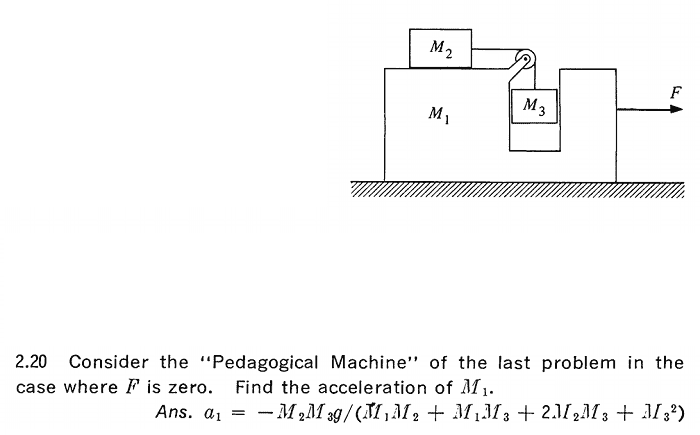
Do M1 and M3 have the same Acceleration?

  • Thread starter Thread starter Andrax
  • Start date Start date
  • Tags Tags
    Acceleration
Join the discussion
Registration is free. Ask a follow-up in this thread, or start your own.
9 replies · 3K views
Andrax
Messages
117
Reaction score
0

Homework Statement


V5MO7.png


Homework Equations


X1=X3?

The Attempt at a Solution


Do M1 ANd M3 have the same horizontal acceleration?
 
Physics news on Phys.org
Tell me a little more about the pedagogical machine. Any friction anywhere ? Since you don't need the answer (it's already there), all you want is the "finding".
Your relevant equation doesn't mean a thing to me. X1 nor X3 are mentioned under 1. And if x1=x3 could help you find the acceleration if F = 0, it can hardly do so all on it's own. Any other relevant equations ?

Your "attempt" under 3 is a rephrasing of what you question under 2. CW and I both say yes: no way x1 - x3 can be anything but a constant -- at least if x is in the same direction as F ("sideways", so to speak; an assumption because the drawing does not reveal the direction of g). Not necessarily zero, but you could define coordinates (why don't you do that ?) such that yes, x1=x3.

As a student, you are forced to make a number of assumptions from context, brainwashing, tradition, or whatever. It is worth your effort to adapt an orderly way of dealing with exercises: list the problem statement, all given/known data; list all the relevant equations (if you can't, at least you should then mention what kind of relationship you are still missing). Link back to 1 and list the assumptions, clarify chosen coordinate systems etc.) Then make an attempt and tell us what you did.

Way you posted it now makes providing sensible help at the right level a nightmare to well-meaning people like me. So far, I all I can muster is 2. depends on choice of coordinates, 3. probably (assuming no significant gap around m3 turns that into a yes).
 
About this, i have a question: just about the direction of the f13 force. I think, inittialy the m1 block will move [just way to say] to left, the wall on right of the m3 block will pressure it and the force (in m3 block) will be to left, [eventually the force on m1 will be to right] but that's not what the resolution say...
 
LCSphysicist said:
I think, inittialy the m1 block will move [just way to say] to left
Can you clarify this? What will cause m1 to move to the left? Is this motion in the nature of a velocity or an acceleration?
 
[QUOTE = "jbriggs444, publicação: 6315537, membro: 422467"]
Você pode esclarecer isso? O que fará com que o m1 se mova para a esquerda? Esse movimento é da natureza de uma velocidade ou aceleração?
[/CITAR]
Well, i think that force net on the pulley. Actually i don't know if its right to think in acceleration or velocity :C
 
LCSphysicist said:
[QUOTE = "jbriggs444, publicação: 6315537, membro: 422467"]
Você pode esclarecer isso? O que fará com que o m1 se mova para a esquerda? Esse movimento é da natureza de uma velocidade ou aceleração?
[/CITAR]
Well, i think that force net on the pulley. Actually i don't know if its right to think in acceleration or velocity :C
Yes, before the rightward force F is applied, the pulley will be responsible for leftward force and acceleration.

It is right to think of acceleration. Velocity will not matter since we can always pick a frame of reference where the system begins at rest.
 
well, so, why does the m3 block will have the net force horizontally to the left?
resolution that i find:
1585080194671.png

if the pulley initially pressure the m1 block, will slip to right, let's say a infinitesimal slip, that will pressure m3 to right, and m3 will answer with a left force on m1, but isn't what the resolution says...
 
LCSphysicist said:
well, so, why does the m3 block will have the net force horizontally to the left?
resolution that i find:
The problem you are having seems to be that in this thread, the question asks for the acceleration of the block with mass, M1, if the applied force, F, is zero. (See the Homework statement below.) Indeed, the M1 block accelerates to the left in this case.

What you have found (correctly) is the applied force, F, needed so that the block with mass, M3, neither rises nor falls. In this case all three blocks accelerate to the right with a common acceleration. By the way, this is the problem referred to in post #4 above.

Homework Statement for the current thread:
Andrax said:

Homework Statement


v5mo7-png.png
Reference to problem referred to by @BvU in post #4 above:
jbunniii said:
I'm trying to solve this problem from Kleppner and Kolenkow:
...
The problem as stated in that thread by @jbunniii :
1585189338520.png

Your solution is consistent with the clue.
 
Last edited: