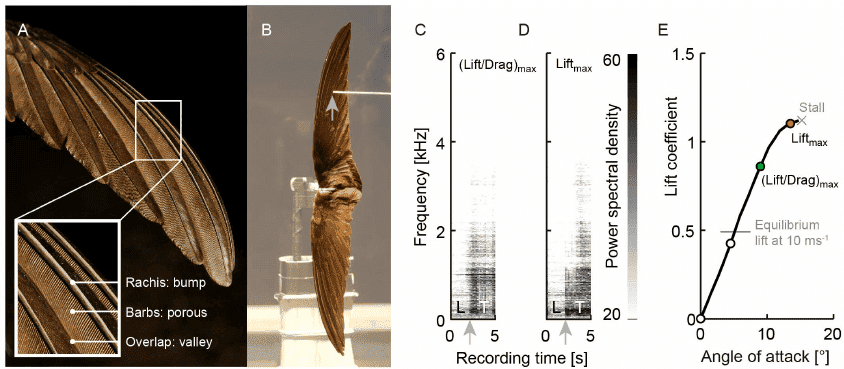
Discussion Overview
The discussion revolves around the potential aerodynamic benefits of overlapping feathers in swift birds and whether these features could inform aircraft design. Participants explore the implications of feather structure on drag, lift, and overall flight efficiency, considering both biological and engineering perspectives.
Discussion Character
- Exploratory
- Technical explanation
- Debate/contested
Main Points Raised
- Some participants question whether the overlapping feathers of swifts provide any aerodynamic advantages or if they contribute to increased drag.
- Others suggest that rough surfaces, like those on golf balls, can reduce drag by re-energizing the boundary layer, but they note that this may not apply directly to bird wings.
- A participant argues that the design of bird wings involves multiple factors beyond drag, including the ability to rotate wings and the underlying skeletal structure.
- There is a suggestion that the evolutionary advantages of overlapping feathers may not be strictly aerodynamic, as feathers also serve purposes like thermal insulation and water shedding.
- One participant mentions that leading edge tabs on airplane wings improve lift and may relate to how birds utilize wing roughness for slow-speed flight and stall characteristics.
- Another participant emphasizes that evolution optimizes for overall performance rather than perfection, indicating that features like overlapping feathers may have developed under various selection pressures.
Areas of Agreement / Disagreement
Participants express differing views on the aerodynamic implications of overlapping feathers, with no consensus reached on whether they are beneficial or detrimental. The discussion remains unresolved regarding the specific aerodynamic effects of these features.
Contextual Notes
Participants highlight the complexity of aerodynamic interactions and evolutionary biology, noting that assumptions about drag and lift may depend on specific conditions and definitions. The discussion includes references to various aerodynamic principles without resolving the mathematical or physical details involved.
Who May Find This Useful
This discussion may be of interest to those studying aerodynamics, evolutionary biology, or aircraft design, particularly in understanding the interplay between biological features and engineering applications.