Amaelle
- 318
- 55
- TL;DR
- Custom 10.23° beveled washer between bolt head and inclined lumbar plate — does it preserve the inclination angle or cancel it? Also: bolt hole becomes elliptical on inclined surface — washer OD sizing implications at 120 kN
*Background**
I am designing a lower torso surrogate adapter for crash test dummy drop tower testing. The assembly works as follows:
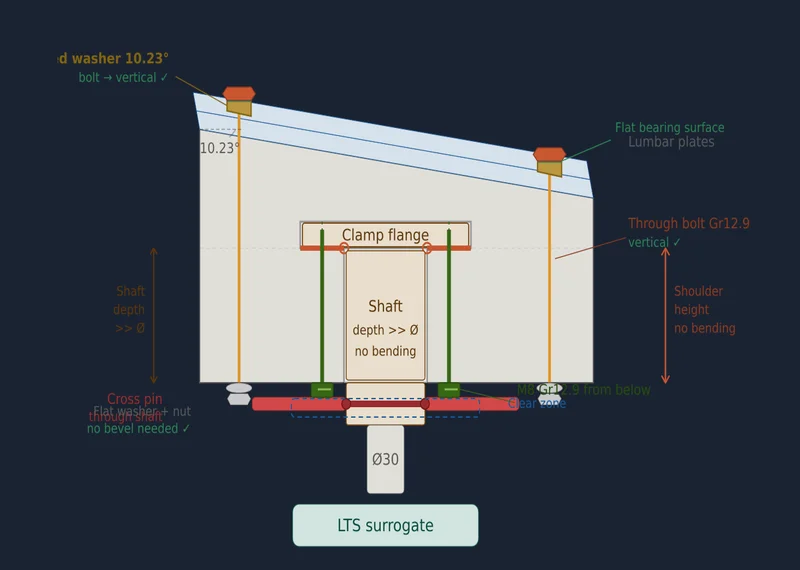
- The **lower torso** (EN24T wedge) is bolted **flat** to the drop tower floor
- The top face of the wedge is inclined at **10.23°** — this is intentional, it replicates the anatomical lumbar inclination
- The **upper torso** sits on top of the inclined lumbar plates at 10.23°
- The two are joined by **M16/M20 Gr12.9 through bolts** passing through both lumbar plates and the wedge
- The bolts must carry **120 kN** impact load
---
**The Problem**
Because the lumbar plate surface is inclined at 10.23°, the bolt holes are drilled perpendicular to that inclined surface. This means:
- The bolt axis is **NOT vertical** — it is at 10.23° to vertical
- The bolt head bears on the **inclined surface** at an angle
- Without correction, the bolt bends on tightening → stress concentration → bolt fails below rated load
---
**Proposed Solution**
Add a **custom machined beveled washer** (10.23° cone angle, EN24T, OD ≈ 40mm) between the bolt head and the inclined lumbar plate surface.
The beveled washer:
- Has an **angled bottom face** matching the 10.23° inclined plate surface
- Has a **flat top face** giving the bolt head a perpendicular bearing surface
- Makes the bolt **perpendicular to its own bearing surface** — full preload, no bending
---
**The Question**
My supervisor flagged a concern: does adding the beveled washer change or cancel the 10.23° inclination of the upper torso?
My understanding is **no** — here is my reasoning:
1. The lower torso wedge is already fixed flat to the floor — the 10.23° inclined top face is fixed geometry, it does not move
2. The upper torso sits on that inclined face — it is at 10.23° regardless of what the bolts do
3. The beveled washer only corrects the **bolt-to-bearing-surface relationship** — it does not change the geometry of the interface between upper and lower torso
4. The inclination is defined by the **wedge geometry**, not by the bolt angle
In other words: the beveled washer makes the bolt work correctly **on the inclined surface** — it does not flatten the surface.
---
**Can anyone confirm or correct this reasoning?**
And as a secondary question — is a custom machined EN24T conical washer the right approach for 120 kN at 10.23°, or is there a better standard solution (DIN 6319 spherical washer pair, for example)?
Thank you
I am designing a lower torso surrogate adapter for crash test dummy drop tower testing. The assembly works as follows:
- The **lower torso** (EN24T wedge) is bolted **flat** to the drop tower floor
- The top face of the wedge is inclined at **10.23°** — this is intentional, it replicates the anatomical lumbar inclination
- The **upper torso** sits on top of the inclined lumbar plates at 10.23°
- The two are joined by **M16/M20 Gr12.9 through bolts** passing through both lumbar plates and the wedge
- The bolts must carry **120 kN** impact load
---
**The Problem**
Because the lumbar plate surface is inclined at 10.23°, the bolt holes are drilled perpendicular to that inclined surface. This means:
- The bolt axis is **NOT vertical** — it is at 10.23° to vertical
- The bolt head bears on the **inclined surface** at an angle
- Without correction, the bolt bends on tightening → stress concentration → bolt fails below rated load
---
**Proposed Solution**
Add a **custom machined beveled washer** (10.23° cone angle, EN24T, OD ≈ 40mm) between the bolt head and the inclined lumbar plate surface.
The beveled washer:
- Has an **angled bottom face** matching the 10.23° inclined plate surface
- Has a **flat top face** giving the bolt head a perpendicular bearing surface
- Makes the bolt **perpendicular to its own bearing surface** — full preload, no bending
---
**The Question**
My supervisor flagged a concern: does adding the beveled washer change or cancel the 10.23° inclination of the upper torso?
My understanding is **no** — here is my reasoning:
1. The lower torso wedge is already fixed flat to the floor — the 10.23° inclined top face is fixed geometry, it does not move
2. The upper torso sits on that inclined face — it is at 10.23° regardless of what the bolts do
3. The beveled washer only corrects the **bolt-to-bearing-surface relationship** — it does not change the geometry of the interface between upper and lower torso
4. The inclination is defined by the **wedge geometry**, not by the bolt angle
In other words: the beveled washer makes the bolt work correctly **on the inclined surface** — it does not flatten the surface.
---
**Can anyone confirm or correct this reasoning?**
And as a secondary question — is a custom machined EN24T conical washer the right approach for 120 kN at 10.23°, or is there a better standard solution (DIN 6319 spherical washer pair, for example)?
Thank you