DAirey said:
It's my understanding that the term ##\phi^2t^4## has units of ##km^2##, just like the rest of the terms
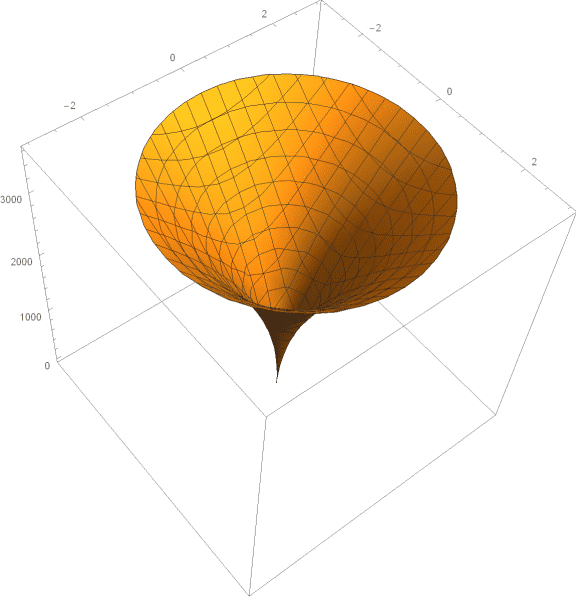
We're not talking about the equation you wrote in your OP. That's not a metric. It's just an equation that the coordinates of the surface have to satisfy. It doesn't tell you the distance between neighboring points on the surface.
You still don't appear to be clear about what you are looking for. There are basically two possibilities:
(1) You are looking for a Lorentzian metric for a 4-dimensional spacetime. An example of such a metric is:
$$
ds^2 = - dt^2 + a^2(t) \left( dx^2 + dy^2 + dz^2 \right)
$$
This is the metric of an FRW universe with flat spacelike surfaces of constant time; that is, each surface of constant ##t## is a flat Euclidean 3-dimensional space. The only difference between any two such spaces is the scale factor ##a(t)##, which is a function of ##t##. But note that the metric as a whole is
not a function of ##t##; only the scale factor is.
(2) You are looking for a Riemannian metric for a 3-dimensional space; more precisely, for a parameterized family of metrics for a parameterized family of 3-dimensional spaces, where the parameter is a thing called ##t##, which you are interpreting as "time". An example of such a family of metrics would be:
$$
ds^2 = a^2(t) \left( dx^2 + dy^2 + dz^2 \right)
$$
Note that this looks just like the spatial part of the FRW metric I wrote down above; but here, we are not interpreting this as a single metric of a single geometric spacetime, we are interpreting it as a family of metrics for a family of geometric spaces. (And, of course, all of these spaces are flat Euclidean spaces, so this metric doesn't describe the surface you are interested in.)
Also note that in these metrics, each term some coefficient times the differential of one of the coordinates (i.e., ##dt##, ##dx##, ##dy##, or ##dz##). There are no terms that are not of that form. The "metric" you wrote down in post #5 does not have that form; there are terms in it that involve ##t## but don't have any coordinate differential in them. (And of course the expression you wrote down in your OP has no coordinate differentials at all, anywhere.) That's why it doesn't make sense as a metric.
Also note that you appear to be interested in a single surface, not a family of surfaces, because you only drew one surface in your OP. But that surface is a 3-dimensional surface, not a 4-dimensional one: the equation you wrote in your OP describes a 3-dimensional surface embedded in a 4-dimensional space. But you talk about finding a metric that is a function of time, which implies that you are looking for a family of metrics parameterized by time, not the metric of a single surface. So it appears to me that you are somewhat confused about what you are actually looking for.