Does Acceleration Affect Tension in a Sphere and Car System?

Join the discussion
Ask a follow-up here, or get your own question answered by working scientists, mathematicians and engineers — people, not an autocomplete.
Real named experts · corrections over time · the nuance an AI answer skips
18 replies · 2K views
rudransh verma
Gold Member
Messages
1,067
Reaction score
96
Homework Statement
A small sphere is suspended by a string from the ceiling of car. If the car begins to accelerate with a , the tension generated in string is(##T_0## is tension at rest)
Relevant Equations
F=ma
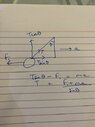
If I draw the fbd then some force will accelerate the car in horizontal direction which I think does not effect the string in vertical direction. So same tension regardless of acceleration.
But we know it will increase. So what will be the correct physics behind it?
 

Attachments
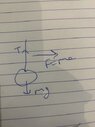
  • image.jpg
    image.jpg
    24 KB · Views: 167
Physics news on Phys.org
ergospherical said:
Are you sure that the string will remain vertical? What's wrong with this picture as it stands?
No. Fictitious force. Inertia. Something like it will act.
If it stands vertical the two resultant forces cannot affect each other. So tension will remain same but it’s not true.
 
rudransh verma said:
Homework Statement:: A small sphere is suspended by a string from the ceiling of car. If the car begins to accelerate with a , the tension generated in string is(##T_0## is tension at rest)
Relevant Equations:: F=ma

If I draw the fbd then some force will accelerate the car in horizontal direction which I think does not effect the string in vertical direction. So same tension regardless of acceleration.
But we know it will increase. So what will be the correct physics behind it?
The question is not sufficiently specific.

Are you to give the tension the instant after the car abruptly begins the acceleration?
or
Are you to give the tension with sphere at the new equilibrium position - with respect to the car?
or
Are you to analyze the tension as the sphere undergoes motion?
 
Last edited:
rudransh verma said:
If I draw the fbd then some force will accelerate the car in horizontal direction which I think does not effect the string in vertical direction.
Hold a small object attached to a string and swing your hand while holding the other string's end. Does the string remain vertical?

The upper end of the string is connected to the accelerating car and the sphere will remain at rest.

This is equivalent to the sphere accelerating in the opposite direction, while attached to a fixed car.
 
rudransh verma said:
Fictitious force. Inertia. Something like it will act.
Pick a reference frame and stick to it: inertial frame or accelerating frame?
Either way, draw the appropriate FBD and write the corresponding ##\Sigma F=ma## equation for the horizontal direction.
 
ergospherical said:
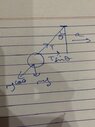
Right, but let's stick to inertial frames for the meantime. If the string hangs at an angle, say ##\theta##, to the vertical, then the tension will have both a horizontal and a vertical component - yes? What does Newton II say?
##T=\frac{F_i+ma}{\sin\theta}## where ##F_i## is fictitious force
 

Attachments

  • image.jpg
    image.jpg
    29 KB · Views: 121
rudransh verma said:
##T=\frac{F_i+ma}{\sin\theta}## where ##F_i## is fictitious force
You were advised (and I agree) to stick to an inertial frame. (Note that if you are using fictitious forces, you are in a frame moving with the ball and thus there's no acceleration.)

So, forget about using accelerated frames or fictitious forces. (You'll need them soon enough, but first get inertial frames down cold.) Draw the usual free body diagram for the ball: Only two forces act on it. Then apply Newton's 2nd law and see what you learn.

(Of course, I'm merely restating what @haruspex told you above.)
 
  • Like
Likes   Reactions: Lnewqban
Doc Al said:
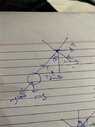
Draw the usual free body diagram for the ball: Only two forces act on it. Then apply Newton's 2nd law and see what you learn.
##T=mg\cos\theta+ma\sin\theta## (increased tension in rope as compared to T=mg).
 

Attachments

  • image.jpg
    image.jpg
    32.4 KB · Views: 177
rudransh verma said:
##T=mg\cos\theta+ma\sin\theta## (increased tension in rope as compared to T=mg).
Not sure what you're doing here. Do this: (1) Analyze vertical force components; (2) Analyze horizontal force components.
 
Doc Al said:
Not sure what you're doing here. Do this: (1) Analyze vertical force components; (2) Analyze horizontal force components.
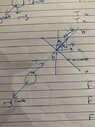
I aligned my axis along tension T. So the eqn comes out to be ##T-mg\cos\theta=ma\sin\theta##
 

Attachments

  • image.jpg
    image.jpg
    38.4 KB · Views: 177
  • image.jpg
    image.jpg
    42.2 KB · Views: 155
Last edited:
rudransh verma said:
I aligned my axis along tension T. So the eqn comes out to be ##T-mg\cos\theta=ma\sin\theta##
OK, fair enough. You'll need a second equation to solve for ##T## and ##\theta##.
 
What you have done so far is not incorrect. However, if you have to write Newton's second law in a situation where force vectors have angles between them that are other than zero or 180°, you have a two-dimensional situation which means that you have to write two equations no matter how you choose your coordinate axes. You cannot reduce the problem to one equation and you have an infinity of mutually perpendicular axes to choose from.

I have already indicated to you in another thread that, of all these choices, the algebra is made easier if the axes are oriented so that the acceleration is along one of them. Then the sum of the force components in the other direction will be zero. Of course, the final choice of axes is yours as is the task of figuring out what you could have done differently if you get stuck in the algebra.
 
Doc Al said:
OK, fair enough. You'll need a second equation to solve for ##T## and ##\theta##.
##T-mg\cos\theta=ma\sin\theta##
##mg\sin\theta=ma\cos\theta##
##T=ma##
 
kuruman said:
The third equation holds only when the acceleration and the tension are in the same direction. Are they? Please show how you got it.
Third is the result when I solved the above two eqns.