Does anyone know what this equipment is for?

  • Thread starter Thread starter nobahar
  • Start date Start date
  • Tags Tags
    Equipment
Click For Summary
SUMMARY

The discussed equipment is identified as a distillation apparatus, likely used for measuring boiling point temperature elevation and separating volatile substances. It consists of a conical flask, graduated boiling tube, and a larger glass container, with specific components designed for temperature control and liquid separation. The design suggests that the apparatus can operate above room temperature, potentially reaching 50°C or higher, and may be applicable in processes such as petroleum assay. The inclusion of a thermometer is essential for monitoring temperature during distillation.

PREREQUISITES
  • Understanding of distillation processes and apparatus design
  • Familiarity with temperature measurement techniques, including digital thermometers
  • Knowledge of volatile substance separation methods
  • Basic principles of thermodynamics related to boiling and condensation
NEXT STEPS
  • Research advanced distillation techniques and their applications in chemistry
  • Learn about the design and operation of digital thermometers in laboratory settings
  • Explore the principles of petroleum assay and its relevance to distillation
  • Investigate the effects of temperature control on distillation efficiency and yield
USEFUL FOR

Chemists, laboratory technicians, and anyone involved in distillation processes or volatile substance separation will benefit from this discussion.

nobahar
Messages
482
Reaction score
2
Hello,

I have found this chemistry equipment, but I cannot determine what it is for. I have a suspicion it is for measuring boiling point temperature elevation.

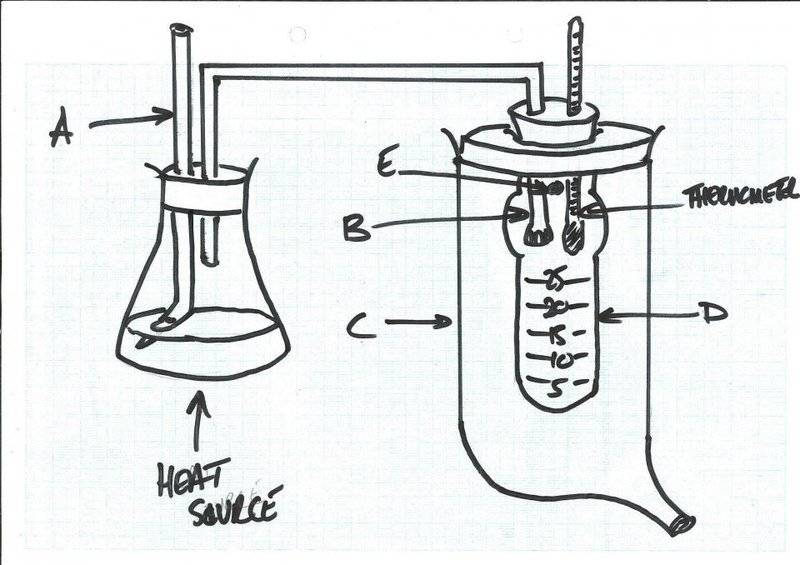
I have included a drawing of how I think it should go together. It consists of a conical flask connected to a graduated boiling tube (D) (for volume); the conical flask has a two-holed bung: one aperture contains a delivery tube (B) connected to the boiling tube (there are small holes in the delivery tube within the boiling tube, and the other has a glass cylinder passing vertically upwards, which is angled at the bottom (A; this might be to do with maintaining atmospheric pressure?). The boiling tube has a bulb on the upper portion. The boiling tube is contained within a larger glass container (C). There is an aperture in the boiling tube opening into the larger container (E). The larger container has a spout at the bottom.

So the liquid in the conical flask is heated and passes through E and condenses in the boiling tube (D). I am not sure if the delivery part, E, has to be lower, so that as the liquid condenses the delivery tube becomes submerged in the liquid. Then I am guessing the liquid that condenses in the boiling tube will at some point be hot enough to pass from the boiling tube, through aperture E into the larger container (C). Quite what is happening, I am not sure...
Qfqbv.jpg
 
  • Like
Likes   Reactions: Fervent Freyja
Chemistry news on Phys.org
It could certainly be used to separate methanol from your brand.
 
fresh_42 said:
It could certainly be used to separate methanol from your brand.

Funny...

Anyhow, I thought the drawing was quite nice.
 
Would it make coffee - water in the flask, coffee grinds in the boiling tube, and cup under the spout?
Steam should be demineralized.
 
I don't know what this is. Here are some ideas, based on your descriptions. First, as you know, anything except straight glass tubing adds to both cost and makes the equipment much more delicate, so nothing is done without a good reason (at least, in the mind of the designer). You appear to have drawn a hole in the side of A near the bottom. I've no explanation for that, which suggests that my other ideas are suspect. I assume A's design is intended to drip liquid down the side of the flask, so that the material at reflux is being added to very slowly and gradually. This is obviously some sort of separatory apparatus, but I do not know whether there is a reaction going on in the flask, nothing to confirm it, but nothing to contradict that idea. Anyway, some volatile is being separated and moved into D. The fact that B has "holes" at the bottom suggests it is being used submerged to bubble the evaporate through some liquid in order to collect (or react??) it. Since D is graduated, I'd assume there is some 'yield' expected. So both volume collected and temperature are used as control variables. As far as C is concerned, is it possible that there is a vacuum being pulled? I suppose that none of this necessarily has to be done under air, perhaps some gas is being introduced from A as well. The thing I like least about this is that the only temperature control, is from your heat source; no cooling is provided, in fact the C+D would tend to keep D's contents hot (with the exception of cooling due to gas flow). So, I'd further speculate that this is used well above room temperature (I'd guess at least 50°C if not double or triple that). Is it possible this has something to do with petroleum assay? I really don't know.
 
It looks like a distillation apparatus and I think the thermometer belongs on the side that is being heated (the left side). You could distill anything from water to petroleum products-for some processes it may be important to control the temperature. Nowadays they have digital thermometers connected to feedback loops that can carefully control the temperature. Previously, you would simply watch the temperature on the thermometer and add the heat as necessary.
 

Similar threads

  • · Replies 3 ·
Replies
3
Views
3K
  • · Replies 2 ·
Replies
2
Views
2K
  • · Replies 4 ·
Replies
4
Views
4K
  • · Replies 3 ·
Replies
3
Views
3K
  • · Replies 13 ·
Replies
13
Views
21K
  • · Replies 1 ·
Replies
1
Views
1K
  • · Replies 2 ·
Replies
2
Views
7K
Replies
2
Views
2K
  • · Replies 4 ·
Replies
4
Views
2K
  • · Replies 8 ·
Replies
8
Views
3K