Does Kutta Joukowski Theorem applies to Coanda effect (UAV)?

  • Context: Graduate 
  • Thread starter Thread starter godilocks9999
  • Start date Start date
  • Tags Tags
    Theorem Uav
Click For Summary

Discussion Overview

The discussion revolves around the applicability of the Kutta-Joukowski theorem (KJT) to a Coanda UAV design. Participants explore the mechanisms of lift generation in the context of the Coanda effect, contrasting it with traditional applications of KJT, which typically involve rotating cylinders and airfoils. The conversation includes theoretical considerations, experimental observations, and the challenges of modeling lift in this specific UAV context.

Discussion Character

  • Exploratory
  • Technical explanation
  • Debate/contested
  • Experimental/applied

Main Points Raised

  • One participant notes that the Coanda UAV lacks a mathematical model for its lift effects, relying instead on a generic lift expression involving dynamic pressure, area, and a coefficient.
  • Another participant argues that KJT does not apply to the Coanda UAV, emphasizing that the fundamental lift generation mechanism differs from that of airfoils, which rely on circulation in inviscid flow.
  • There is a suggestion that the UAV uses the Coanda effect to redirect exhaust downward, providing lift through thrust vectoring rather than traditional aerodynamic lift.
  • Concerns are raised about the applicability of lift coefficients, with one participant expressing skepticism about their relevance to the Coanda UAV's lift generation.
  • Another participant clarifies that KJT relates to net circulation and lift, stating that not all objects need a sharp trailing edge to generate lift, citing rotating cylinders as an example.
  • One participant shares experimental results indicating no lift augmentation when comparing propeller-only configurations to those with a Coanda fuselage, noting only minor lift losses.
  • There is a request for clarification on the Kutta condition, which involves the flow from the top and bottom surfaces meeting at a trailing edge for KJT to be applicable.

Areas of Agreement / Disagreement

Participants generally agree that the Kutta-Joukowski theorem does not apply to the Coanda UAV due to differing mechanisms of lift generation. However, there is no consensus on the implications of the Coanda effect or the effectiveness of the UAV's design in generating lift.

Contextual Notes

Participants express uncertainty regarding the assumptions behind lift coefficients and the specific conditions under which KJT can be applied, highlighting the complexity of modeling the Coanda effect in UAV design.

godilocks9999
Messages
3
Reaction score
0
Hi everyone,

I am currently working on a Coanda UAV and I am aware that there's no mathematical model to express the lifting effects of Coanda. It is more of a physical description of airflow movement. Correct me if I am wrong!

Thus, I am using the generic expression of lift to describe the lift forces generated by the UAV. (dynamic pressure*area*coefficient).

However, I am also curious if the Kutta Joukowski theorem can be applied to the Coanda UAV. From what I know KJT is for rotating cylinders and airfoils where Kutta condition must be met at the trailing edge. Coanda UAV doesn't seem to fulfill the requirement for KJT at all. Thus, I am currently presuming that (L=rho*velocity*circulation factor) cannot be applied to Coanda UAV.
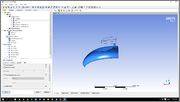
fuselage_view.jpg

Here's a view of my axis-symmetric model of the Coanda UAV. Air will flow from the wireframe immediately above the fuselage skin, on to the top surface of the fuselage and be directed downwards due to Coanda effect.
 
Physics news on Phys.org
While I am not 100% familiar with this particular variety of UAV, it does not appear to me that the Kutta-Joukowski theorem would apply. For one, the fundamental mechanism for lift generation is different here. The Kutta-Joukowski theorem applies to two-dimensional shapes (and 3D shapes that can be approximated as such) that operate by essentially setting up a net circulation superposed on the inviscid flow surrounding the object, such as an airfoil.

Really, this looks to me more like the craft uses the Coandă effect to basically bend the exhaust around the body and direct it downward, and it is this downward exhaust that provides "lift". Then you would end up placing some kind of series of vanes around the body to redirect this thrust in a more subtle way to allow forward and backward movement. Essentially, it looks like a fancy method of thrust vectoring that ultimately boils down to something akin to the LiftFan on the F-35, only it uses the Coandă effect to bend the initially non-vertical jet around the body. It isn't even clear to me what advantage this would provide versus a downward-facing fan aside from maybe some more complex thrust-vectoring options.

Application of lift coefficient here would not be straightforward, either. Lift coefficients generally are measured/calculated on shapes that are similar to those that would work just as well in the Kutta-Joukowski paradigm. You may still be able to find a coefficient correlating dynamic pressure (I assume generated by your fan?) to the lift produced, but ultimately I wouldn't be willing to assume that such a coefficient would have the same level of applicability, i.e. I wouldn't guarantee that lift is even proportional to dynamic pressure in the first place. Instead it will likely be some fraction of the downward thrust that would be generated by the fan alone, and you would lose some of that lift due to the angle (relative to vertical) at which the jet leaves the surface at the edge and viscous dissipation along the length of the surface due to both the boundary layer at the wall and the shear layer formed with the free-stream. I'd be surprised if the proportionality with dynamic pressure held in this case.
 
boneh3ad said:
While I am not 100% familiar with this particular variety of UAV, it does not appear to me that the Kutta-Joukowski theorem would apply. For one, the fundamental mechanism for lift generation is different here. The Kutta-Joukowski theorem applies to two-dimensional shapes (and 3D shapes that can be approximated as such) that operate by essentially setting up a net circulation superposed on the inviscid flow surrounding the object, such as an airfoil.

Really, this looks to me more like the craft uses the Coandă effect to basically bend the exhaust around the body and direct it downward, and it is this downward exhaust that provides "lift". Then you would end up placing some kind of series of vanes around the body to redirect this thrust in a more subtle way to allow forward and backward movement. Essentially, it looks like a fancy method of thrust vectoring that ultimately boils down to something akin to the LiftFan on the F-35, only it uses the Coandă effect to bend the initially non-vertical jet around the body. It isn't even clear to me what advantage this would provide versus a downward-facing fan aside from maybe some more complex thrust-vectoring options.

Application of lift coefficient here would not be straightforward, either. Lift coefficients generally are measured/calculated on shapes that are similar to those that would work just as well in the Kutta-Joukowski paradigm. You may still be able to find a coefficient correlating dynamic pressure (I assume generated by your fan?) to the lift produced, but ultimately I wouldn't be willing to assume that such a coefficient would have the same level of applicability, i.e. I wouldn't guarantee that lift is even proportional to dynamic pressure in the first place. Instead it will likely be some fraction of the downward thrust that would be generated by the fan alone, and you would lose some of that lift due to the angle (relative to vertical) at which the jet leaves the surface at the edge and viscous dissipation along the length of the surface due to both the boundary layer at the wall and the shear layer formed with the free-stream. I'd be surprised if the proportionality with dynamic pressure held in this case.

Really appreciate for the thorough opinion on my queries! With regards to Kutta-Joukowski theorem, it must fulfil the Kutta condition where the flow beneath and atop an airfoil surface meets at the trailing edge?
 
Not really. The Kutta-Joukowski theorem relates the net circulation around an object moving at a constant speed through a uniform fluid to the lift on that object. Not every object needs to have a sharp trailing edge. For example, a rotating cylinder has no trailing edge but generates lift, which can be calculated using the Kutta-Joukowski theorem. The flow does meet back up somewhere, but not at a traditional trailing edge.

I just don't think Kutta-Joukowski applies to your design because it doesn't fulfill these requirements. It isn't lift generated through movement through the air. It is lift generated by directing thrust downward.
 
  • Like
Likes   Reactions: godilocks9999
boneh3ad said:
Not really. The Kutta-Joukowski theorem relates the net circulation around an object moving at a constant speed through a uniform fluid to the lift on that object. Not every object needs to have a sharp trailing edge. For example, a rotating cylinder has no trailing edge but generates lift, which can be calculated using the Kutta-Joukowski theorem. The flow does meet back up somewhere, but not at a traditional trailing edge.

I just don't think Kutta-Joukowski applies to your design because it doesn't fulfill these requirements. It isn't lift generated through movement through the air. It is lift generated by directing thrust downward.

I would agree with you, I've done test and no lift augmentation was generated when i compare lift results from propeller only configuration and propeller plus coanda fuselage configuration.

The only positive behaviour i observed was that there was lesser lift losses than what i would expect from such a buff object in the wake of the propeller, about 6-8% loss. The skin friction drag should be a big contributor which would cause the latter configuration to differ largely from the 'propeller only' configuration.

which could mean that the coanda effect fuselage is efficient in facilitating the airflow downwards well enough to not cost major lift losses, despite its larger than propeller size. or the widely mentioned effect of air entrainment contributed lift to the aircraft which compensated for the drag loss, but this is hard to confirm experimentally.

Oh yes, I will like to confirm again on the Kutta condition that an flow over an object has to fulfil in order for KJT to be applicable:
Kutta condition is when flow from top and bottom surfaces must meet again?
 
Well it would be literally impossible for the top and bottom flow over an object to not meet, as there would be a vacuum, so yes, it is a requirement for the Kutta-Joukowski theorem to apply.

Maybe I am just both following what you are trying to describe?
 

Similar threads

  • · Replies 30 ·
2
Replies
30
Views
5K
  • · Replies 8 ·
Replies
8
Views
5K
  • · Replies 7 ·
Replies
7
Views
2K
Replies
6
Views
3K
Replies
2
Views
2K
  • · Replies 1 ·
Replies
1
Views
2K
  • · Replies 28 ·
Replies
28
Views
5K
  • · Replies 38 ·
2
Replies
38
Views
47K