Does Observing the Double Slit Collapse the Wave Function?

Click For Summary

Discussion Overview

The discussion revolves around the implications of observing particles in the double slit experiment, particularly focusing on whether observation causes the wave function to collapse and how this affects the perceived source of detected particles. Participants explore concepts related to wave-particle duality, the nature of photons, and interpretations of quantum mechanics.

Discussion Character

  • Debate/contested
  • Conceptual clarification
  • Exploratory

Main Points Raised

  • Some participants suggest that observing which slit a particle goes through causes the wave function to collapse, potentially altering the perceived source of the detected particle.
  • Others argue that the act of observation does not redirect particles to travel in a straight line but rather reshapes the probability distribution of their wave functions.
  • There is a contention regarding the interpretation of wave-particle duality, with some asserting that everything is fundamentally a wave until observed as a particle, while others view this as a duality interpretation.
  • Participants discuss the concept of delayed choice quantum erasure (DCQE) and how it allows for knowledge of which slit was used without physical perturbation, raising questions about the implications of such findings.
  • Some express skepticism about the fundamental nature of quarks and propose that particles are merely interpretations of underlying wave phenomena.
  • Concerns are raised about the uncertainty principle in relation to non-perturbative measurements in quantum mechanics.

Areas of Agreement / Disagreement

Participants express multiple competing views on the nature of observation in quantum mechanics, wave-particle duality, and the implications of DCQE. The discussion remains unresolved with no consensus on these interpretations.

Contextual Notes

Participants note limitations in understanding the implications of wave behavior and the challenges posed by various interpretations of quantum mechanics. The discussion also highlights the complexity of defining fundamental particles and the nature of measurement in quantum experiments.

ourben
Messages
5
Reaction score
0
Am I correct in thinking that the act of observing which slit a "particle" goes through causes the wave function to collapse, ergo making the source of the "particle" we detect on the back screen to actually be on our detection side of the slits rather than the emitter side?

I've drawn it, in case what I said didn't make sense...
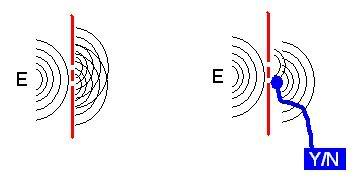
dualslit.jpg


Now, nobody has ever taught me so this might be wrong:

The way I understand optics, a collimator for example, doesn't actually redirect "particles" to travel in a straight line, what it actually does is reshape the probability that the wavefunction will collapse somewhere that is in that straight line path (I know they are the wrong words)...

I should add, I understand the wavefunction does collapse at the optics and is re-emitted in it's new shape/configuration.

Granted my understanding might be wrong; but this is the way I imagine it to be. Until the energy (photon) is absorbed (observed) it will continue to bounce (be emitted) from points in space (mirrors, lenses).

Also I don't believe in wave-particle duality - everything is a wave until it is a "particle", there is no such thing as both and when something does behave like a particle (a proton say) it is really that the contributory wave sources (quarks) are quantum jumping to new points of origin, giving the impression that a particle exists.

I don't think quarks are fundamental either, but that's another topic.
 
Physics news on Phys.org
ourben said:
Am I correct in thinking that the act of observing which slit a "particle" goes through causes the wave function to collapse, ergo making the source of the "particle" we detect on the back screen to actually be on our detection side of the slits rather than the emitter side?
….. doesn't actually redirect "particles" to travel in a straight line, …
No
if you want to think of it as the source changing to the barrier area you should do so for both slits, not just the one being observed.

And there is no “travel in a straight line” - IMO better to think of how a single slit works; it does not cause photons to travel in a straight line but redirects them in a dispersion pattern which is itself a ‘wave function’. Summing the two dispersion patterns of two independent slits give a minutely larger (based on separation of the slits) dispersion pattern of twice the intensity.
We still get this expected two slit dispersion pattern using two slits – what might be unexpected is that imbedded within the exact boundaries of that dispersion pattern is an interference pattern.

That something “collapses” due to local detection at one slit is an interpretation. It has unexplained challenges as most interpretations do. For example by not measuring anything at the slits a DCQE can select a small group of photons passing the slits and gain knowledge of which slit was used without perturbing them in any physical way. And by gaining that knowledge the inference pattern imbedded in the dispersion pattern is still “Erased”.
 
ourben said:
Also I don't believe in wave-particle duality - everything is a wave until it is a "particle", there is no such thing as both and when something does behave like a particle (a proton say) it is really that the contributory wave sources (quarks) are quantum jumping to new points of origin, giving the impression that a particle exists.
But we know a proton is not a fundamental particle and you are describing how its wave behavior reducing to a particle measurement can be accounted for by wave behaviors of Quarks jumping to new particle points of origin. Sorry, I’d have to view yours as a “wave-particle duality” interpretation.

I don't think quarks are fundamental either, but that's another topic.
Yes a separate topic for another thread – but not an unusual expectation. String Theory clearly expects strings to be more fundamental than most of the Standard Model particles.
 
RandallB said:
For example by not measuring anything at the slits a DCQE can select a small group of photons passing the slits and gain knowledge of which slit was used without perturbing them in any physical way.
How is that achieved?
 
Do a search in these forums for DCQE or google Delayed Choice Quantum Erasure.
You will fin plenty to review
 
RandallB said:
No
if you want to think of it as the source changing to the barrier area you should do so for both slits, not just the one being observed.

I didn't say otherwise.

RandallB said:
And there is no “travel in a straight line” - IMO better to think of how a single slit works; it does not cause photons to travel in a straight line but redirects them in a dispersion pattern which is itself a ‘wave function’.

I was talking about a collimator lens in that example, not the dual slit.


RandallB said:
That something “collapses” due to local detection at one slit is an interpretation.

Marvellous! I can live with that!

RandallB said:
It has unexplained challenges as most interpretations do.

Such as?

RandallB said:
For example by not measuring anything at the slits a DCQE can select a small group of photons passing the slits and gain knowledge of which slit was used without perturbing them in any physical way. And by gaining that knowledge the inference pattern imbedded in the dispersion pattern is still “Erased”.

It's interesting you said, without perturbing them in any physical way... maybe my knowledge is limited, but doesn't uncertainty principle say that is impossible?
 
RandallB said:
But we know a proton is not a fundamental particle and you are describing how its wave behavior reducing to a particle measurement can be accounted for by wave behaviors of Quarks jumping to new particle points of origin. Sorry, I’d have to view yours as a “wave-particle duality” interpretation.

Okay, I think I need to explain this again...

Hrmm...

You know how there is no such thing as colour, how although we interpret different wavelengths of light to be colours - it's my believe there is no such thing as particles, we interpret waves to be particles...

Make sense?

Of course, these waves must originate from somewhere, but that entity is not at all a particle by any classical interpretation or with any respect to the standard model.

RandallB said:
Yes a separate topic for another thread – but not an unusual expectation. String Theory clearly expects strings to be more fundamental than most of the Standard Model particles.

My own inquiring has led me to have a great deal of confidence in such a notion; however, string theory has done very little to woo me. I'd honestly go as far as demoting it to a religion. Having said that I haven't entirely turned off the possibility.
 
ourben said:
I didn't say otherwise.
Not when you said "the source of the "particle" we detect"
that says the source of the undetected ones going through the other slit do not change source location.
 
as far as I know

modern experiments show that light is made of particles, as in, the energy detected from a light source comes in separate sizeable quantities, just like when you stand infront of a tennis ball shooting machine, you feel them hitting you 1 by 1, when I aim a flashlight at you, the photons are hitting you 1 by 1.

of course the wavelike behavor of particles demands an explanation, the theory separates the particle from it's wavelike behavor, saying each particle's position has a certain probability, which is determined by the sum of the probabilities of all the paths a photon can go through to reach that position, and the probability for each of these paths is determined in a wavelike way.
of course it eventually still leaves us in the dark, and there's a big question of what is this wavelike thing which tells the photon where to go, where is it coming from, how "existing" it is, when does it all happen, and that is for another topic.

oh, and if we choose to believe in it, since so far it matches experiment better than any other known theory, by measuring one slit, you force the photon to either be there or not (since it's a particle), therefor it makes some kind of a stop by in the slit, to be detected by yourself. after it was detected (or not detected, therefor being in the other slit) it makes another journey from the slit to the screen, but that journey is different (different possible paths), therefor it's position on the screen is different, which usualy results as killing the interference pattern.
so in a way it is samiliar to what you said, by measuring the photon, we bring it to the slit, and set it free again from there, but only from one of the slits, no both at once.
 

Similar threads

  • · Replies 3 ·
Replies
3
Views
6K
  • · Replies 10 ·
Replies
10
Views
2K
  • · Replies 3 ·
Replies
3
Views
1K
  • · Replies 11 ·
Replies
11
Views
3K
  • · Replies 14 ·
Replies
14
Views
4K
  • · Replies 42 ·
2
Replies
42
Views
6K
  • · Replies 36 ·
2
Replies
36
Views
9K
  • · Replies 65 ·
3
Replies
65
Views
5K
  • · Replies 28 ·
Replies
28
Views
8K
  • · Replies 7 ·
Replies
7
Views
2K