Science Advisor
Gold Member
- 2,862
- 12,777
- TL;DR
- New articles have been recently published on dog evolution.
They cover the origin of dogs from wolves, a dog rediscovered in the wild, and selection schemes that might have been in play during dog domestication.
New dog genomes from a variety of current dogs as well as many ancient dog genomes have recently revealed a lot about dog evolution.
Article in Science (possibly pay-walled).
News article in Science.
NY Times article.
Dog origins:
It was thought that there might have been two origins of dogs from wolves (in different locations, which then interbred).
Now, it is thought to have been only one origin of dogs from wolves (although some still argue this point).
There were five distinct dog lineages by 11,000 years ago.
These got scrambled around, due to dog and human migrations.
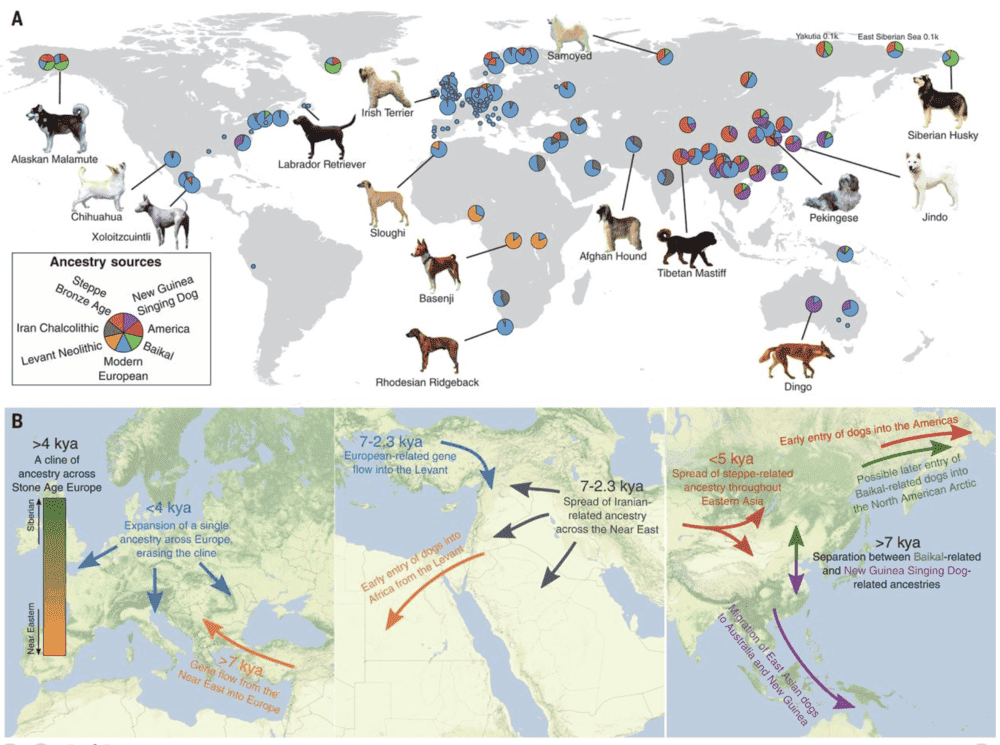
Dog and human migrations were tracked through genome analysis of ancient dog and human genomes from different places.
Dogs and humans mostly moved in together, but exceptions were found. Perhaps trading dogs between non-migrating groups of people.

There has been minimal gene flow from wolves to dogs since domestication, but substantial dog to wolf gene flow occurred.
Presumably because people would not want half wolves around that might kill them or their children.

Differences between recently developed (European) dog strains are largely the result of breeders manipulating a small number of genes with strong effects.The New Guinea (or Highland) Singing Dog has been rediscovered in the wild.
It is closely related to the dingo, doesn't hang out that much with humans, and can climb trees.
200 or 300 have been kept in captivity.

A new hypothesis about the mutual adaptive advantages for humans and pre-dogs (wolves) leading to domestication has been published.
It provides a new rationale for domestication.
NY Times article.
Open access research article (Nature).
During winter humans would be killing and eating large animals. Their most important parts to eat were fatty. They could only eat so much of the protein without getting protein poisoning (from eating too much protein).
Dogs (due to their different digestive system) could eat almost exclusively protein, and got leftovers humans did not want.
Because the humans (during winter) were not really in competition for the same food (protein for dogs vs. greater fat content for people), cooperative behavior could come more easily (both were persistent (following prey for a long distances) pack hunters at the time).
Leading to a closer association between humans and dogs, and in the long run, greater human control of dog reproduction (domestication).
Article in Science (possibly pay-walled).
News article in Science.
NY Times article.
Dog origins:
It was thought that there might have been two origins of dogs from wolves (in different locations, which then interbred).
Now, it is thought to have been only one origin of dogs from wolves (although some still argue this point).
There were five distinct dog lineages by 11,000 years ago.
These got scrambled around, due to dog and human migrations.
Dog and human migrations were tracked through genome analysis of ancient dog and human genomes from different places.
Dogs and humans mostly moved in together, but exceptions were found. Perhaps trading dogs between non-migrating groups of people.
There has been minimal gene flow from wolves to dogs since domestication, but substantial dog to wolf gene flow occurred.
Presumably because people would not want half wolves around that might kill them or their children.
Differences between recently developed (European) dog strains are largely the result of breeders manipulating a small number of genes with strong effects.The New Guinea (or Highland) Singing Dog has been rediscovered in the wild.
It is closely related to the dingo, doesn't hang out that much with humans, and can climb trees.
200 or 300 have been kept in captivity.
A new hypothesis about the mutual adaptive advantages for humans and pre-dogs (wolves) leading to domestication has been published.
It provides a new rationale for domestication.
NY Times article.
Open access research article (Nature).
During winter humans would be killing and eating large animals. Their most important parts to eat were fatty. They could only eat so much of the protein without getting protein poisoning (from eating too much protein).
Dogs (due to their different digestive system) could eat almost exclusively protein, and got leftovers humans did not want.
Because the humans (during winter) were not really in competition for the same food (protein for dogs vs. greater fat content for people), cooperative behavior could come more easily (both were persistent (following prey for a long distances) pack hunters at the time).
Leading to a closer association between humans and dogs, and in the long run, greater human control of dog reproduction (domestication).
Naomi Sykes, a zoo-archaeologist at the University of Exeter in Britain, who reviewed the paper for publication, said she thought the researchers made two important points. “The first is their suggestion that there would have been minimal dietary competition between humans and wolves.” The second, she said, was that their hypothesis “flips the idea of domestication” to people feeding animals rather than raising them to eat.
Last edited: