Are Animal Sounds in Different Languages Accurate Representations?

  • Context: Lingusitics 
  • Thread starter Thread starter BillTre
  • Start date Start date
Click For Summary

Discussion Overview

The discussion centers around the representation of animal sounds in different languages, particularly focusing on how these sounds are interpreted and expressed through human language. It includes various examples of how dogs' barks are represented in different cultures, as well as comparisons with other animals.

Discussion Character

  • Exploratory
  • Debate/contested
  • Conceptual clarification

Main Points Raised

  • Some participants question the authenticity of animal sounds represented in different languages, wondering if they are accurate or fabricated.
  • A participant notes that in German, the sound for a dog is represented as "Wau-Wau," which is pronounced similarly to "Wow" but starts with a "V."
  • Another participant expresses a personal anecdote about their dog, highlighting the emotional connection and the various sounds dogs make in different contexts.
  • One participant discusses the concept of onomatopoeia, suggesting that human representations of animal sounds are limited to the linguistic tools available to them.
  • A post provides a detailed overview of dog vocalizations, contrasting the sounds made by dogs and their wild ancestors, the wolves, and discussing the social nature of dogs.
  • Several participants share examples of how dogs' sounds are represented in Finnish and Polish, noting similarities in the sounds used in these languages.
  • One participant explores the Thai words for animals, noting that the sounds represented do not always align with the actual vocalizations of the animals.

Areas of Agreement / Disagreement

Participants express a range of views on the accuracy and representation of animal sounds across languages, with no clear consensus reached. Some agree on specific representations, while others highlight discrepancies and personal interpretations.

Contextual Notes

The discussion includes various assumptions about linguistic representation and cultural differences in interpreting animal sounds. Some claims rely on personal experiences and anecdotal evidence, which may not be universally applicable.

Who May Find This Useful

Readers interested in linguistics, animal behavior, cultural studies, or those curious about the intersection of language and sound may find this discussion relevant.
BillTre
Science Advisor
Gold Member
Messages
2,752
Reaction score
12,020
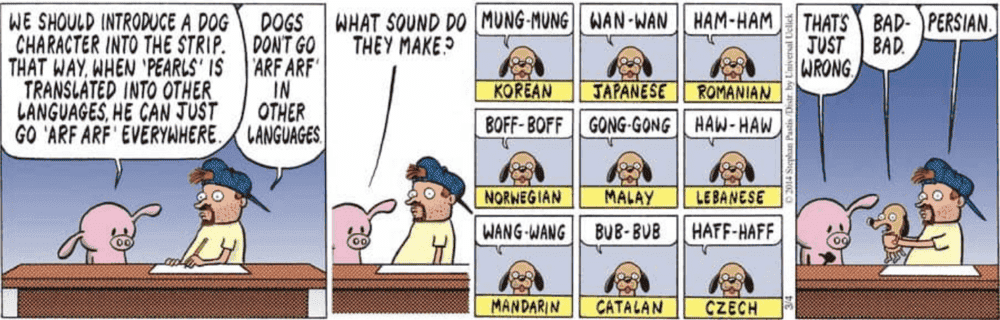
Are these real dogs sounds from other languages, or did the guy just make them up?

Screen Shot 2020-04-02 at 1.22.48 PM.png
 
  • Like
Likes   Reactions: hutchphd
Science news on Phys.org
Don't know the others, but in German it is Wau-Wau (pronounced like Wow but with a V at the beginning).
 
  • Like
  • Informative
Likes   Reactions: Klystron, Keith_McClary and BillTre
ARF !
 
  • Skeptical
  • Wow
Likes   Reactions: Keith_McClary and BillTre
My Gracie Girl coonhound whines when she knows it's time to eat, pee, jump on the king size bed . . . !:smile:
I love her and she knows it! :kiss:
 
The sounds of dogs are those which the dog makes. Any human attempt to represent some of those sounds using WORDED speech, like some word, "woof", or "arf", or the like, is just a piece of what A HUMAN DOES WITH WHATEVER LANGUAGE HE HAS OR KNOWS. Now we know why we are introduced to Onomatopoeia in junior high school and high school.
 
SCIENCE AND HISTORY

Dog Speak: The Sounds of Dogs

Understanding dog barks, more than just noise

By Julie Hecht, February 2013, Updated March 2020

[ . . . ]

Dogs are anything but mute, and while we usually focus on wagging tails and beguiling eyes, vocalizations—among them, barks and growls—provide us with another window into dogs’ everyday experiences.

[ . . .]

Social species are known to be much noisier than animals who lead solitary lives. Snow leopards roam the mountains of central Asia in near silence, but groups of monkeys do a lot of highvolume chattering. So, given that dogs and their wild progenitor, the wolf, are über-social, it’s no surprise that both produce a wide range of vocalizations: they bark, whine, whimper, howl, huff, growl, yelp and yip (among other nuanced sounds). From the earliest moments of their lives, dogs and their canid relatives produce tonal yelps and whines, and atonal barks and grunts appear in the first few weeks of life in conjunction with the onset of social behavior.

There’s a big difference between the bark of an adult dog and that of an adult wolf, however. Dogs seem to play every instrument in the orchestra, hitting the highs of the flute and the lows of the tuba, sometimes with the duration of a Wagnerian opera. Plus, there seems to be no context in which a dog won’t bark: They bark when alone and with other dogs. Some bark before, during and even after a ball is thrown. A car goes by or the doorbell rings and barking ensues. In contrast, wolves bark less frequently and in fewer contexts, primarily for warning or defense.

[ . . . ]

https://thebark.com/content/dog-speak-sounds-dogs
 
Finnish dogs say “hau-hau” (pretty much like “how-how” in English)

For other Finnish animals, see here.
 
  • Like
Likes   Reactions: BillTre
jtbell said:
Finnish dogs say “hau-hau” (pretty much like “how-how” in English)
Turns out Finnish dogs and Polish dogs speak the same language.
 
  • Like
  • Haha
Likes   Reactions: jtbell, Keith_McClary, hutchphd and 1 other person
  • #10
Bandersnatch said:
Turns out Finnish dogs and Polish dogs speak the same language.
And we have the same sound with a V at the beginning. The silent barks go "wuff = vooff".
 
  • Like
Likes   Reactions: BillTre
  • #11
While this thread is about the sounds dogs make, I am intrigued by words for animals.

The Thai word for dog หมา pronounced "ma" does not sound much like a bark to me.
The Thai word for cat แมว pronounced "meow" definitely sounds like a cat vocalization.

If you expect Thai for cow วัว to sound like "moo", you would be disappointed; cow is pronounced "uwa", somewhat similar to Latin for grape uva. In Thai "moo" means pig หมู .
 

Similar threads

  • · Replies 4 ·
Replies
4
Views
2K
  • · Replies 9 ·
Replies
9
Views
4K
  • · Replies 64 ·
3
Replies
64
Views
16K
  • · Replies 1 ·
Replies
1
Views
1K
  • · Replies 3 ·
Replies
3
Views
2K
Replies
34
Views
4K
  • · Replies 17 ·
Replies
17
Views
3K
  • · Replies 25 ·
Replies
25
Views
2K
  • · Replies 6 ·
Replies
6
Views
4K
  • Sticky
  • · Replies 0 ·
Replies
0
Views
4K