Door Code Locked Out: What to Do?

  • Thread starter Thread starter quantim
  • Start date Start date
Click For Summary
SUMMARY

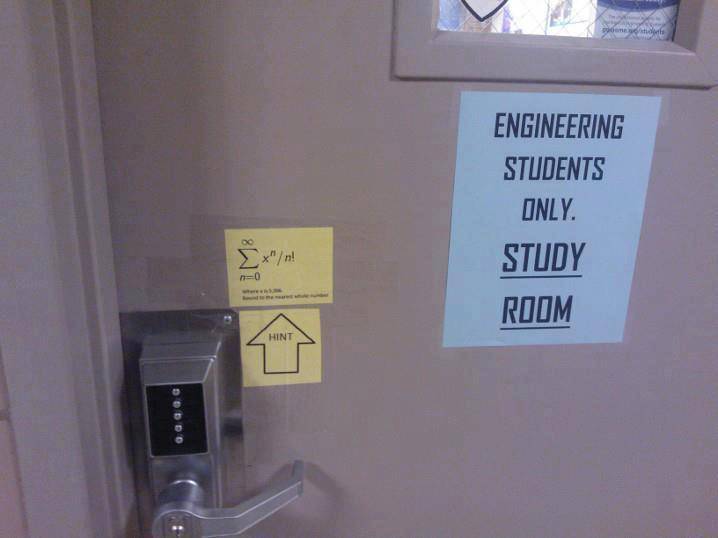
The door code in question is derived from the mathematical constant e, represented by the sequence 2718281828. The exact number of digits required for the code depends on the value of x, which is indicated in the fine print as "Where x=1.000". Understanding this relationship is crucial for determining the correct door code. The unreadable fine print adds an element of uncertainty, but the sequence itself is a well-known mathematical concept.

PREREQUISITES
  • Understanding of mathematical constants, specifically the constant e.
  • Familiarity with sequences and their applications in coding.
  • Basic knowledge of how to interpret mathematical notation.
  • Ability to read and analyze fine print or technical documentation.
NEXT STEPS
  • Research the mathematical constant e and its significance in various fields.
  • Learn about sequences and series in mathematics, focusing on their applications in coding.
  • Explore how to interpret and extract information from technical documentation.
  • Investigate common coding practices for implementing security codes based on mathematical sequences.
USEFUL FOR

This discussion is beneficial for mathematicians, software developers, and anyone involved in creating or deciphering security codes based on mathematical principles.

quantim
Messages
2
Reaction score
0
What the heck is the door code?

attachment.php?attachmentid=53382&stc=1&d=1353982142.jpg
 
Last edited by a moderator:
Mathematics news on Phys.org
2718281828 - Not sure how many digits it actually takes, but however many, they come from this sequence.
 
The series -- you should know that on sight.

The fine print underneath the series is unreadable. It looks like "Where x is ...", but I can't read the "...".
 
Ah, never mind. Didn't read the fine print. Well, I suppose, I couldn't have read the fine print, but DH's guess seems right.
 
K^2 said:
2718281828 - Not sure how many digits it actually takes, but however many, they come from this sequence.
You are assuming x=1 here. If the first line of text is, for example, "Where x=1.000", that tells an engineer how many digits it actually does take.
 
D H said:
The series -- you should know that on sight.

The fine print underneath the series is unreadable. It looks like "Where x is ...", but I can't read the "...".

Am I embarrassed for not recognizing it? Let me know. ;/
 
quantim said:
Am I embarrassed for not recognizing it? Let me know. ;/
Yes, you are. Or you should be.
 
quantim said:
What the heck is the door code?

attachment.php?attachmentid=53382&stc=1&d=1353982142.jpg

Please do not remove your posts once it has received replies.
 

Attachments

  • 526182_499989623355387_1859238220_n.jpg
    526182_499989623355387_1859238220_n.jpg
    24.3 KB · Views: 530
"Rounded to the nearest..."
 

Similar threads

  • · Replies 12 ·
Replies
12
Views
3K
  • · Replies 7 ·
Replies
7
Views
2K
  • · Replies 4 ·
Replies
4
Views
4K
Replies
3
Views
1K
  • · Replies 18 ·
Replies
18
Views
2K
  • · Replies 3 ·
Replies
3
Views
2K
  • · Replies 4 ·
Replies
4
Views
2K
  • · Replies 3 ·
Replies
3
Views
2K
  • · Replies 154 ·
6
Replies
154
Views
8K
  • · Replies 15 ·
Replies
15
Views
2K