Doppler effect with non-collinear source and observer motion

Join the discussion
Registration is free. Ask a follow-up in this thread, or start your own.
3 replies · 1K views
undividable
Messages
23
Reaction score
0
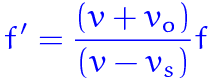
how does the doppler effect work when the observer and source are not moving in a straight line, what do we take in as the velocity of the observer and the source in the doppler effect equation?
source-and-observer-towards-each-other-png.187422.png
 
Physics news on Phys.org
What do you think?

Given the physics of what's going on there's only one plausible answer as far as I can see.
 
is it the velocity component that is parallel to the direction of the propagation of the wave?
 
Correct. You need to take care about what direction the wave is traveling because where the receiver is when it receives a pulse is not where it was when it was emitted (which can get messy if the receiver is accelerating). As long as you remember about leading a moving target when you set up your maths, you're fine.