Doppler Shift & Christoffel Symbols Issues

Click For Summary
SUMMARY

The forum discussion centers on the implementation of Christoffel symbols for the Schwarzschild metric in light physics simulations around black holes. A user reported an issue where the photon ring appeared flipped, leading to questions about potential coding errors or inaccuracies in Mathematica calculations. The conversation reveals that using Schwarzschild symbols in a Kerr spacetime context can yield incorrect results, and a temporary fix involved multiplying the symbols by 2, although this was deemed unsatisfactory. The discussion emphasizes the importance of correctly specifying the metric and coordinates used in simulations.

PREREQUISITES
  • Understanding of general relativity principles and metrics
  • Familiarity with Christoffel symbols and their applications
  • Proficiency in Mathematica for physics simulations
  • Knowledge of Schwarzschild and Kerr black hole metrics
NEXT STEPS
  • Research the derivation of Christoffel symbols for Kerr black holes
  • Learn about the implications of using Schwarzschild metrics in non-static spacetimes
  • Explore advanced Mathematica techniques for simulating gravitational fields
  • Study the effects of Doppler shifts in light emissions from rotating accretion discs
USEFUL FOR

Physicists, astrophysicists, and computational scientists working on simulations of black hole physics and general relativity.

Jessie24789
Messages
8
Reaction score
4
TL;DR
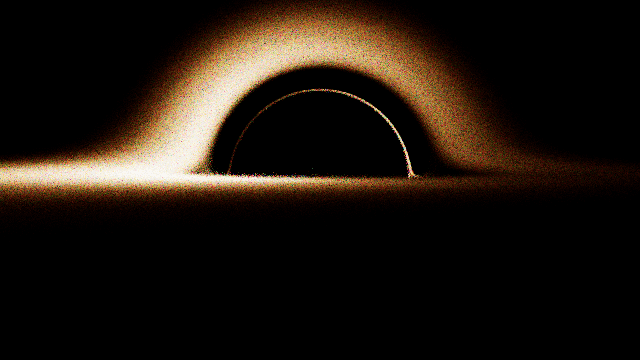
I am doing simulations of black holes in GLSL and recently stopped using a general calculation in shader. Now my photon ring has a bright spot opposite the accretion disk bright spot.
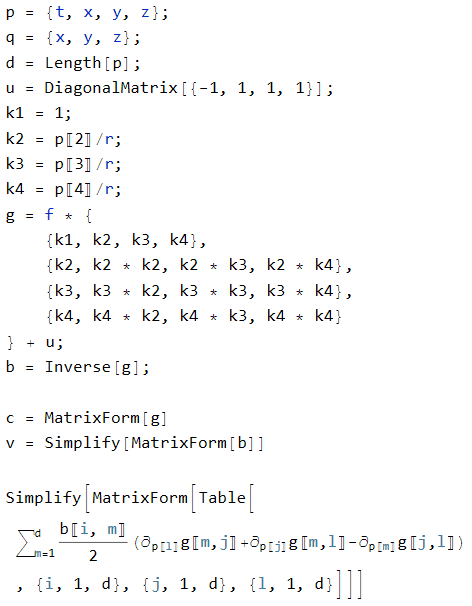
About a month or two ago I started doing simulations of light physics around black holes and yesterday I got a fast Christoffel symbols function for the Schwarzschild metric in cartesian coordinates, but now the photon ring appears flipped. I feel as though it is wrong. But as I am still pretty new to general relativity, I am not sure. Would the physics allow for this to happen, or is it caused by an oversight in the code? Or is the Mathematica calculation of it incorrect?

Included below is the code I am using as well as an image showing the results of the simulation.
Screenshot 2022-12-14 184557.png

[CODE title="GLSL Code"]mat4[4] SchwarzschildChristoffel(in vec4 q) {
vec3 position = q.yzw;

float rho = dot(position,position);
float r2 = 0.5*(rho + sqrt(rho*rho));
float r = sqrt(r2);

float x = position.x;
float y = position.y;
float z = position.z;

float f = (G / r2) * (2.0 * M * r);

vec4 empty = vec4(0.0);
mat4 T0 = mat4(
empty,
vec4(0.0, (f * r) / ((f - 1.0) * r2 - f * rho), 0.0, 0.0),
vec4(0.0, 0.0, (f * r) / ((f - 1.0) * r2 - f * rho), 0.0),
vec4(0.0, 0.0, 0.0, (f * r) / ((f - 1.0) * r2 - f * rho))
);
mat4 T1 = mat4(
empty,
vec4(0.0, (f * x) / (-((f - 1.0) * r2) + f * rho), 0.0, 0.0),
vec4(0.0, 0.0, (f * x) / (-((f - 1.0) * r2) + f * rho), 0.0),
vec4(0.0, 0.0, 0.0, (f * x) / (-((f - 1.0) * r2) + f * rho))
);
mat4 T2 = mat4(
empty,
vec4(0.0, (f * y) / (-((f - 1.0) * r2) + f * rho), 0.0, 0.0),
vec4(0.0, 0.0, (f * y) / (-((f - 1.0) * r2) + f * rho), 0.0),
vec4(0.0, 0.0, 0.0, (f * y) / (-((f - 1.0) * r2) + f * rho))
);
mat4 T3 = mat4(
empty,
vec4(0.0, (f * z) / (-((f - 1.0) * r2) + f * rho), 0.0, 0.0),
vec4(0.0, 0.0, (f * z) / (-((f - 1.0) * r2) + f * rho), 0.0),
vec4(0.0, 0.0, 0.0, (f * z) / (-((f - 1.0) * r2) + f * rho))
);

return mat4[4](
T0,
T1,
T2,
T3
);
}

vec4 ParallelTransportRateOfChange(mat4[4] christoffelSymbols, vec4 v, vec4 dxds) {
vec4 dvds = vec4(0.0);
dvds -= vec4(christoffelSymbols[0][0][0], christoffelSymbols[1][0][0], christoffelSymbols[2][0][0], christoffelSymbols[3][0][0]) * dxds[0] * v[0];
dvds -= vec4(christoffelSymbols[0][0][1], christoffelSymbols[1][0][1], christoffelSymbols[2][0][1], christoffelSymbols[3][0][1]) * dxds[0] * v[1];
dvds -= vec4(christoffelSymbols[0][0][2], christoffelSymbols[1][0][2], christoffelSymbols[2][0][2], christoffelSymbols[3][0][2]) * dxds[0] * v[2];
dvds -= vec4(christoffelSymbols[0][0][3], christoffelSymbols[1][0][3], christoffelSymbols[2][0][3], christoffelSymbols[3][0][3]) * dxds[0] * v[3];
dvds -= vec4(christoffelSymbols[0][1][0], christoffelSymbols[1][1][0], christoffelSymbols[2][1][0], christoffelSymbols[3][1][0]) * dxds[1] * v[0];
dvds -= vec4(christoffelSymbols[0][1][1], christoffelSymbols[1][1][1], christoffelSymbols[2][1][1], christoffelSymbols[3][1][1]) * dxds[1] * v[1];
dvds -= vec4(christoffelSymbols[0][1][2], christoffelSymbols[1][1][2], christoffelSymbols[2][1][2], christoffelSymbols[3][1][2]) * dxds[1] * v[2];
dvds -= vec4(christoffelSymbols[0][1][3], christoffelSymbols[1][1][3], christoffelSymbols[2][1][3], christoffelSymbols[3][1][3]) * dxds[1] * v[3];
dvds -= vec4(christoffelSymbols[0][2][0], christoffelSymbols[1][2][0], christoffelSymbols[2][2][0], christoffelSymbols[3][2][0]) * dxds[2] * v[0];
dvds -= vec4(christoffelSymbols[0][2][1], christoffelSymbols[1][2][1], christoffelSymbols[2][2][1], christoffelSymbols[3][2][1]) * dxds[2] * v[1];
dvds -= vec4(christoffelSymbols[0][2][2], christoffelSymbols[1][2][2], christoffelSymbols[2][2][2], christoffelSymbols[3][2][2]) * dxds[2] * v[2];
dvds -= vec4(christoffelSymbols[0][2][3], christoffelSymbols[1][2][3], christoffelSymbols[2][2][3], christoffelSymbols[3][2][3]) * dxds[2] * v[3];
dvds -= vec4(christoffelSymbols[0][3][0], christoffelSymbols[1][3][0], christoffelSymbols[2][3][0], christoffelSymbols[3][3][0]) * dxds[3] * v[0];
dvds -= vec4(christoffelSymbols[0][3][1], christoffelSymbols[1][3][1], christoffelSymbols[2][3][1], christoffelSymbols[3][3][1]) * dxds[3] * v[1];
dvds -= vec4(christoffelSymbols[0][3][2], christoffelSymbols[1][3][2], christoffelSymbols[2][3][2], christoffelSymbols[3][3][2]) * dxds[3] * v[2];
dvds -= vec4(christoffelSymbols[0][3][3], christoffelSymbols[1][3][3], christoffelSymbols[2][3][3], christoffelSymbols[3][3][3]) * dxds[3] * v[3];
return dvds;
}
float Doppler(in vec3 photonDirection, in vec3 velocity) {
float lorentzFactor = 1.0 / sqrt(1.0 - dot(velocity, velocity));
float doppler = lorentzFactor * (1.0 + dot(photonDirection, velocity));
}[/CODE]
Simulated Schwarzschild Black Hole.png
 
Physics news on Phys.org
Well, that looks like an image of a Kerr black hole with an accretion disc. Using Christoffel symbols from Schwarzschild spacetime is not going to give you correct answers in a Kerr spacetime...
 
  • Like
Likes   Reactions: vanhees71
Ibix said:
Well, that looks like an image of a Kerr black hole with an accretion disc. Using Christoffel symbols from Schwarzschild spacetime is not going to give you correct answers in a Kerr spacetime...
I can assure you it is not a Kerr black hole. I am in the process of implementing the Christoffel symbols for a Kerr black hole, but that simulation is using the Schwarzschild metric for the spacetime and the symbols.
 
I could not figure out how to edit the post, so I will say it here. I forgot to mention something, specifically that I tried multiplying the Christoffel symbols by 2 and that appears to fix it. But that multiply feels wrong.
 
I would have expected an image in a Schwarzschild metric to show left-right symmetry. But perhaps you are also simulating the emissions from a rotating accretion disc and the Doppler effects of that are responsible for the asymmetry?
 
Ibix said:
I would have expected an image in a Schwarzschild metric to show left-right symmetry. But perhaps you are also simulating the emissions from a rotating accretion disc and the Doppler effects of that are responsible for the asymmetry?
That is correct. My apologies for not making that clear in the original post.
 
  • Like
Likes   Reactions: Ibix
What's the functional form of your metric? Is it:
$$\pmatrix{1-\frac{R_S}r&0&0&0\cr
0&-1-{{R_Sx^2}\over{r^2(r-R_S)}}&-{{R_Sxy}\over{r^2(r-R_S)}}&-{{R_Sxz}\over{r^2(r-R_S)}}\cr
0&-{{R_Sxy}\over{r^2(r-R_S)}}&-1-{{R_Sy^2}\over{r^2(r-R_S)}}&-{{R_Syz}\over{r^2(r-R_S)}}\cr0&-{{R_Sxz}\over{r^2(r-R_S)}}&-{{R_Syz}\over{r^2(r-R_S)}}&-1-{{R_Sz^2}\over{r^2(r-R_S)}}\cr}$$(Did this on the train - errors are possible...)
 
Ibix said:
What's the functional form of your metric? Is it:
$$\pmatrix{1-\frac{R_S}r&0&0&0\cr
0&-1-{{R_Sx^2}\over{r^2(r-R_S)}}&-{{R_Sxy}\over{r^2(r-R_S)}}&-{{R_Sxz}\over{r^2(r-R_S)}}\cr
0&-{{R_Sxy}\over{r^2(r-R_S)}}&-1-{{R_Sy^2}\over{r^2(r-R_S)}}&-{{R_Syz}\over{r^2(r-R_S)}}\cr0&-{{R_Sxz}\over{r^2(r-R_S)}}&-{{R_Syz}\over{r^2(r-R_S)}}&-1-{{R_Sz^2}\over{r^2(r-R_S)}}\cr}$$(Did this on the train - errors are possible...)
1671127477248.png

Kind of. It is this. f is Rs / r. I even tested it to make sure the equation is correct for the Schwarzschild metric in cartesian coordinates, well technically Kerr-Schild but that is just a cartesian coordinate system. I derived the metric from Reissner-Nordström in Kerr-Schild coordinates, as that becomes Schwarzschild if the charge is zero.
 
Ah. Mine is for "Cartesianised" Schwarzschild coordinates, which correspond to Boyer-Lindquist coordinates in the Kerr metric with zero angular momentum. I'll try starting with Kerr-Schild later.

This is why you should always specify exactly what coordinates you're using...
 
  • #10
I haven't bothered re-deriving your metric. I've just confirmed that it's spherically symmetric, vacuum, and has a time-like Killing vector field. Thus by Birkhoff's theorem it's the Schwarzschild metric, so I don't see any mistakes there.

The Christoffel symbols I get from it are rather messy and I've only made limited efforts to spot the ones that are the same. You can them a few against your code and check they're the same:
$$\begin{eqnarray*}
\Gamma^t_{tt}&=&{{R_S^2}\over{2r^3}}\\
\Gamma^t_{tx}=\Gamma^t_{xt}&=&{{\left(R_Sr+R_S^2\right)x}\over{2r^4}}\\
\Gamma^t_{ty}=\Gamma^t_{yt}&=&{{\left(R_Sr+R_S^2\right)y}\over{2r^4}}\\
\Gamma^t_{tz}=\Gamma^t_{zt}&=&{{\left(R_Sr+R_S^2\right)z}\over{2r^4}}\\
\Gamma^t_{xx}&=&{{\left(4R_Sr+R_S^2\right)x^2-2R_Sr^3 }\over{2r^5}}\\
\Gamma^t_{xy}=\Gamma^t_{yx}&=&{{\left(4R_Sr+R_S^2\right)xy}\over{2r^5}}\\
\Gamma^t_{xz}=\Gamma^t_{zx}&=&{{\left(4R_Sr+R_S^2\right)xz}\over{2r^5}}\\
\Gamma^t_{yy}&=&{{\left(4R_Sr+R_S^2\right)y^2-2R_Sr^3 }\over{2r^5}}\\
\Gamma^t_{yz}=\Gamma^t_{zy}&=&{{\left(4R_Sr+R_S^2\right)yz}\over{2r^5}}\\
\Gamma^t_{zz}&=&{{\left(4R_Sr+R_S^2\right)z^2-2R_Sr^3 }\over{2r^5}}\\
\Gamma^x_{tt}&=&{{\left(R_Sr-R_S^2\right)x}\over{2r^4}}\\
\Gamma^x_{tx}=\Gamma^x_{xt}&=&-{{R_S^2x^2}\over{2r^5}}\\
\Gamma^x_{xx}&=&-{{\left(3R_Sr+R_S^2\right)x^3-2R_Sr^3x }\over{2r^6}}\\
\Gamma^x_{xy}=\Gamma^x_{yx}&=&-{{\left(3R_Sr+R_S^2\right)x^2y}\over{2r^6}}\\
\Gamma^x_{xz}=\Gamma^x_{zx}&=&-{{\left(3R_Sr+R_S^2\right)x^2z}\over{2r^6}}\\
\Gamma^x_{yy}&=&-{{\left(3R_Sr+R_S^2\right)xy^2-2R_Sr^3 x}\over{2r^6}}\\
\Gamma^x_{zz}&=&-{{\left(3R_Sr+R_S^2\right)xz^2-2R_Sr^3 x}\over{2r^6}}\\
\Gamma^y_{tt}&=&{{\left(R_Sr-R_S^2\right)y}\over{2r^4}}\\
\Gamma^y_{tx}=\Gamma^y_{xt}=\Gamma^x_{ty}=\Gamma^x_{yt}&=&-{{R_S^2xy}\over{2r^5}}\\
\Gamma^y_{ty}=\Gamma^y_{yt}&=&-{{R_S^2y^2}\over{2r^5}}\\
\Gamma^y_{xx}&=&-{{\left(\left(3R_Sr+R_S^2\right)x^2-2R_Sr ^3\right)y}\over{2r^6}}\\
\Gamma^y_{xy}=\Gamma^y_{yx}&=&-{{\left(3R_Sr+R_S^2\right)xy^2}\over{2r^6}}\\
\Gamma^y_{yy}&=&-{{\left(3R_Sr+R_S^2\right)y^3-2R_Sr^3y }\over{2r^6}}\\
\Gamma^y_{yz}=\Gamma^y_{zy}&=&-{{\left(3R_Sr+R_S^2\right)y^2z}\over{2r^6}}\\
\Gamma^y_{zz}&=&-{{\left(3R_Sr+R_S^2\right)yz^2-2R_Sr^3 y}\over{2r^6}}\\
\Gamma^z_{tt}&=&{{\left(R_Sr-R_S^2\right)z}\over{2r^4}}\\
\Gamma^z_{tx}=\Gamma^z_{xt}=\Gamma^x_{tz}=\Gamma^x_{zt}&=&-{{R_S^2xz}\over{2r^5}}\\
\Gamma^z_{ty}=\Gamma^z_{yt}=\Gamma^y_{tz}=\Gamma^y_{zt}&=&-{{R_S^2yz}\over{2r^5}}\\
\Gamma^z_{tz}=\Gamma^z_{zt}&=&-{{R_S^2z^2}\over{2r^5}}\\
\Gamma^z_{xx}&=&-{{\left(\left(3R_Sr+R_S^2\right)x^2-2R_Sr ^3\right)z}\over{2r^6}}\\
\Gamma^z_{xy}=\Gamma^z_{yx}=\Gamma^y_{xz}=\Gamma^y_{zx}=\Gamma^x_{yz}=\Gamma^x_{zy}&=&-{{\left(3R_Sr+R_S^2\right)xyz}\over{2r^6}}\\
\Gamma^z_{xz}=\Gamma^z_{zx}&=&-{{\left(3R_Sr+R_S^2\right)xz^2}\over{2r^6}}\\
\Gamma^z_{yy}&=&-{{\left(\left(3R_Sr+R_S^2\right)y^2-2R_Sr ^3\right)z}\over{2r^6}}\\
\Gamma^z_{yz}=\Gamma^z_{zy}&=&-{{\left(3R_Sr+R_S^2\right)yz^2}\over{2r^6}}\\
\Gamma^z_{zz}&=&-{{\left(3R_Sr+R_S^2\right)z^3-2R_Sr^3z }\over{2r^6}}
\end{eqnarray*}$$Hint: quote my post to see the LaTeX source, paste it into a code editor, and search and replace will get you most of the way to valid code in your language of choice.
 
  • #11
Ibix said:
I haven't bothered re-deriving your metric. I've just confirmed that it's spherically symmetric, vacuum, and has a time-like Killing vector field. Thus by Birkhoff's theorem it's the Schwarzschild metric, so I don't see any mistakes there.

The Christoffel symbols I get from it are rather messy and I've only made limited efforts to spot the ones that are the same. You can them a few against your code and check they're the same:
$$\begin{eqnarray*}
\Gamma^t_{tt}&=&{{R_S^2}\over{2r^3}}\\
\Gamma^t_{tx}=\Gamma^t_{xt}&=&{{\left(R_Sr+R_S^2\right)x}\over{2r^4}}\\
\Gamma^t_{ty}=\Gamma^t_{yt}&=&{{\left(R_Sr+R_S^2\right)y}\over{2r^4}}\\
\Gamma^t_{tz}=\Gamma^t_{zt}&=&{{\left(R_Sr+R_S^2\right)z}\over{2r^4}}\\
\Gamma^t_{xx}&=&{{\left(4R_Sr+R_S^2\right)x^2-2R_Sr^3 }\over{2r^5}}\\
\Gamma^t_{xy}=\Gamma^t_{yx}&=&{{\left(4R_Sr+R_S^2\right)xy}\over{2r^5}}\\
\Gamma^t_{xz}=\Gamma^t_{zx}&=&{{\left(4R_Sr+R_S^2\right)xz}\over{2r^5}}\\
\Gamma^t_{yy}&=&{{\left(4R_Sr+R_S^2\right)y^2-2R_Sr^3 }\over{2r^5}}\\
\Gamma^t_{yz}=\Gamma^t_{zy}&=&{{\left(4R_Sr+R_S^2\right)yz}\over{2r^5}}\\
\Gamma^t_{zz}&=&{{\left(4R_Sr+R_S^2\right)z^2-2R_Sr^3 }\over{2r^5}}\\
\Gamma^x_{tt}&=&{{\left(R_Sr-R_S^2\right)x}\over{2r^4}}\\
\Gamma^x_{tx}=\Gamma^x_{xt}&=&-{{R_S^2x^2}\over{2r^5}}\\
\Gamma^x_{xx}&=&-{{\left(3R_Sr+R_S^2\right)x^3-2R_Sr^3x }\over{2r^6}}\\
\Gamma^x_{xy}=\Gamma^x_{yx}&=&-{{\left(3R_Sr+R_S^2\right)x^2y}\over{2r^6}}\\
\Gamma^x_{xz}=\Gamma^x_{zx}&=&-{{\left(3R_Sr+R_S^2\right)x^2z}\over{2r^6}}\\
\Gamma^x_{yy}&=&-{{\left(3R_Sr+R_S^2\right)xy^2-2R_Sr^3 x}\over{2r^6}}\\
\Gamma^x_{zz}&=&-{{\left(3R_Sr+R_S^2\right)xz^2-2R_Sr^3 x}\over{2r^6}}\\
\Gamma^y_{tt}&=&{{\left(R_Sr-R_S^2\right)y}\over{2r^4}}\\
\Gamma^y_{tx}=\Gamma^y_{xt}=\Gamma^x_{ty}=\Gamma^x_{yt}&=&-{{R_S^2xy}\over{2r^5}}\\
\Gamma^y_{ty}=\Gamma^y_{yt}&=&-{{R_S^2y^2}\over{2r^5}}\\
\Gamma^y_{xx}&=&-{{\left(\left(3R_Sr+R_S^2\right)x^2-2R_Sr ^3\right)y}\over{2r^6}}\\
\Gamma^y_{xy}=\Gamma^y_{yx}&=&-{{\left(3R_Sr+R_S^2\right)xy^2}\over{2r^6}}\\
\Gamma^y_{yy}&=&-{{\left(3R_Sr+R_S^2\right)y^3-2R_Sr^3y }\over{2r^6}}\\
\Gamma^y_{yz}=\Gamma^y_{zy}&=&-{{\left(3R_Sr+R_S^2\right)y^2z}\over{2r^6}}\\
\Gamma^y_{zz}&=&-{{\left(3R_Sr+R_S^2\right)yz^2-2R_Sr^3 y}\over{2r^6}}\\
\Gamma^z_{tt}&=&{{\left(R_Sr-R_S^2\right)z}\over{2r^4}}\\
\Gamma^z_{tx}=\Gamma^z_{xt}=\Gamma^x_{tz}=\Gamma^x_{zt}&=&-{{R_S^2xz}\over{2r^5}}\\
\Gamma^z_{ty}=\Gamma^z_{yt}=\Gamma^y_{tz}=\Gamma^y_{zt}&=&-{{R_S^2yz}\over{2r^5}}\\
\Gamma^z_{tz}=\Gamma^z_{zt}&=&-{{R_S^2z^2}\over{2r^5}}\\
\Gamma^z_{xx}&=&-{{\left(\left(3R_Sr+R_S^2\right)x^2-2R_Sr ^3\right)z}\over{2r^6}}\\
\Gamma^z_{xy}=\Gamma^z_{yx}=\Gamma^y_{xz}=\Gamma^y_{zx}=\Gamma^x_{yz}=\Gamma^x_{zy}&=&-{{\left(3R_Sr+R_S^2\right)xyz}\over{2r^6}}\\
\Gamma^z_{xz}=\Gamma^z_{zx}&=&-{{\left(3R_Sr+R_S^2\right)xz^2}\over{2r^6}}\\
\Gamma^z_{yy}&=&-{{\left(\left(3R_Sr+R_S^2\right)y^2-2R_Sr ^3\right)z}\over{2r^6}}\\
\Gamma^z_{yz}=\Gamma^z_{zy}&=&-{{\left(3R_Sr+R_S^2\right)yz^2}\over{2r^6}}\\
\Gamma^z_{zz}&=&-{{\left(3R_Sr+R_S^2\right)z^3-2R_Sr^3z }\over{2r^6}}
\end{eqnarray*}$$Hint: quote my post to see the LaTeX source, paste it into a code editor, and search and replace will get you most of the way to valid code in your language of choice.
Thank you, I appreciate the assistance. I will implement those and let you know the results. I do have a question though. What did you use to calculate them? I want to know so I can calculate them in a similar, or even the same, way for other metrics, since I do need the Christoffel symbols for the Kerr metric and a few other metrics.
 
Last edited:
  • #12
Maxima. It's a free symbolic algebra package and its ctensor library (plus a bit of ingenuity in simplifying things) will spit out what you need. It has a fairly steep learning curve, but check out my Insight article on it (tap/click the orange Insight Author badge in the header of my posts) and former PF Mentor Ben Crowell's free online GR book (www.lightandmatter.com/genrel) for some code. I can post what I used to generate the above tomorrow.
 
  • #13
Ibix said:
Maxima. It's a free symbolic algebra package and its ctensor library (plus a bit of ingenuity in simplifying things) will spit out what you need. It has a fairly steep learning curve, but check out my Insight article on it (tap/click the orange Insight Author badge in the header of my posts) and former PF Mentor Ben Crowell's free online GR book (www.lightandmatter.com/genrel) for some code. I can post what I used to generate the above tomorrow.
I actually installed Maxima before Mathematica since I do not have $300 to spend on a math program, but I could not figure out how to use Maxima, due to exhaustion from bare sleeping the nights before, so I got the free trial of Mathematica. However, once the trial runs out I shall start using Maxima so I can continue this stuff. Once again, thank you for the assistance and help. It is very much appreciated.
 
  • Like
Likes   Reactions: Ibix and vanhees71
  • #14
Here's the Maxima code. Sorry it took me longer to get to pasting this in than I thought it would - it needed a bit of cleaning, but I took the opportunity to add some comments. Hope it's helpful!
Code:
load(ctensor);

/* Define the metric (lower indices) */
dim:4;
ct_coords:[t,x,y,z];
f:Rs/r;
lg:matrix([-1+f,f*x/r,f*y/r,f*z/r],
		[f*x/r,1+f*x^2/r^2,f*x*y/r^2,f*x*z/r^2],
		[f*y/r,f*x*y/r^2,1+f*y^2/r^2,f*y*z/r^2],
		[f*z/r,f*x*z/r^2,f*y*z/r^2,1+f*z^2/r^2]);

/* Manifestly symmetric under interchange of spatial coordinates. Check that */
/* it's symmetric under rotation about x - that is enough to confirm that    */
/* it's spherically symmetric.                                               */
R:matrix([1,0,0,0],
          [0,1,0,0],
          [0,0,cos(psi),sin(psi)],
          [0,0,-sin(psi),cos(psi)]);

lgr:R.lg.transpose(R);
trigsimp(substitute([y=yp*cos(psi)-zp*sin(psi),
			z=yp*sin(psi)+zp*cos(psi)],lgr));

/* Grind through to the Christoffel symbols */
depends(r,[x,y,z]);     /* Warn Maxima that r is a function of x, y, and z. */
cmetric(false);         /* Compute the inverse metric. */
christof(false);        /* Compute the Christoffel symbols. */

/* Simplify the Christoffel symbols. Replace dr/dx with x/r (etc) and      */
/* x^2+y^2+z^2 with r^2. Unfortunately the latter means a bit of mucking   */
/* around to make sure we don't replace an isolated x^2, y^2 or z^2. So we */
/* try replacing x^2 with r^2-y^2-z^2, then try y^2 then z^2, and keep the */
/* shortest expression.                                                    */
diffDefs:[diff(r,x)=x/r, diff(r,y)=y/r, diff(r,z)=z/r];
for i:1 thru 4 do block (
  for j:1 thru 4 do block (
    for k:1 thru 4 do block (
      [temp,shortest],
      shortest:ratsimp(subst([x^2=r^2-y^2-z^2],subst(diffDefs,mcs[i,j,k]))),
      temp:ratsimp(subst([y^2=r^2-x^2-z^2],subst(diffDefs,mcs[i,j,k]))),
      if length(args(expand(temp))) < length(args(expand(shortest))) then block(
        shortest:temp
      ),
      temp:ratsimp(subst([z^2=r^2-x^2-y^2],subst(diffDefs,mcs[i,j,k]))),
      if length(args(expand(temp))) < length(args(expand(shortest))) then block(
        shortest:temp
      ),
      mcs[i,j,k]:shortest,
      /* Print Christoffel symbols in tex form */
      print("\\Gamma^",ct_coords[k],"_{",ct_coords[i],ct_coords[j],"}="),
      tex(mcs[i,j,k])
    )
  )
);

/* Finally, generate and simplify the Ricci tensor to check this is a vacuum */
ricci(false);
for i:1 thru 4 do block (
  for j:1 thru 4 do block (
    ric[i,j]: radcan(substitute(diffDefs,ric[i,j])),
    ric[i,j]: radcan(substitute([r=sqrt(x^2+y^2+z^2)],ric[i,j]))
  )
);
cdisplay(ric);
I tend to use Maxima because I know more or less what I'm doing with it. Another thing you could look into is the python SymPy symbolic algebra package. I've been meaning to learn how to use it for a while (it's a lot more modern than Maxima) but never get round to it, but it might be a better place to start if you aren't overly invested in Maxima.
 
  • Like
Likes   Reactions: vanhees71
  • #16
Ibix said:
Here's the Maxima code. Sorry it took me longer to get to pasting this in than I thought it would - it needed a bit of cleaning, but I took the opportunity to add some comments. Hope it's helpful!
Code:
load(ctensor);

/* Define the metric (lower indices) */
dim:4;
ct_coords:[t,x,y,z];
f:Rs/r;
lg:matrix([-1+f,f*x/r,f*y/r,f*z/r],
        [f*x/r,1+f*x^2/r^2,f*x*y/r^2,f*x*z/r^2],
        [f*y/r,f*x*y/r^2,1+f*y^2/r^2,f*y*z/r^2],
        [f*z/r,f*x*z/r^2,f*y*z/r^2,1+f*z^2/r^2]);

/* Manifestly symmetric under interchange of spatial coordinates. Check that */
/* it's symmetric under rotation about x - that is enough to confirm that    */
/* it's spherically symmetric.                                               */
R:matrix([1,0,0,0],
          [0,1,0,0],
          [0,0,cos(psi),sin(psi)],
          [0,0,-sin(psi),cos(psi)]);

lgr:R.lg.transpose(R);
trigsimp(substitute([y=yp*cos(psi)-zp*sin(psi),
            z=yp*sin(psi)+zp*cos(psi)],lgr));

/* Grind through to the Christoffel symbols */
depends(r,[x,y,z]);     /* Warn Maxima that r is a function of x, y, and z. */
cmetric(false);         /* Compute the inverse metric. */
christof(false);        /* Compute the Christoffel symbols. */

/* Simplify the Christoffel symbols. Replace dr/dx with x/r (etc) and      */
/* x^2+y^2+z^2 with r^2. Unfortunately the latter means a bit of mucking   */
/* around to make sure we don't replace an isolated x^2, y^2 or z^2. So we */
/* try replacing x^2 with r^2-y^2-z^2, then try y^2 then z^2, and keep the */
/* shortest expression.                                                    */
diffDefs:[diff(r,x)=x/r, diff(r,y)=y/r, diff(r,z)=z/r];
for i:1 thru 4 do block (
  for j:1 thru 4 do block (
    for k:1 thru 4 do block (
      [temp,shortest],
      shortest:ratsimp(subst([x^2=r^2-y^2-z^2],subst(diffDefs,mcs[i,j,k]))),
      temp:ratsimp(subst([y^2=r^2-x^2-z^2],subst(diffDefs,mcs[i,j,k]))),
      if length(args(expand(temp))) < length(args(expand(shortest))) then block(
        shortest:temp
      ),
      temp:ratsimp(subst([z^2=r^2-x^2-y^2],subst(diffDefs,mcs[i,j,k]))),
      if length(args(expand(temp))) < length(args(expand(shortest))) then block(
        shortest:temp
      ),
      mcs[i,j,k]:shortest,
      /* Print Christoffel symbols in tex form */
      print("\\Gamma^",ct_coords[k],"_{",ct_coords[i],ct_coords[j],"}="),
      tex(mcs[i,j,k])
    )
  )
);

/* Finally, generate and simplify the Ricci tensor to check this is a vacuum */
ricci(false);
for i:1 thru 4 do block (
  for j:1 thru 4 do block (
    ric[i,j]: radcan(substitute(diffDefs,ric[i,j])),
    ric[i,j]: radcan(substitute([r=sqrt(x^2+y^2+z^2)],ric[i,j]))
  )
);
cdisplay(ric);
I tend to use Maxima because I know more or less what I'm doing with it. Another thing you could look into is the python SymPy symbolic algebra package. I've been meaning to learn how to use it for a while (it's a lot more modern than Maxima) but never get round to it, but it might be a better place to start if you aren't overly invested in Maxima.
I do intend on learning how to use SymPy, and actually started this entire journey with the Christoffel symbols by trying to learn it. I gave up and went for something simpler after seeing how much of a pain it would be to convert the output to GLSL code. I do however plan on going back to it eventually, just not now. Thank you for the Maxima code btw, it is very helpful. And the comments definitely help with that.
 
  • Like
Likes   Reactions: Ibix

Similar threads

  • · Replies 11 ·
Replies
11
Views
2K
  • · Replies 6 ·
Replies
6
Views
7K
  • · Replies 19 ·
Replies
19
Views
6K
  • · Replies 8 ·
Replies
8
Views
2K
  • · Replies 75 ·
3
Replies
75
Views
7K
  • · Replies 6 ·
Replies
6
Views
2K
  • · Replies 5 ·
Replies
5
Views
3K
  • · Replies 1 ·
Replies
1
Views
2K
  • · Replies 17 ·
Replies
17
Views
3K
  • · Replies 12 ·
Replies
12
Views
3K