Double integral Problem (with solution)

Click For Summary
SUMMARY

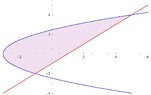
The discussion focuses on evaluating the double integral $\iint_{R} xy \, dA$ over the region $R$ bounded by the line $y = x - 1$ and the parabola $y^2 = 2x + 6$. The iterated integral is established as $I=\int_{-2}^{4} y\int_{\frac{y^2-6}{2}}^{y+1} x\,dx\,dy$, leading to the conclusion that $I=36$. Participants discuss the setup of the integral using horizontal strips and provide insights into the intersection points of the curves involved.

PREREQUISITES
  • Understanding of double integrals in calculus
  • Knowledge of iterated integrals and their setup
  • Familiarity with curves and their intersections
  • Ability to apply the quadratic formula for solving polynomials
NEXT STEPS
  • Study the method of evaluating double integrals using horizontal and vertical strips
  • Learn about the properties of parabolas and linear equations in calculus
  • Explore the application of the quadratic formula in finding intersection points of curves
  • Investigate advanced techniques for solving double integrals in different coordinate systems
USEFUL FOR

Students and educators in calculus, mathematicians interested in integral calculus, and anyone looking to deepen their understanding of double integrals and region boundaries in multivariable calculus.

DrWahoo
Messages
45
Reaction score
0
Evaluate (use attached figure for depiction) $ \iint_{R} \, xy \, dA $

where $R$ is the region bounded by the line
$y = x - 1$ and the parabola $y^2 = 2 x + 6$.

View attachment 7598

I will post solution in just a moment with a reply.
 

Attachments

  • integration-region-page-001.jpg
    integration-region-page-001.jpg
    29.6 KB · Views: 127
Physics news on Phys.org
Anyone want to attempt a solution or give some hints?
 
I would use horizontal strips, where:

$$\frac{y^2-6}{2}\le x\le y+1$$

And these strips run from:

$$-2\le y\le4$$

And so we obtain the iterated integral:

$$I=\int_{-2}^{4} y\int_{\Large{\frac{y^2-6}{2}}}^{y+1} x\,dx\,dy$$

I will leave it to a student to demonstrate:

$$I=36$$
 
Thanks mark. I will give a little intuition as well and let a student come up with the result. This is just a reiteration of Marks work.

Based off of $\Bbb{R}$ pick to integrate with respect to $x$ first.
This would imply; that the boundaries of the region in the $x$ direction would be;
$x=\frac{(y^2)-6}{2} $ and $x=y+1$.

Now find the range, that is the range of values for $y$. In order to do this we need to find the $y$-coordinates in the points of the intersection between the following two curves;
$y=x-1$ and $y^2 =2x-6$.

Substituting $x=y+1$ into the second equation we obtain;
$y^2 =2(y+1)+6 $

Solve by factoring or quadratic formula to find the roots of the polynomial.
So we have $(y-4)(y+2)=0$ $\implies$ $y=4, y=-2$

Now try to set up the integrals to find the region requested;
I will give everyone a chance to set it up and or solve.

Thanks Mark.
MarkFL said:
I would use horizontal strips, where:

$$\frac{y^2-6}{2}\le x\le y+1$$

And these strips run from:

$$-2\le y\le4$$

And so we obtain the iterated integral:

$$I=\int_{-2}^{4} y\int_{\Large{\frac{y^2-6}{2}}}^{y+1} x\,dx\,dy$$

I will leave it to a student to demonstrate:

$$I=36$$
 
If you really want to use vertical strips, so that you are integrating with respect to x rather than y, you will need to break this into two integrals, one from -3 to -1, the other from -1 to 5.
 

Similar threads

  • · Replies 5 ·
Replies
5
Views
2K
Replies
5
Views
2K
Replies
4
Views
2K
  • · Replies 10 ·
Replies
10
Views
3K
  • · Replies 5 ·
Replies
5
Views
2K
  • · Replies 7 ·
Replies
7
Views
3K
  • · Replies 2 ·
Replies
2
Views
3K
  • · Replies 2 ·
Replies
2
Views
2K
  • · Replies 20 ·
Replies
20
Views
4K
  • · Replies 2 ·
Replies
2
Views
2K