Double Slit Diffraction with Angled Light

Click For Summary
SUMMARY

The discussion centers on solving the double slit diffraction problem with angled light, specifically addressing the relationship between interference maxima and the angles involved. The key equations presented are sinθ = (mλ)/d and tanθ = ym/L, with the participant attempting to derive ym using θ = 40 degrees. The confusion arises from the fixed angle β and the need to solve for θo without knowing the wavelength or slit separation. The small-angle approximation is considered but not definitively applicable in this scenario.

PREREQUISITES
  • Understanding of double slit diffraction principles
  • Familiarity with trigonometric identities and relationships
  • Knowledge of interference patterns and maxima
  • Ability to apply small-angle approximations in physics
NEXT STEPS
  • Research the derivation of the double slit diffraction formula
  • Study the implications of fixed angles in diffraction problems
  • Explore the small-angle approximation in various contexts
  • Learn about the significance of wavelength and slit separation in interference patterns
USEFUL FOR

Physics students, educators, and researchers interested in wave optics and diffraction phenomena will benefit from this discussion.

ab200
Messages
13
Reaction score
3
Homework Statement
Suppose that a laser beam hits a double-slit apparatus at an angle of β = 40 degrees with respect to the normal. The screen is a distance L away, with slit width a and slit separation d.

Derive a symbolic expression for locating the double-slit interference maxima. At what angle θo is the center of the interference pattern located on the screen? Is the interference pattern symmetric about that angle?
Relevant Equations
dsinθ = mλ (maxima)
tanθ = ym / L
Given that [y][/m] is equal to the position of the interference maxima and is the variable I’m solving for. I got as far as setting up two expressions, one for sinθ and the other for tanθ.

sinθ = (mλ)/d
tanθ = ym/L

My first instinct was to set θ = 40 degrees. By relating sinθ and tanθ to each other through cosθ, I get:

ym = (Lmλ) / (dcos40)

However, I don’t think this makes sense if I have to solve for θo in the second part of the question, so θ must not be fixed. I’m confused about how I am supposed to use the given value of β, but I assume it must be relevant.

If I were able to use small-angle approximation, sinθ ≈ tanθ, but does this still apply here?
 

Attachments

  • 16B6B9E7-E7F0-4248-A4F6-400C5457F3B7.jpeg
    16B6B9E7-E7F0-4248-A4F6-400C5457F3B7.jpeg
    27.3 KB · Views: 131
Physics news on Phys.org
There are many ways to do this. Personally I would look at the two paths and figure the difference in distance using plane geometry. ( Make a good drawing of the path near the plate. ) Then write down the condition for each max assuming β to be held fixed
 
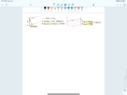
This drawing is from my notes, but this is also what I was thinking for this problem. (Ignore the s1, that’s just a reference point.) I‘m still a bit confused by what you mean with “the condition for each max assuming β to be held fixed.” In this case, β is explicitly held fixed at 40 degrees, no? Is there an assumption I’m making without realizing it?
 

Attachments

  • CBAD53D5-28DC-4513-B75B-8F005D66B9C3.png
    CBAD53D5-28DC-4513-B75B-8F005D66B9C3.png
    10.3 KB · Views: 116
Yes I meant that you are interested in solving for θm (in fact only for θ0 ) in terms of the other parameters.
 
I see what you mean and why that is the goal, but I‘m still short-circuiting on what to do in order to get there. For instance, I suppose I could say θm = sin-1[(mλ)/d] = tan-1(ym/L), but is that really a sufficient symbolic expression?

And assuming that it is, how does that help me find θo since I don’t know wavelength or slit separation?
 

Similar threads

  • · Replies 2 ·
Replies
2
Views
2K
  • · Replies 1 ·
Replies
1
Views
2K
  • · Replies 34 ·
2
Replies
34
Views
3K
  • · Replies 3 ·
Replies
3
Views
2K
Replies
1
Views
2K
  • · Replies 3 ·
Replies
3
Views
7K
  • · Replies 8 ·
Replies
8
Views
7K
  • · Replies 2 ·
Replies
2
Views
1K
  • · Replies 4 ·
Replies
4
Views
22K
  • · Replies 10 ·
Replies
10
Views
2K