Doubt regarding derivation of De Broglie relation

Click For Summary

Discussion Overview

The discussion revolves around the derivation of the de Broglie relation, focusing on the integration constant in the context of wave packets and momentum. Participants explore the implications of setting the constant to zero and the physical reasoning behind it, as well as the nature of wavenumber and momentum as vector quantities.

Discussion Character

  • Exploratory
  • Technical explanation
  • Debate/contested
  • Mathematical reasoning

Main Points Raised

  • One participant questions the justification for setting the integration constant to zero in the derivation of the de Broglie relation.
  • Another participant suggests that symmetry considerations imply the constant must be zero, arguing that a change in the sign of momentum should also change the sign of wavenumber.
  • Concerns are raised about whether wavenumber is a scalar or vector quantity, with one participant asserting that it is a vector, which supports the symmetry argument.
  • Participants discuss the implications of a zero momentum condition, noting that it leads to an infinite wavelength and the behavior of wave packets under such conditions.
  • There are discussions about the group velocity of waves and how it relates to the mean momentum and wavenumber, with some participants elaborating on the statistical nature of group velocity.
  • One participant seeks clarification on how to evaluate the group velocity derivative and whether it should be averaged over various points in space or over wavenumber values.
  • A formula for the mean position of a wave packet is presented, linking it to the group velocity and the significance of evaluating derivatives at peak wavenumber values.

Areas of Agreement / Disagreement

Participants express differing views on the nature of the integration constant and its implications, with no consensus reached on the justification for setting it to zero. The discussion includes multiple competing perspectives on the relationship between momentum, wavenumber, and group velocity.

Contextual Notes

Some participants highlight the complexity of the derivation when considering vector quantities and the need for careful treatment of mathematical expressions. There are also unresolved questions regarding the assumptions made in the derivation and the implications of zero momentum.

Who May Find This Useful

This discussion may be of interest to those studying quantum mechanics, wave-particle duality, and the mathematical foundations of wave mechanics, particularly in the context of the de Broglie relation and wave packet analysis.

weezy
Messages
92
Reaction score
5
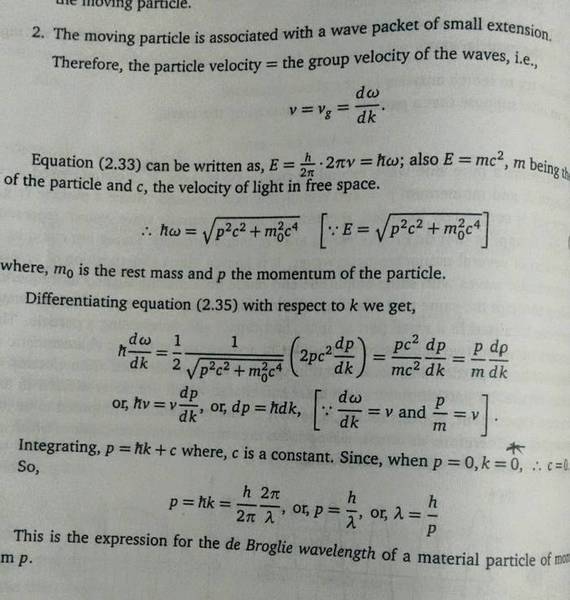
For someone who's familiar with the de Broglie relation it's easy to say that for k=0 we have p=0 but how would we know that before deriving the result? In this image the author derives de Broglie relation by considering a wave packet in motion. As you can see where I have star-marked the author sets integration constant c=0 without giving reason. This has been bothering me since you can't just
8PT69.jpg
 
Physics news on Phys.org
I think you can use symmetry considerations to understand that the integration constant c must be zero.

In particular, we would require that changing the sign (direction) of p also changes the sign of k. This is perfectly legitimate, as this is what a coordinate flip would do.

If
p=\hbar k + c,
and
(-p) = \hbar (-k) +c
then adding these two equations together gives
0=2c, or c=0.
 
jfizzix said:
I think you can use symmetry considerations to understand that the integration constant c must be zero.

In particular, we would require that changing the sign (direction) of p also changes the sign of k. This is perfectly legitimate, as this is what a coordinate flip would do.

If
p=\hbar k + c,
and
(-p) = \hbar (-k) +c
then adding these two equations together gives
0=2c, or c=0.
I think where this proof could be wrong is because k is a scalar quantity isn't it? And scalar quantities can't flip signs like that. Correct me if I'm wrong.
 
the wavenumber k is a vector quantity with magnitude and direction, just like momentum. If you take all the above quantities to refer to one-dimensional propagation, this will work out just fine.

Alternatively, if you explicitly use the vector expressions of k and p throughout this derivation, you should be able to show that
\hbar = \frac{\partial p_{x}}{\partial k_{x}}=\frac{\partial p_{y}}{\partial k_{y}}=\frac{\partial p_{z}}{\partial k_{z}}.
It gets a little tricky toward the end, but since what you derive must be true for all (p_{x},p_{y},p_{z}), you can make some simplifications.
 
Last edited:
jfizzix said:
the wavenumber k is a vector quantity with magnitude and direction, just like momentum. If you take all the above quantities to refer to one-dimensional propagation, this will work out just fine.

Alternatively, if you explicitly use the vector expressions of k and p throughout this derivation, you should be able to show that
\hbar = \frac{\partial p_{x}}{\partial k_{x}}=\frac{\partial p_{y}}{\partial k_{y}}=\frac{\partial p_{z}}{\partial k_{z}}.
It gets a little tricky toward the end, but since what you derive must be true for all (p_{x},p_{y},p_{z}), you can make some simplifications.
While I find your proof correct now(after considering k as a vector) and satisfying what's the physical reason you would give to argue the constant must be 0?
 
When I visualizer the situation for P=0, the wavelength becomes infinite. What does this imply? @jfizzix
 
weezy said:
While I find your proof correct now(after considering k as a vector) and satisfying what's the physical reason you would give to argue the constant must be 0?

The physical reason I would give is that the magnitude of the wave number as well as the momentum should be constant under a reflection of coordinates.
 
weezy said:
When I visualizer the situation for P=0, the wavelength becomes infinite. What does this imply? @jfizzix
It helps to recall that the group velocity of a wave is only approximately \frac{\partial\omega}{\partial k}, and that each frequency component travels at its own velocity, so that the group velocity is a statistical average (equal to the rate of change of the mean position of the pulse).

The derivation we're discussing here shows that the mean momentum is equal to hbar times the mean wavenumber. If the mean momentum is zero, the mean position of the pulse is stationary, but the pulse itself spreads out in time, since it will have components moving at nonzero velocities.

If the wave's momentum components were tightly clustered near zero, then the wavepacket would spread out in opposite directions very quickly.
 
  • Like
Likes   Reactions: weezy
jfizzix said:
It helps to recall that the group velocity of a wave is only approximately \frac{\partial\omega}{\partial k}, and that each frequency component travels at its own velocity, so that the group velocity is a statistical average (equal to the rate of change of the mean position of the pulse).

The derivation we're discussing here shows that the mean momentum is equal to hbar times the mean wavenumber. If the mean momentum is zero, the mean position of the pulse is stationary, but the pulse itself spreads out in time, since it will have components moving at nonzero velocities.

If the wave's momentum components were tightly clustered near zero, then the wavepacket would spread out in opposite directions very quickly.
You mean the phase component waves move out rapidly in opp. directions?
 
  • #10
I mean the positive frequency components move in the opposite direction as the negative frequency components.

If the pulse is very narrow in space/time, then it will have to have very many wavenumber/frequency components, some of which will be moving a lot faster, simply because there are more significant frequency components making up the wave.
 
  • Like
Likes   Reactions: weezy
  • #11
jfizzix said:
It helps to recall that the group velocity of a wave is only approximately \frac{\partial\omega}{\partial k}, and that each frequency component travels at its own velocity, so that the group velocity is a statistical average (equal to the rate of change of the mean position of the pulse).

The derivation we're discussing here shows that the mean momentum is equal to hbar times the mean wavenumber. If the mean momentum is zero, the mean position of the pulse is stationary, but the pulse itself spreads out in time, since it will have components moving at nonzero velocities.

If the wave's momentum components were tightly clustered near zero, then the wavepacket would spread out in opposite directions very quickly.
Also when you say that group velocity is \frac{\partial\omega}{\partial k} does this mean that if I were to find the velocity of a group packet, I'd have to evaluate this derivative at various points in space? And then sum average all the values to get an approximate number? Or just evaluate the derivatives for all values of k in the group and then sum average over k?
 
  • #12
Where a wave \Psi(x,t)can be decomposed into an integral of plane waves, each with amplitude A(k), we have:
\Psi(x,t)=\frac{1}{\sqrt{2\pi}}\int dk A(k) e^{i(kx - \omega(k) t)}.
The time derivative of the mean position \langle x\rangle as weighted according to intensity |\Psi(x,t)|^{2}, can be given by the following formula.

\frac{d\langle x\rangle}{dt}=\int dk |A(k)|^{2} \Big(\frac{\partial \omega(k)}{\partial k}\Big),

so that when \Big(\frac{\partial \omega(k)}{\partial k}\Big) is nearly constant over the significant wavenumbers of |A(k)|^{2}, we get the approximate formula for the group velocity.

Then, it is understood that \frac{\partial \omega(k)}{\partial k} is to be evaluated at the peak value of k for the pulse under consideration. The three-dimensional version of this derivation follows the same steps without a substantial increase in difficulty.

Technically, the group velocity is the velocity of the pulse envelope (which itself only makes sense for very narrowband pulses), but this formula is how I make sense of it.
 
  • Like
Likes   Reactions: weezy
  • #13
Thanks for your time and answers :)
 

Similar threads

  • · Replies 3 ·
Replies
3
Views
2K
  • · Replies 6 ·
Replies
6
Views
3K
  • · Replies 40 ·
2
Replies
40
Views
6K
  • · Replies 28 ·
Replies
28
Views
5K
  • · Replies 4 ·
Replies
4
Views
2K
  • · Replies 17 ·
Replies
17
Views
5K
  • · Replies 8 ·
Replies
8
Views
2K
  • · Replies 1 ·
Replies
1
Views
3K
  • · Replies 14 ·
Replies
14
Views
5K
  • · Replies 1 ·
Replies
1
Views
2K