Doubt regarding relative acceleration

  • Context: High School 
  • Thread starter Thread starter Dark85
  • Start date Start date
Click For Summary
SUMMARY

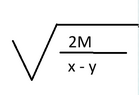
This discussion confirms that when two bodies, A and B, start from rest with body A "M" meters behind body B and undergo uniform accelerations of "x" m/s² and "y" m/s² respectively (where x > y), body A will catch up with body B after a time calculated by the formula $$\sqrt{\frac{2M}{x-y}}$$. The conversation emphasizes the importance of using correct kinematic notation, such as using "a_1" and "a_2" for accelerations, and clarifies the role of initial velocity in displacement calculations. The discussion also highlights that relative motion concepts apply to both two and three-dimensional scenarios.

PREREQUISITES
  • Understanding of kinematic equations
  • Familiarity with uniform acceleration concepts
  • Knowledge of relative motion principles
  • Basic proficiency in LaTeX for mathematical notation
NEXT STEPS
  • Study the derivation of kinematic equations for uniform acceleration
  • Learn about relative motion in two and three dimensions
  • Explore advanced topics in dynamics, such as collision theory
  • Practice using LaTeX for formatting mathematical expressions
USEFUL FOR

Students studying physics, educators teaching kinematics, and professionals in engineering fields who require a solid understanding of motion dynamics.

Dark85
Messages
30
Reaction score
5
TL;DR
If two objects are separated at a distance and start from rest with a uniform acceleration, when will the object behind catch up?
Hey everyone,
I would just like to confirm if the following is correct:
If there are 2 bodies A and B and they both start from rest such that A is "M" meters behind B and once they start, they undergo a uniform acceleration of "x" m/s^2 for A and "y" m/s^2 for B, such that x>y, then A would catch up with B after:

1745207051090.png
 

Attachments

  • 1745207033768.png
    1745207033768.png
    1.8 KB · Views: 43
Physics news on Phys.org
You are correct.
 
  • Like
Likes   Reactions: Dark85
Baluncore said:
You are correct.
Alright, thank you!
 
If you are going to post maths here, you probably want to read the LaTeX Guide, linked below the reply box. This:$$\sqrt{\frac{2M}{x-y}}$$is a lot more readable than your image.

Note that the first time LaTeX is added to a page the parser doesn't always kick in. If you see letters, back slashes and curly brackets instead of maths, refresh the page.
 
  • Like
Likes   Reactions: Dark85
Sure.. will do so next time
 
  • Like
Likes   Reactions: Ibix
Dark85 said:
TL;DR Summary: If two objects are separated at a distance and start from rest with a uniform acceleration, when will the object behind catch up?

Hey everyone,
I would just like to confirm if the following is correct:
If there are 2 bodies A and B and they both start from rest such that A is "M" meters behind B and once they start, they undergo a uniform acceleration of "x" m/s^2 for A and "y" m/s^2 for B, such that x>y, then A would catch up with B after:
View attachment 360146
Although you can use whatever notation you like, in kinematics its conventional to use ##M## for mass rather than distance, ##x, y## for the x and y coordinates and something like ##a_1, a_2## for two accelerations.

More generally, if two objects have initial displacements ##x_1(0)## and ##x_2(0)##, initial velocities ##v_1(0)## and ##v_2(0)## and constant accelerations ##a_1## and ##a_2##, then the displacements at time ##t## are the usual:
$$x_1(t) = x_1(0) + v_1(0)t + \frac 1 2 a_1t^2, \ \ x_2(t) = x_2(0) + v_2(0)t + \frac 1 2 a_2t^2$$And we can define the displacement of object 2 relative to object 1 as:
$$x_{21}(t) \equiv x_2(t) - x_1(t)$$And we have:$$x_{21}(t) = \big ( x_2(0) - x_1(0) \big ) + \big (v_2(0) - v_1(0) \big ) t + \frac 1 2 \big (a_2 - a_1 \big )t^2$$The important point is that this is equivalent to the displacement of an object with initial position ##x(0) = x_2(0) - x_1(0)##, initial velocity ##v(0) = v_2(0) - v_1(0)## and constant acceleration ##a = a_2 - a_1##.

This means that we can look at the scenario as though object 1 were at rest and only object 2 were moving. Or, vice versa.

Note finally that the concept of relative motion extents to the case of two and three dimensional motion.
 
  • Like
Likes   Reactions: Dark85, Baluncore and Ibix
I did not understand how you got:
##x_1(t)=x_1(0)+v_1(0)t+\frac 1 2a_1t^2##
i.e. why the term ##v_1(0)t## must be present. Won't ##\frac 1 2a_1t^2## be enough to calculate for displacement since it's an accelerated motion? The bodies start accelerating right from the time when they start moving.
 
Dark85 said:
I did not understand how you got:
##x_1(t)=x_1(0)+v_1(0)t+\frac 1 2a_1t^2##
i.e. why the term ##v_1(0)t## must be present. Won't ##\frac 1 2a_1t^2## be enough to calculate for displacement since it's an accelerated motion? The bodies start accelerating right from the time when they start moving.
The general case has an initial velocity. If you are driving at constant speed, then you can start to accelerate or decelerate.
 
PeroK said:
The general case has an initial velocity. If you are driving at constant speed, then you can start to accelerate or decelerate.
Right my bad, I thought you were referring solely to the case I mentioned above.
 

Similar threads

  • · Replies 7 ·
Replies
7
Views
2K
  • · Replies 7 ·
Replies
7
Views
2K
  • · Replies 13 ·
Replies
13
Views
3K
  • · Replies 5 ·
Replies
5
Views
3K
  • · Replies 3 ·
Replies
3
Views
1K
  • · Replies 2 ·
Replies
2
Views
1K
  • · Replies 2 ·
Replies
2
Views
2K
  • · Replies 29 ·
Replies
29
Views
2K
  • · Replies 11 ·
Replies
11
Views
2K
  • · Replies 6 ·
Replies
6
Views
2K