Dragon Curve Fractal Using Golden Ratio

Click For Summary
SUMMARY

The forum discussion centers on generating the Dragon Curve fractal using the Golden Ratio, specifically comparing two different fractal constructions. The user successfully understands the left turn/right turn algorithm but struggles to recreate a specific version of the fractal as shown in an image from Wikipedia. The original construction method involves a unique meshing technique that avoids line overwriting, while the user seeks clarification on the magnification process and the algorithm used for the golden dragon fractal, which is identified as an Iterated Function System (IFS) rather than a Lindenmeyer system.

PREREQUISITES
  • Understanding of fractal geometry concepts
  • Familiarity with MS Excel for graphical representation
  • Knowledge of Iterated Function Systems (IFS)
  • Basic algorithmic principles for fractal generation
NEXT STEPS
  • Research the principles of Iterated Function Systems (IFS) in fractal generation
  • Learn how to implement fractals in MS Excel for visual representation
  • Explore the differences between the Dragon Curve and Levy C curve
  • Investigate the mathematical foundations of the Golden Ratio in fractals
USEFUL FOR

Mathematicians, graphic designers, educators, and anyone interested in fractal generation and visualization techniques using software like MS Excel.

EebamXela
Messages
16
Reaction score
0
I've been fooling around in MS Excel trying to reconstruct this fractal:
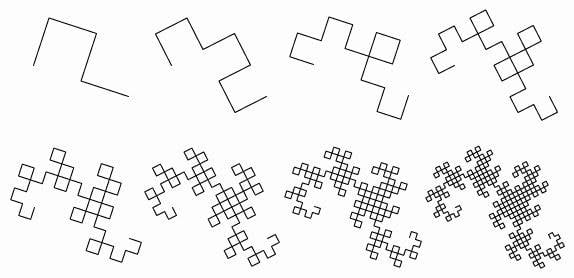
dragonfractal.jpg


I haven't had any issues here making it. I totally understand the algorithm for generating the left turn/right turn ordering. What I really want to know is how this version is generated:
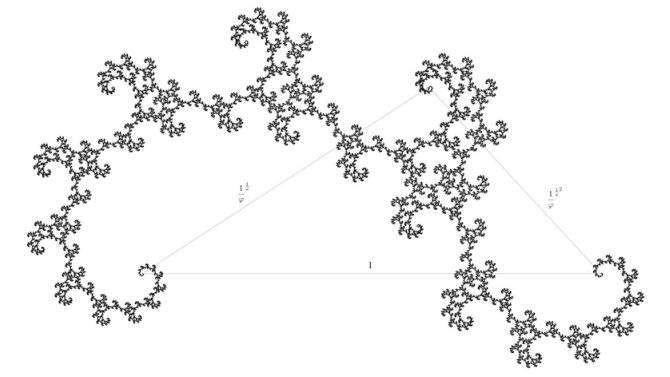
Phi_glito.jpe


Original image: http://en.wikipedia.org/wiki/File:Phi_glito.png
The sides of the base triangle are equal to:
1.000000000
0.742742945
0.551667082

Is this fractal generated using the same algorithm as the above one? I can't seem to find any explanations anywhere to confirm. I tried using the same algorithm and steps to recreate it in excel but all i get is a fractal that KINDA looks like it, but it's obviously not:
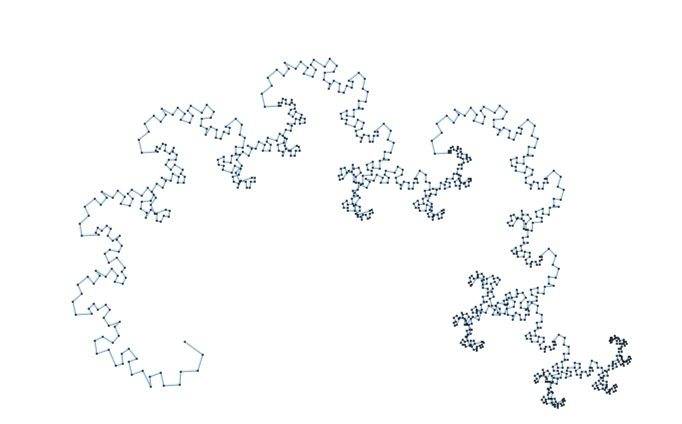
goldenatempt.jpg


I don't have any code to share because I'm not very good with code. I figured once i nail down how to actually construct the thing manually i'd try coding it.

Please someone tell me what I'm doing wrong. Thanks.
 
Mathematics news on Phys.org
When I discovered the Dragon curve back in about 1970 (ok, I can't prove it, but I did), I generated it as shown in your first picture: Draw some figure (short line segment to start with) from point A to point B, take a copy of the figure and rotate it 90 degrees about B, and make the copy of the point A your new point B. So necessarily the points A, B, A' form a 45 degree right triangle. The second picture above appears to be the same but with a magnification of the copy. The question is, how was the magnification selected?
The original construction has this fascinating trick of meshing seamlessly with itself, never overwriting any lines. The magnifying variation doesn't mesh in the same way, but seems to be chosen just so that it touches itself at many points.
 
What I really want to know is how this version is generated:

The clue is in the triangle behind the picture. For every line (e.g. the horizontal line in the triangle), replace it with the other two lines in the triangle. The trick is to note that there are two orientations for each of these two new lines, each is a 180 degree rotation of the other. Hence, if you make both lines use the closest orientation to the horizontal line, you get variants of Levy C curve, if you make both lines 'upside down' then you get variants of the Von Koch curve, and if you make the two lines one of each then you get variants of dragon curve fractals.
 
EebamXela said:
Please someone tell me what I'm doing wrong. Thanks.

I think you're just too impatient. What you've produced looks execellent, not just "kinda" like the original from Wikipedia. All you need is more steps to get the straight lines "bumpier".

I'd love to see how you did this in Excel. All I've ever used that for is tables, and never graphs.
 
TGlad said:
The clue is in the triangle behind the picture. For every line (e.g. the horizontal line in the triangle), replace it with the other two lines in the triangle.

According to the caption for the image in Wikipedia, their fractal was not constructed in the way you describe (with a Lindenmeyer system) but rather with an IFS.
 
Can anyone help me figure out the algorithm that was used for this golden dragon fractal?
 

Similar threads

  • · Replies 1 ·
Replies
1
Views
2K
  • · Replies 4 ·
Replies
4
Views
3K
  • · Replies 9 ·
Replies
9
Views
8K
Replies
1
Views
8K
  • · Replies 12 ·
Replies
12
Views
10K
  • · Replies 4 ·
Replies
4
Views
1K
  • · Replies 3 ·
Replies
3
Views
3K
  • · Replies 1 ·
Replies
1
Views
3K
Replies
15
Views
10K
  • · Replies 8 ·
Replies
8
Views
3K